
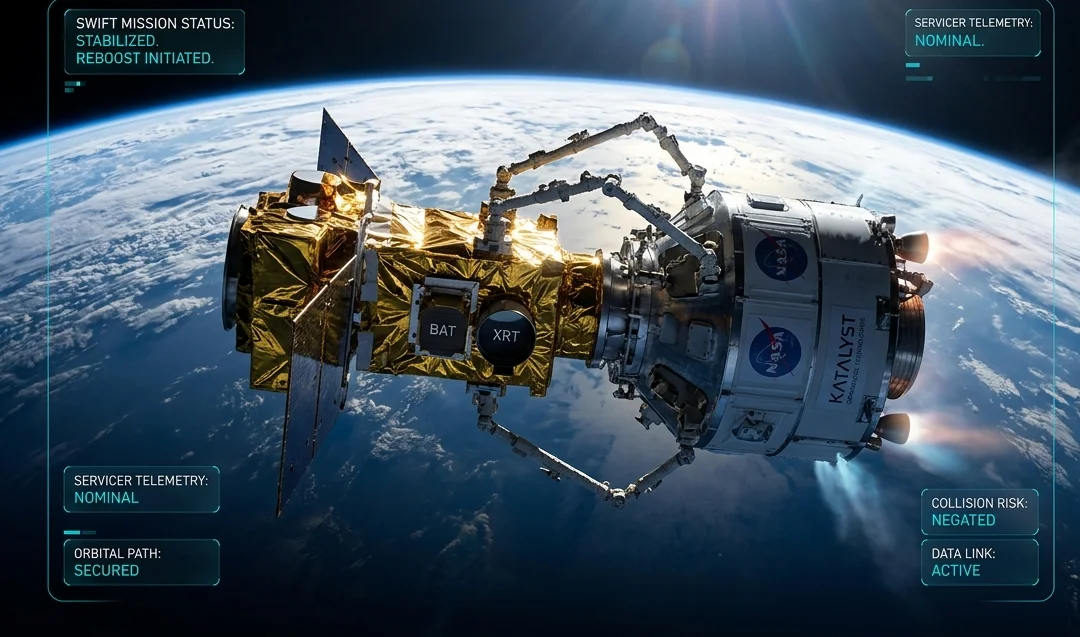
Critical Situation at 500 Kilometers Altitude
The US space agency NASA, in conjunction with private aerospace contractors, has initiated the technical phase of planning an emergency mission to prevent the premature orbital decay of the Swift Gamma-Ray Burst Explorer. This scientific instrument, which has provided crucial data for over two decades, is facing severe operational constraints due to the degradation of its attitude control systems. The primary failure involves the spacecraft’s inertial gyroscopes, which are responsible for precise stabilization. Without reliable attitude control, atmospheric drag in low Earth orbit is gradually reducing the satellite’s altitude, posing a long-term risk of uncontrolled re-entry.
The 1500-kilogram observatory was not engineered for on-orbit servicing or refueling. Unlike the Hubble Space Telescope, which featured specialized handrails and standardized fixtures for Space Shuttle servicing missions, Swift is a sealed, fully autonomous unit. However, advancements in commercial satellite servicing technologies now enable operations on legacy spacecraft previously deemed unserviceable. Engineers are currently designing an external propulsion and stabilization module that can dock with the telescope and assume attitude control functions.
Technical Challenges and the Selection of Katalyst Space Technologies
To address the architecture of this rescue attempt, NASA has turned to the specialized systems developed by Katalyst Space Technologies. The private firm focuses on on-orbit servicing, assembly, and manufacturing solutions. The proposed technical approach involves an autonomous servicing vehicle equipped with robotic manipulators. Because Swift lacks a standard docking mechanism, the servicer will need to secure itself to the satellite’s structural interface ring, which originally mated the spacecraft to its launch vehicle payload adapter.
Orbital synchronization between the two spacecraft requires extremely precise telemetry and computational execution. The robotic servicer must approach a target that may exhibit a slow, uncontrolled tumble. Any structural contact error could damage the observatory’s solar arrays, creating significant amounts of space debris. Upon successful capture, the servicing vehicle will utilize its onboard propulsion systems to execute a series of delta-v burns, raising the orbit’s perigee and mitigating atmospheric drag effects.
Scientific Value and Irreplaceability of the Gamma-Ray Explorer
The Swift observatory occupies a unique operational niche that cannot be replicated by other assets currently in orbit. Its hardware architecture is optimized to detect gamma-ray bursts, the most energetic electromagnetic explosions in the universe, typically associated with stellar core collapse or the merging of binary neutron stars. Swift’s primary capability is its rapid autonomously directed slewing mechanism. Within less than a minute of detecting a burst with its wide-field Burst Alert Telescope, the spacecraft automatically repositions its narrow-field X-ray and Ultraviolet/Optical instruments to observe the fading afterglow.
- Detection and cataloging of over one thousand confirmed short-duration gamma-ray bursts
- Arcsecond-level localization of transient phenomena for rapid distribution to ground-based observatories
- Continuous monitoring of active galactic nuclei and classical nova outbursts
Losing Swift would result in a substantial gap in transient astrophysics capabilities. Developing, certifying, and launching a replacement space telescope of equivalent capability would cost an estimated 350000000 USD and require at least 7 to 10 years of development. Consequently, allocating a comparatively modest budget for an emergency robotic servicing mission represents a highly rational application of scientific funding resources.
Broader Implications for Non-Cooperative Satellite Servicing
The technical framework established for the Swift rescue mission extends far beyond the preservation of an astrophysical asset. A successful execution will serve as an important precedent for the global space industry. To date, commercial satellite life extension operations have been confined largely to communication satellites in geostationary orbit, which feature standardized geometries and predictable stabilization states. Operating in low Earth orbit against a complex scientific satellite requires advanced machine vision and highly reliable robotic control algorithms to govern the manipulator systems.
The progression of technologies pioneered by Katalyst Space Technologies and similar aerospace startups will eventually facilitate active debris removal operations. Rather than allowing deprecated upper stages and obsolete satellites to undergo chaotic orbital decay, dedicated robotic tugs can intercept these objects and steer them toward safe, controlled atmospheric disposal over unpopulated regions of the Pacific Ocean.


0 Comments