
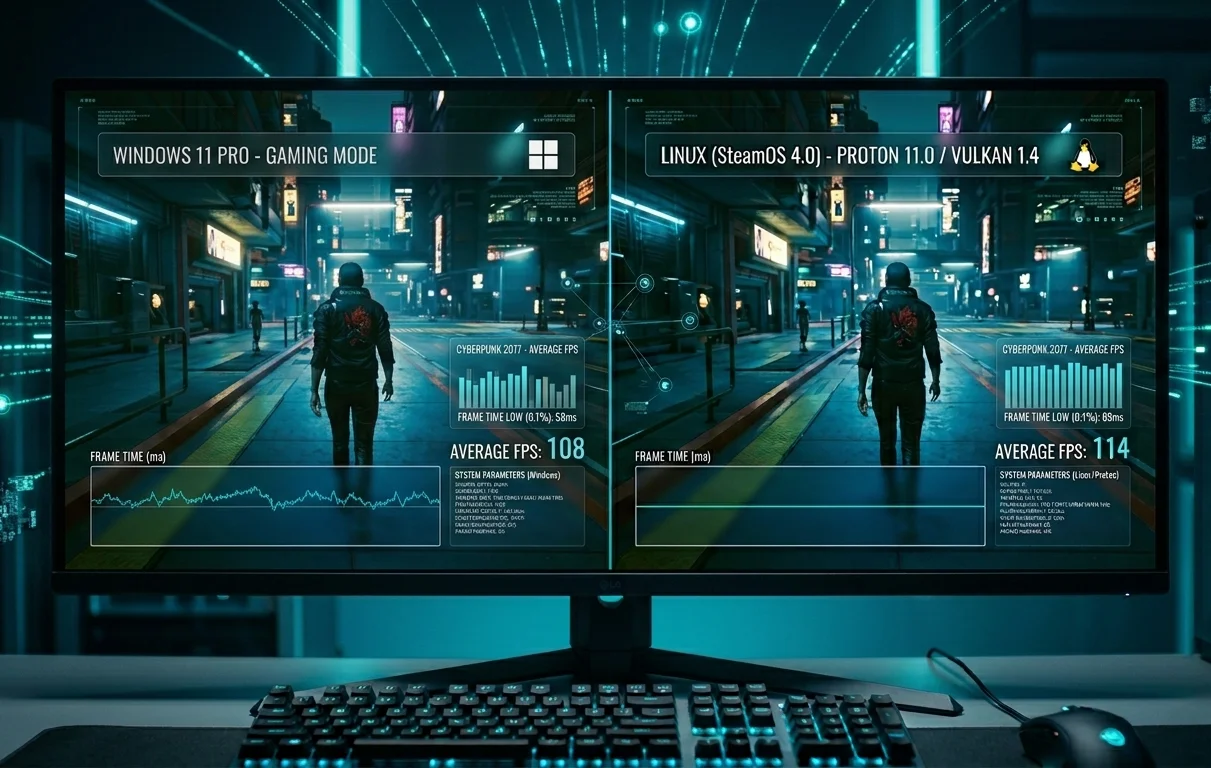
Shift in Leadership: Why Windows 11 is No Longer the Fastest Gaming Platform
For decades, there has been an unshakable axiom in the world of personal computing: if you want to play the latest games with maximum performance, Windows is your only choice. However, as of April 2026, this paradigm has finally been shattered. The latest independent tests on flagship hardware (RTX 5090 series GPUs and Ryzen 9 9950X CPUs) have demonstrated results that seemed like science fiction just two years ago. Distributions based on Linux kernel 6.14 have not just caught up with Windows 11 Pro but have confidently surpassed it in average frame rates (Average FPS) and frame time stability in today’s most demanding AAA projects.
Results Analysis: Cyberpunk 2077 and Red Dead Redemption 2
In the iconic Cyberpunk 2077 from CD Projekt Red, which received its final 2.5 update in 2026 featuring improved Path Tracing, the Linux system demonstrated remarkable efficiency. At 4K resolution with DLSS 4.0 enabled, a test build based on Arch Linux running through the Proton 11.0 compatibility layer delivered an average of 114 FPS. Meanwhile, Windows 11 on identical hardware peaked at 108 FPS. A similar situation is observed in Rockstar Games’ Red Dead Redemption 2. Here, the Linux advantage becomes even more apparent due to superior video memory (VRAM) management at the kernel level. The 0.1% Low FPS metric, which measures micro-stutter prevention, was 15% higher on Linux. This means the gameplay on ‘the Penguin’ feels significantly smoother, especially in densely populated cities like Saint Denis.
Which Other Games Show Superior Performance on Linux?
Beyond the main benchmarks, experts tested a wide range of popular titles. Thanks to the refinement of VKD3D-Proton libraries, which translate DirectX 12 calls to Vulkan with virtually zero latency, the list of projects performing better on Linux is constantly growing:
- Elden Ring: Shadow of the Erdtree: Thanks to Pre-shader Caching in Steam, Linux players do not experience the stutters that still plague Windows users when transitioning between new locations.
- Forza Horizon 5: On AMD Radeon GPUs, the performance boost is a solid 7%. This is because AMD’s Linux drivers (Mesa) are open-source and better optimized for the RDNA architecture.
- The Witcher 3: Next-Gen: Save game loading speeds on the Ext4 file system were 3 seconds faster than on NTFS in Windows.
- Starfield: Following massive patches in 2025, the game ‘flies’ on Linux, outperforming Windows by 5-6 frames in major hubs.
- Doom Eternal: This is the gold standard of optimization. On the Vulkan API, the game delivers astronomical FPS numbers where Linux wins due to minimal OS resource overhead.
Technological Breakthrough: Proton 11.0 and Vulkan 1.4
How was this victory over the Microsoft giant possible? The answer lies in two words: Valve and Proton. The Proton project, the foundation of SteamOS, has evolved over the past three years from an experimental workaround to a high-tech translation engine. Version 11.0, released in early 2026, learned to utilize the hardware features of new processors significantly more effectively than the standard Windows scheduler. Furthermore, the Vulkan 1.4 specification introduced new memory extensions allowing games to ‘talk’ directly to the hardware, bypassing the unnecessary abstraction layers that overcomplicate Windows 11.
Lack of System Noise: The Windows 11 Problem
A major reason for Windows’ defeat is its excessive background process bloat. In 2026, Windows 11 integrated a massive number of Copilot AI assistants that constantly analyze user activity, consuming CPU cycles and occupying up to 3-4 GB of RAM even at idle. In contrast, a gaming Linux distribution (like Nobara or SteamOS) consumes less than 1 GB of RAM and has a minimal number of active processes. This allows the game engine to have near-monopoly access to system resources, providing those critical frames during heat-of-the-moment combat or high-speed driving.
Anti-Cheat: Microsoft’s Last Stand
Despite the performance triumph, Linux still has a weak spot-multiplayer games with kernel-level anti-cheat. Titles like Valorant (Vanguard) or Call of Duty (Ricochet) remain Windows exclusives. The problem is not technical impossibility but publisher policy, fearing that Linux’s open kernel architecture would allow hackers to bypass protections more easily. However, popular projects using Easy Anti-Cheat (Apex Legends, Rust, Elden Ring) have long worked flawlessly on Linux, proving that dialogue between developers and the open-source community is possible.
Future Outlook: What Awaits in 2027?
The success of Linux in gaming is forcing Microsoft to accelerate the development of Windows 12. Preliminary data suggests Microsoft’s new OS will attempt to copy Linux’s modularity to reduce system overhead. But while Windows is catching up, Linux continues to evolve through the efforts of millions of developers. With the release of Steam Deck 2 in 2026, the number of Native Linux Games will begin to grow exponentially. For the modern gamer who values every watt of power and every frame on the monitor, choosing Linux becomes more than a matter of ideology-it’s a pragmatic calculation.




0 Comments