
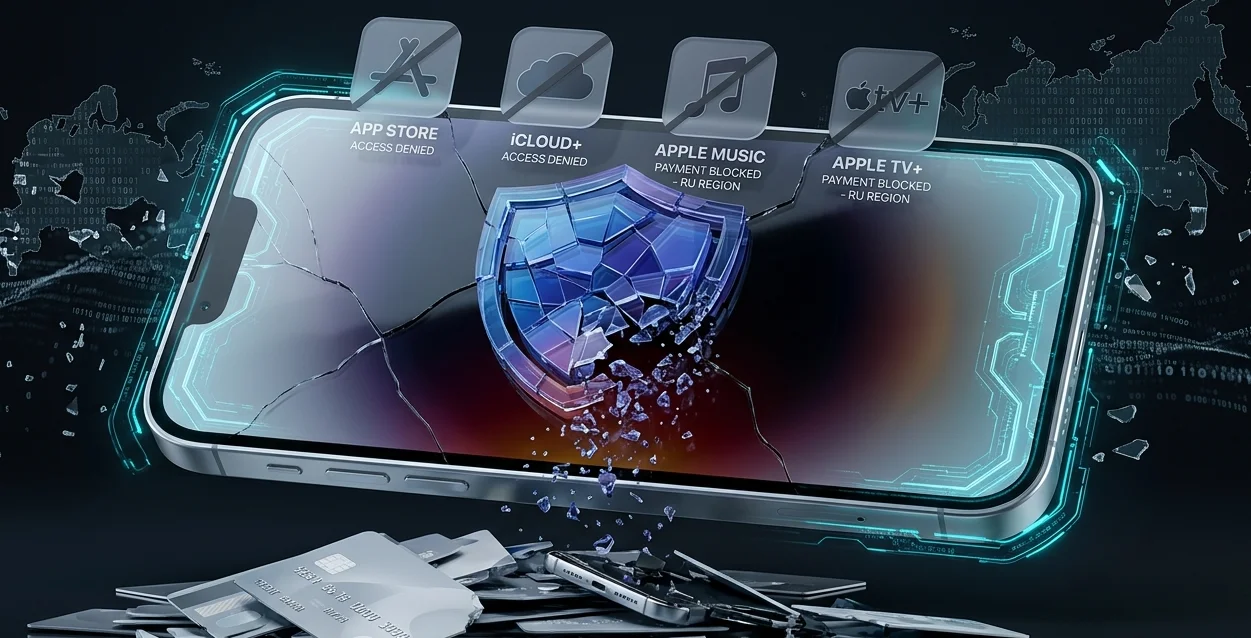
Total Isolation: Why 2026 Marks the Point of No Return for Apple Users in Russia
In April 2026, Apple Corporation took a step that the professional community had been anticipating since the beginning of the full-scale invasion. The company officially and irrevocably ceased support for all payment gateways in the Russian Federation. While users previously managed to navigate restrictions using mobile carrier accounts or third-party gift cards, Apple has now implemented a rigorous geo-blocking system based on device regional identifiers and the origin of payment methods.
Chronology of Digital Withdrawal: From Restrictions to Total Lockdown
Apple’s market exit from the aggressor state occurred in several distinct phases. Each was a clear signal that the Apple ecosystem is no longer a safe or stable place for the Russian consumer. It is vital to understand that Apple is not just a hardware manufacturer; it is a services company whose revenue directly depends on subscriptions. Forgoing this income in an entire region is a powerful political and ethical statement.
- Phase 1 (March 2022): Cessation of official hardware sales via Apple Store Online and suspension of Apple Pay for Visa and Mastercard.
- Phase 2 (2023-2024): Gradual removal of sanctioned Russian banking apps (Sberbank, VTB, Alfa-Bank) and restrictions on the ‘Find My’ service.
- Phase 3 (2025): Final warning regarding the shutdown of cloud services for enterprise clients.
- Phase 4 (April 2026): Complete closure of the payment gateway for App Store, iCloud, Apple Music, and other services for all private individuals.
Technical Aspects of the Block: How the ‘Digital Cage’ Works
Apple has applied a comprehensive approach to blocking. It is not merely a card rejection. The system analyzes several factors: Apple ID identifier, IP address, device activation region, and even the billing address tied to the profile. Any attempts to change the region to Turkey or Kazakhstan without a real bank card from those countries are now instantly tracked by Apple’s fraud monitoring algorithms.
Consequences for Users: From iPhone to ‘Brick’
For the average user in the RF, the iPhone has turned into an expensive device with limited capabilities. Without an iCloud subscription, users lose the ability to back up photos and contacts. Many professional applications for video editing (Final Cut Pro for iPad) and graphic design have simply stopped launching due to the inability to verify licenses. This creates a massive gap in the workflows of many specialists who are forced to switch to pirated software or seek Android alternatives, which is also problematic due to Google’s sanctions.
Apple’s Stance on Ukraine and Humanitarian Support
In contrast to the total isolation of the RF, Apple continues to actively support Ukrainian users. In addition to direct humanitarian aid through major organizations (UNICEF, World Central Kitchen), the company provides a platform for fundraising directly within the App Store interface. It’s important to note that while Apple does not officially purchase weapons, its economic pressure on the aggressor is a form of strategic support for Ukraine. The company also actively implements improved Ukrainian language support across all services, highlighting the priority of our market.
Economic Impact and Market Loss
Analysts estimate that Apple is losing between 3 to 5 billion dollars in annual revenue due to its exit from the RF. However, reputational risks and the threat of secondary sanctions from the US Treasury outweighed financial gains. For Apple, it is essential to maintain its status as a leader of the free world, which is impossible while cooperating with a dictatorship. The Russian market currently accounts for less than 1% of the company’s global revenue, making its loss painful but not critical to Apple’s capitalization.
What’s Next? Development Scenarios
There is a high probability that the next step will be the total disabling of Push notifications for Russian banking apps that still somehow remain on devices. There is also discussion regarding the possibility of remote deactivation of devices under sanctions, though Apple has avoided such radical measures so far. In any case, the era of legal Apple hardware use in the RF is over. Users are left only with the role of observers of progress they no longer have official access to.




0 Comments