
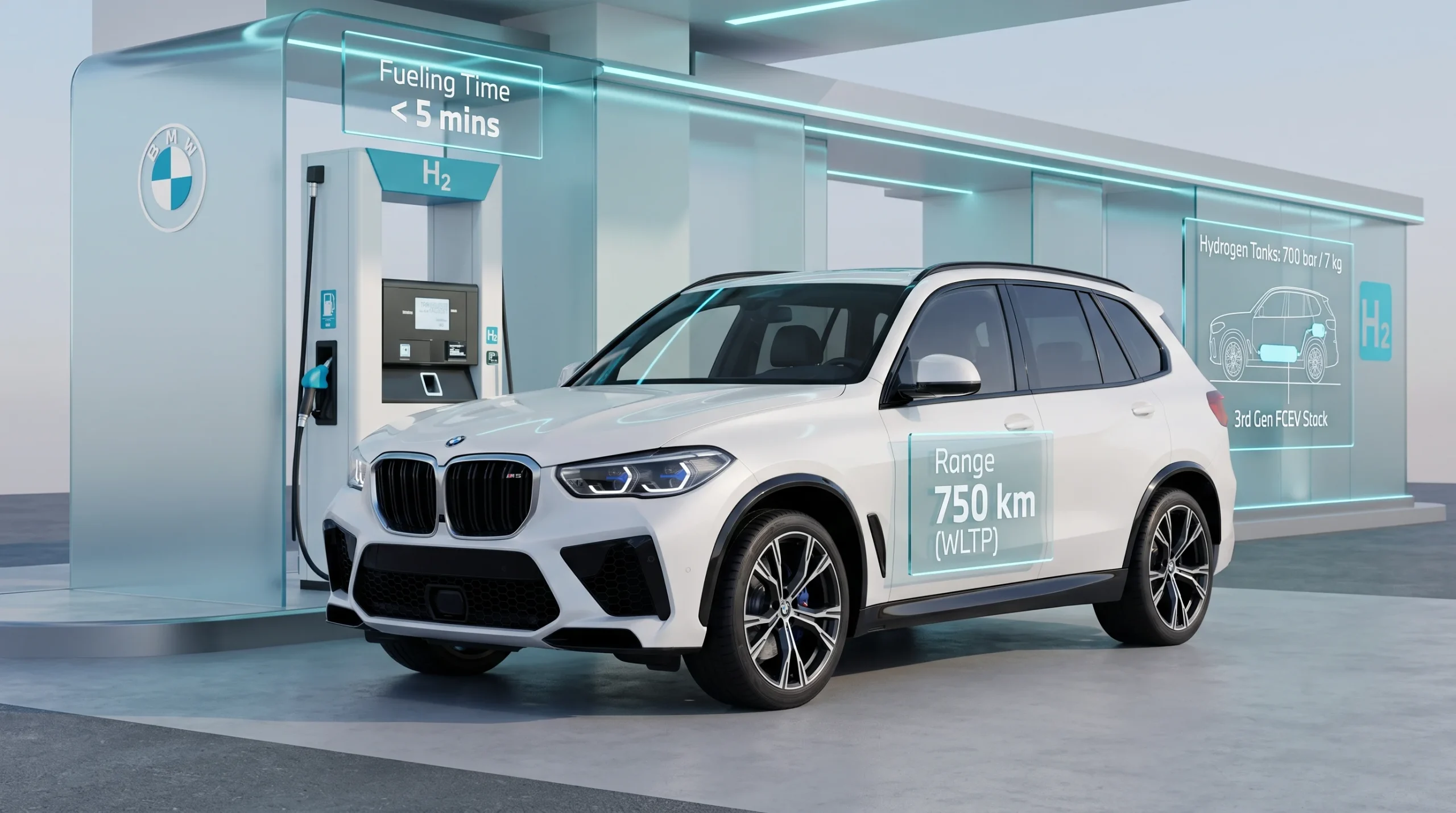
Next-Generation Hydrogen Mobility by BMW
BMW has officially advanced the development of its next-generation iX5 hydrogen fuel cell vehicle into the production preparation phase. Engineered upon the upcoming G65 chassis, the SUV is being co-developed in close engineering collaboration with Toyota Motor Corporation. Slated for commercial assembly in 2028, the model positions itself as an alternative to traditional battery electric vehicles (BEVs), specifically targeting drivers needing continuous long-distance range without extended recharge interruptions.
The engineering core centers around third-generation hydrogen fuel cell modules. By optimizing drivetrain packaging and shrinking hardware dimensions, mechanical engineers integrated the entire powertrain beneath the floor, maintaining passenger and luggage cabin space identical to standard combustion and battery configurations. This eliminates the severe interior packaging compromises found in earlier experimental FCEV prototypes.
Tank Architecture and Technical Specifications of iX5 FCEV
The defining technical milestone is a flat underfloor tank layout. The onboard reservoir architecture holds 7 kg of compressed gaseous hydrogen at an operational pressure of 700 bar. This configuration delivers an estimated driving range of up to 750 km under the WLTP testing cycle.
Fuel cell stacks generate high-voltage electricity on demand through an electrochemical reaction combining compressed hydrogen with ambient atmospheric oxygen. Pure water vapor remains the sole tailpipe byproduct, released cleanly during travel without emitting carbon compounds or nitrogen oxides.
Collaborative Stack Engineering with Toyota
Toyota manufactures the foundational individual fuel cell plates, while BMW designs bespoke system peripherals including high-voltage inverters, proprietary high-discharge buffer batteries, dedicated cooling loops, and integrated eDrive transaxles. By re-engineering the membrane electrode assembly for generation three, raw platinum group metal content has dropped by 40%, directly moderating industrial manufacturing costs.
The fuel cell stack produces steady baseline current during cruising, while a dedicated dynamic buffer battery provides torque boost during wide-open throttle acceleration. When braking, the integrated drive units harvest kinetic friction, cycling reserve power back into the buffer battery to maximize system efficiency.
Infrastructure Boundaries and Energy Economics
While the mechanical refueling speed matches liquid fuels, distribution accessibility remains the critical growth hurdle. Commercial 700-bar hydrogen refueling stations (HRS) across Europe remain limited to roughly three hundred active locations, concentrated primarily throughout Germany, France, Switzerland, and the Benelux union.
- Dispenser Pressure Regulation. Passenger vehicles strictly mandate 700-bar supply, whereas legacy commercial transit stations frequently operate at lower 350-bar limits.
- Thermal Compression Demands. Dispensing hydrogen safely requires precooling gas streams down to -40°C directly before tank entry to control internal compression heat.
- Market Fuel Pricing. Retail green hydrogen currently retails between $12 and $15 per kg at European pumps, resulting in operational costs higher than residential home grid charging but close to diesel parity.
Market Placement and Strategic Outlook
BMW management does not position hydrogen power to displace battery vehicles entirely, but rather as an essential dual-track pillar of carbon-neutral mobility. Fleet applications, VIP transport shuttles, and long-range highway travelers represent the core target demographic seeking fast turnarounds without waiting at grid charging queues.
The scheduled 2028 production run coincides with broader regulatory rollouts across the European Union. Under the Alternative Fuels Infrastructure Regulation (AFIR), member states face binding mandates to erect 700-bar hydrogen filling hubs along designated TEN-T transport corridors every 200 km, laying essential operational groundwork for commercial adoption.


0 Comments