
A New Step in Video Interface Evolution
The HDMI Forum has officially approved the technical specifications for the HDMI 2.2 standard, which is set to replace the current HDMI 2.1. The main change is a massive increase in bandwidth, allowing display manufacturers to bypass image compression when connecting top-tier graphics adapters to high-resolution panels with extreme refresh rates.
This speed boost paves the way for the mass adoption of next-generation monitors and TVs tailored for professional content creation and competitive gaming. The first commercial devices equipped with the new controllers are expected to hit the market around 2027.
Technical Parameters and Bandwidth Comparison
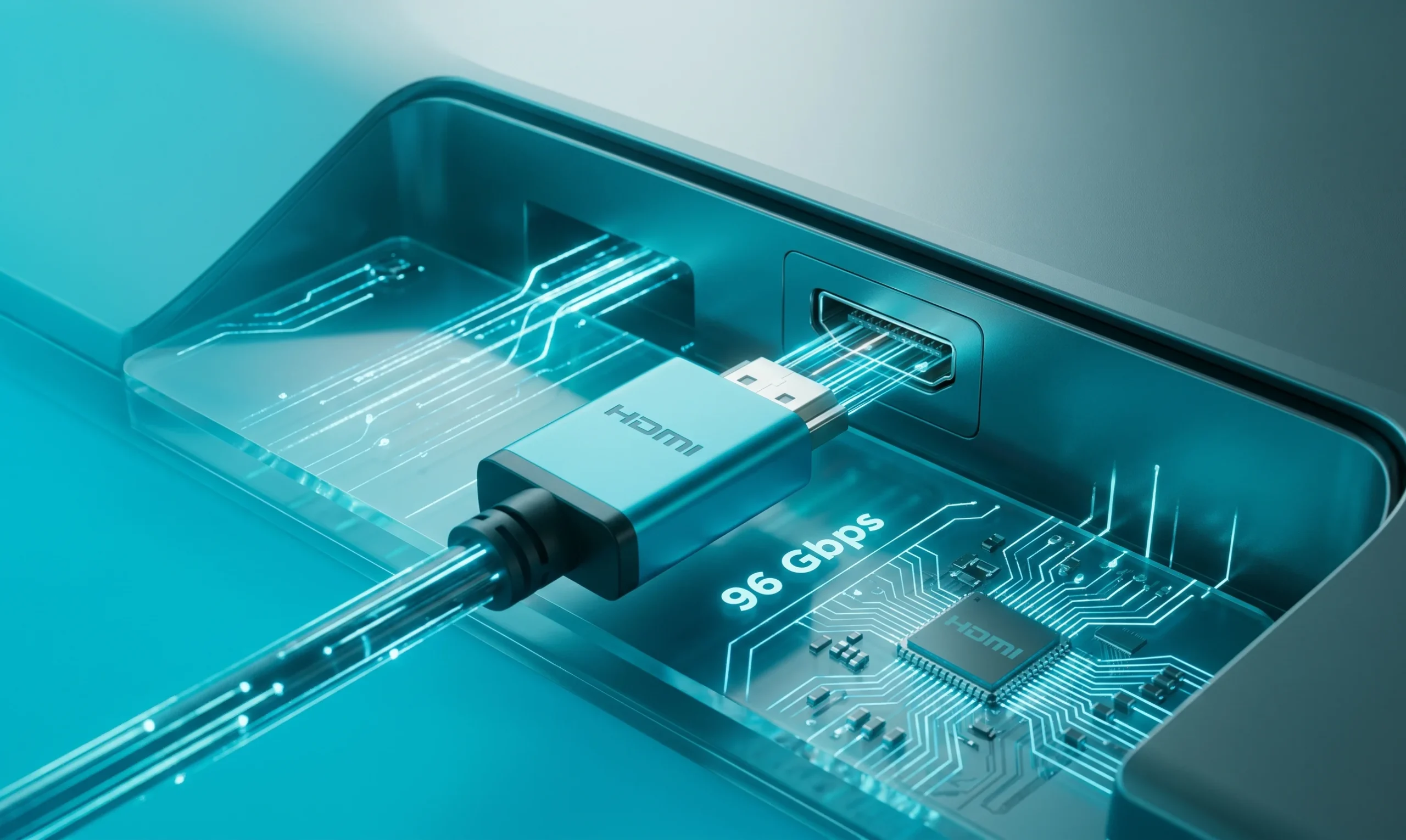
The core technical advantage of HDMI 2.2 lies in doubling the net interface bandwidth. While the current HDMI 2.1 version delivers data transfer speeds up to 48 Gbps, the new standard raises this ceiling to 96 Gbps. This is achieved by upgrading signaling protocols and switching to a new link encoding scheme.
To maintain a stable 96 Gbps speed, users will need new cables labeled Ultra96. These cables feature enhanced shielding to prevent crosstalk at high frequencies, while maintaining full backward compatibility with previous generation ports.
Impact on Gaming Monitors and Televisions
The extra speed overhead is targeted at the evolution of the gaming and entertainment industries. Thanks to the 96 Gbps bus, video stream transmission at 4K resolution with a 480 Hz refresh rate becomes possible when using Display Stream Compression (DSC). For esports monitors, this means minimal response time without losing text clarity or fine details, which often happens due to compression artifacts.
In the premium TV segment, HDMI 2.2 will enable signal transmission at 8K resolution at 240 Hz with a 120-bit color depth per channel without chroma subsampling. This is crucial for displaying HDR content with high accuracy in brightness gradations and complex color transitions.
The New Latency Indication Protocol
Beyond the raw speed increase, the HDMI 2.2 architecture introduces a hardware-level Latency Indication Protocol (LIP). This technology allows the signal source (such as a gaming console or PC) to receive precise real-time data regarding the internal frame processing delay of the monitor or TV itself. The gathered data helps to dynamically adjust audio-video synchronization and optimize Variable Refresh Rate (VRR) systems to eliminate display micro-stuttering.
Market Rollout Timeline
Despite the technical specifications being finalized, a rapid rollout of hardware should not be expected. The development and certification of compatible chipsets for transmitters and receivers require a lengthy period. Manufacturers plan to integrate HDMI 2.2 ports into flagship graphics cards, media players, and premium OLED TVs closer to 2027. Current HDMI 2.1 devices will remain highly relevant for most users, as 4K at 120 Hz completely covers the capabilities of modern consoles and mid-tier hardware.


0 Comments