
A New Approach to User Verification
Google has begun testing an alternative method to protect websites from automated spam and bots. Traditional text and image-based tests are gradually losing their effectiveness due to the rapid advancement of generative artificial intelligence. Modern neural networks have learned to recognize distorted characters and identify traffic signs in images much faster than humans. To address this issue, developers have decided to leverage biometric parameters and local computer vision algorithms.
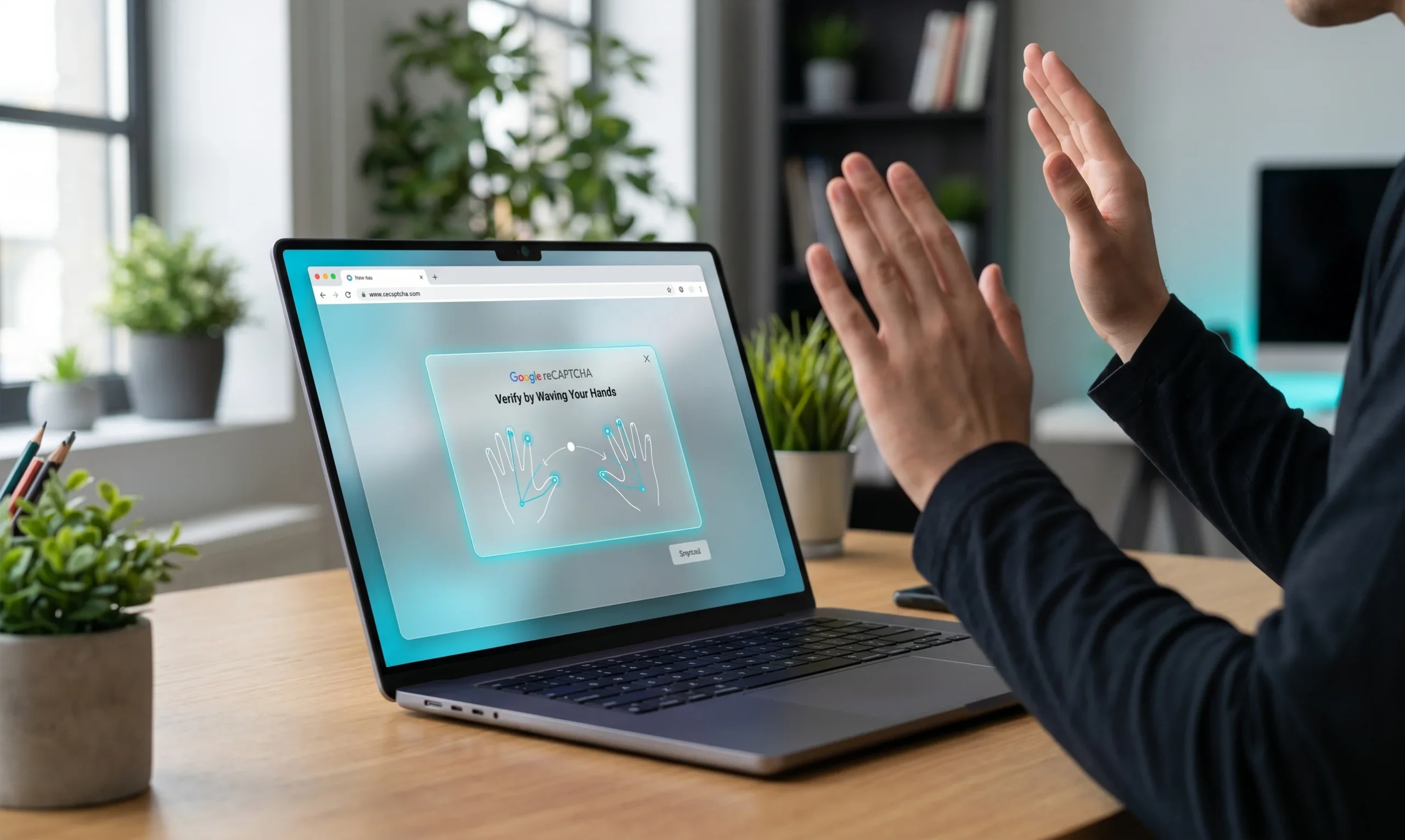
The new verification system will require users to have a webcam and perform simple hand movements in front of their computer or smartphone screen. Instead of clicking on images, a person must perform a gesture prompted by the system at random. This confirms that the action is performed by a real user in real time, rather than a static algorithm or a pre-recorded video stream.
How Gesture Recognition Technology Works
The new CAPTCHA is based on integration with local artificial intelligence libraries capable of tracking key points on a human palm. The verification process consists of several sequential steps that minimize the risk of false positives. The user is asked to raise their hand and perform a specific action, such as waving at the screen, bending several fingers, or rotating their palm at a certain angle.
The webcam captures the movement at a frame rate sufficient to analyze the dynamics. The local algorithm analyzes the changing positions of limbs in three-dimensional space. Thanks to modern web standards, processing of the video stream occurs directly on the user’s device, avoiding the transmission of sensitive biometric data to the company’s servers. Only the successful verification result, in the form of an encrypted token, is sent to the server to grant access to the web resource.
Privacy Concerns and Technical Limitations
The implementation of biometric verification methods always sparks debates among security experts. The main question concerns the protection of user privacy. Google notes that gesture recognition is implemented via a computer vision API operating within an isolated browser environment. The video stream is not saved to the hard drive or sent to cloud storage, eliminating the possibility of leaking private images of the user’s workspace.
However, there are obvious hardware limitations. Not all desktop computers are equipped with high-quality cameras, and indoor lighting conditions can significantly affect the accuracy of movement recognition. For users with physical disabilities or those lacking the necessary peripherals, Google promises to maintain alternative text or audio verification methods. Developers plan to use flexible test difficulty scaling based on the security threat level detected by the website’s defense system.
The Future of Web Resource Protection Systems
Shifting toward behavioral factor analysis and dynamic movements is a logical step in the evolution of cybersecurity systems. Fully automated pattern recognition systems have become too accessible to malicious actors. Using hand gestures creates a dynamic barrier that is difficult to bypass using standard device emulation techniques. In the coming months, developers plan to expand the closed testing program to gather statistical data on system performance across various browsers and operating systems.


0 Comments