
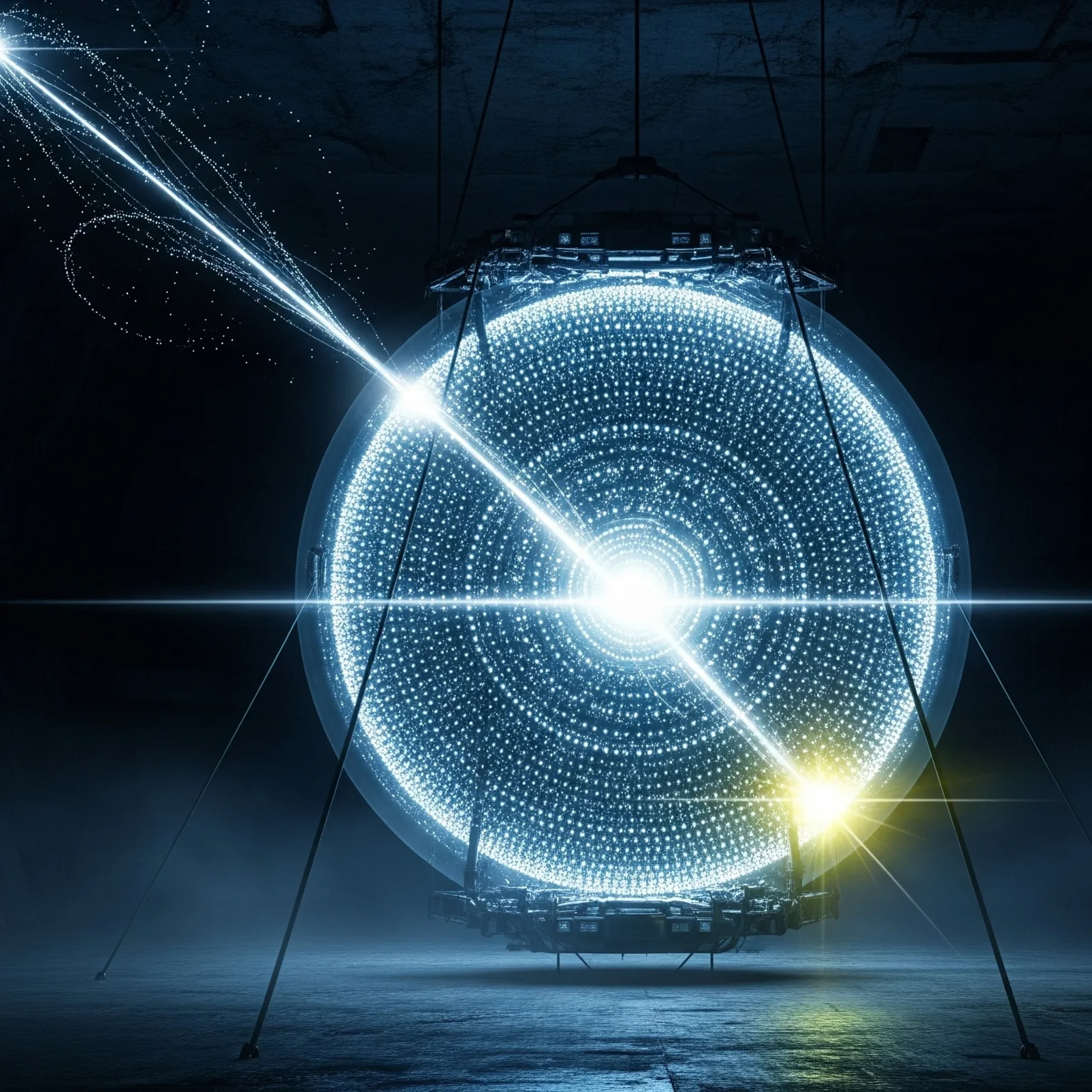
The scientific world is on the brink of a new discovery. The world’s most advanced underground laboratory, the Jiangmen Underground Neutrino Observatory (JUNO), has officially opened in China. Its primary purpose is to study the most mysterious elementary particles-neutrinos. A key feature of this project is its unique liquid detector, recognized as the largest and most precise in the world. This achievement underscores China’s growing role in fundamental scientific research and opens new perspectives for neutrino physics, a key field in modern science.
Why neutrinos?
Neutrinos are remarkable particles. They lack an electric charge, have very little mass, and rarely interact with matter. They constantly permeate us: billions of neutrinos from the Sun pass through our bodies every second, leaving no trace. It is this elusiveness that makes them so difficult to study, yet so crucial for understanding the structure of the universe. Scientists believe neutrinos can unlock the mysteries of the origin of matter, hidden mass (so-called dark matter), and the inner workings of stars. Therefore, searching for neutrinos is a key task in modern physics.
The technological heart of the laboratory: a unique detector
The JUNO lab’s crown jewel is its rare detector. It consists of a massive sphere over 35 meters in diameter, filled with 20,000 tons of liquid scintillator. This liquid emits light when neutrinos interact with it. To detect this subtle glow, more than 18,000 photomultiplier tubes-highly sensitive sensors capable of detecting even a single photon-are positioned along the sphere’s interior. This colossal engineering feat was built approximately 700 meters underground. Its underground location is critical, as it protects the detector from “noise”-cosmic rays and other particles that can mimic neutrino signals.
Scientific objectives and global significance
The main task the JUNO experiment aims to address is the so-called “neutrino mass hierarchy.” Although we know that neutrinos have mass, the exact order of masses (which of the three types is lighter, which is heavier) remains unknown. Answering this question is one of the most important in particle physics. Furthermore, JUNO will help measure the parameters of neutrino oscillations with high precision, which will allow us to better understand how these particles change their “flavor” (type) as they travel through space.
This is not just a regional but a global scientific project, involving scientists from around the world. JUNO is designed to complement existing research conducted at other neutrino laboratories around the world. Data from JUNO can aid in the study of the universe, opening new horizons in our understanding of the fundamental laws of nature.
The launch of the JUNO underground laboratory in China, with its rarest detector in the world, is a true scientific breakthrough. This experiment demonstrates China’s investment in fundamental research that doesn’t yield immediate commercial profits but is crucial to the advancement of human knowledge. The results obtained could not only unlock the mysteries of neutrinos but also significantly expand our understanding of the cosmos, making the world a little less mysterious.



0 Comments