
A New Era in Peripheral Nerve Surgery
French medical technology company Tissium has officially announced the securing of 60 million euros (equivalent to approximately 64.3 million USD) in additional funding to accelerate its expansion into the US market and scale its ongoing clinical activities. This financing round comprises a Series D2 equity raise and a debt facility provided by the European Investment Bank. The primary objective of this capital injection is the commercial launch and scaling of its proprietary biomorphic programmable polymer platform, designed to reconstruct damaged tissues without traditional suture needles.
The reconstruction of damaged peripheral nerves remains one of the most complex challenges in modern reconstructive surgery. Traditional methods rely heavily on microsurgical suturing, which frequently induces additional trauma to delicate nerve fascicles, promotes scar tissue formation, and often results in incomplete functional recovery. The innovative approach developed by European bioengineers offers a sophisticated alternative using a liquid photopolymer that cures under light activation to create a fluid-tight, flexible, and biocompatible barrier.
Mechanics of the Sutureless Polymer Platform
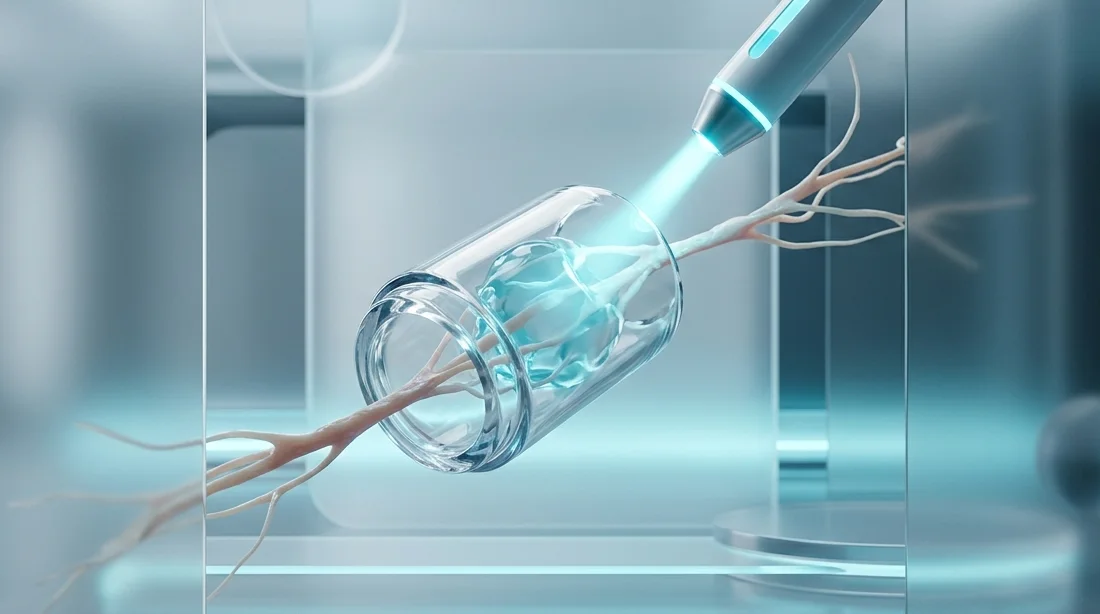
At the core of Tissium’s technological ecosystem is a patented biomorphic polymer featuring highly customizable physical and chemical properties. A surgeon applies the liquid material directly to the severed nerve stumps using a dedicated delivery micro-applicator. Subsequently, a specific light wavelength is directed at the reconstruction site, triggering rapid polymerization. The gel transitions into an elastic, protective cuff that maintains structural alignment without disrupting natural nerve signaling or internal axonal regeneration.
A critical advantage of this specialized material is its programmable bioresorbable nature. The polymer remains structurally stable for the precise duration required for initial tissue approximation and natural cellular healing. Once the critical healing phase concludes, the material safely degrades and is absorbed by the human body without producing toxic degradation byproducts or leaving foreign particulate matter inside the tissue structure.
US Market Strategy and FDA Pathway
The majority of the newly acquired capital will be deployed to fund active clinical trials and compile regulatory submissions for the US Food and Drug Administration (FDA). The company is actively developing its lead commercial application, branded as COAPTIUM CONNECT, which is engineered specifically for peripheral nerve repair. Achieving regulatory clearance in the United States will unlock access to thousands of specialized surgical centers and medical institutions managing extremity trauma and reconstructive procedures daily.
Beyond nerve reconstruction, Tissium plans to adapt its flexible polymer platform to address clinical needs across multiple medical disciplines. Research programs are currently underway targeting cardiovascular anastomosis sealing, gastrointestinal tissue repair, and the sutureless fixation of abdominal hernia meshes. The inherent modularity of the polymer’s chemical architecture allows engineers to program elasticity, degradation rates, and tissue adhesion mechanics based on the targeted human tissue profile.
Economic Implications and Investment Partners
The successful closing of the 60 million euros Series D2 round highlights strong international investor confidence in the European MedTech landscape. Partnering with the European Investment Bank provides the organization with extended financial runway to complete capital-intensive research and clinical programs. Introducing sutureless closure systems into the United States healthcare matrix could lower total operational costs by decreasing overall operating room duration and minimizing secondary corrective surgeries caused by poor initial nerve alignment.
Clinical experts note that successful FDA clearance of COAPTIUM CONNECT will establish a new clinical benchmark for nerve trauma management, where minimizing recovery latency is crucial for patient outcomes. Initial large-scale data regarding the utilization of this photopolymer platform within US clinical institutions is anticipated following the conclusion of current investigational phases and the subsequent commercial rollout.


0 Comments