
Modern AI image generators like Midjourney, DALLE-2, and Stable Diffusion are amazing creative tools, but they have one significant drawback: they consume enormous amounts of energy. This places a significant burden on data centers and limits their use on low-power devices. However, a recent scientific breakthrough, described in the journal Nature, could change this situation dramatically. Researchers from the University of California, Los Angeles (UCLA) have invented an AI image generator that operates solely on light and consumes virtually no energy. This technology opens the door to creating cleaner and more affordable artificial intelligence.
How does the optical model work?
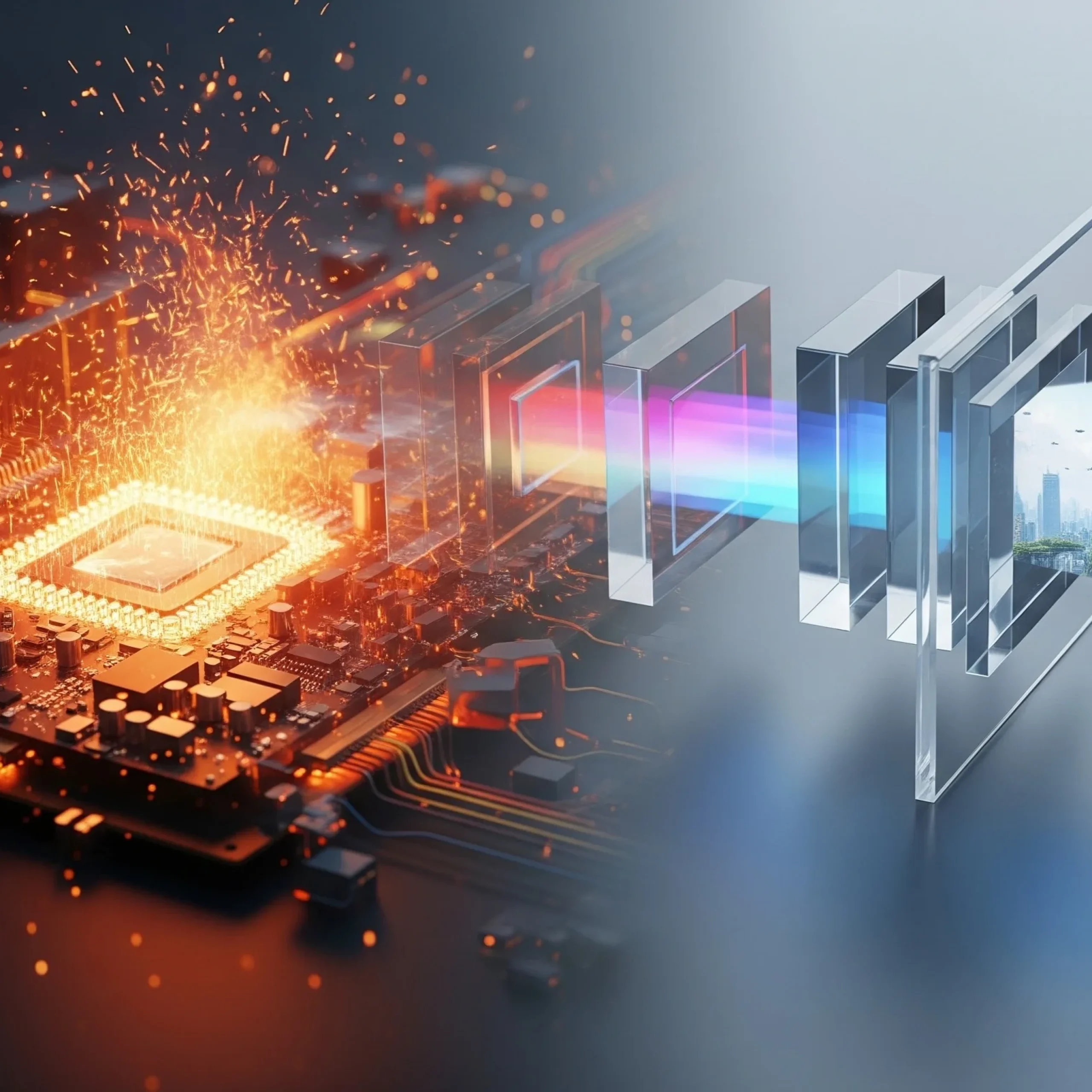
Instead of traditional computing processes occurring on silicon chips, this iterative generative optical model uses light for computation. Imagine data (for example, a text query) is encoded into light waves. These light waves pass through a series of specially designed “optical layers”-essentially a set of masks or lenses that alter the light flow. The output of this process, occurring at the speed of light, is a finished image. This is why this AI generator doesn’t require constant power to perform complex calculations. Instead of the gigawatts of power required by traditional GPUs, it requires the power of a single LED.
Advantages of an optical image generator
Using light to generate images has several important advantages that make this technology stand out from others.
- Minimal energy consumption: This is the most obvious advantage. A zero-energy AI generator solves one of the biggest problems with modern AI – its impact on the environment.
- Incredible speed: Because calculations occur at the speed of light, the image generation process is almost instantaneous, significantly faster than traditional models.
- Scalability The theory allows this approach to be scaled to gigantic sizes while maintaining high efficiency, making it attractive for future research and commercial use.
Implications for the future of SI technologies
The discovery of the optical generator opens a new era of AI innovation. This technology enables complex models to be integrated into mobile devices, sensors, workstations, and other equipment where energy consumption is critical. This will make AI image generators ubiquitous and accessible even in regions with limited energy resources. This iterative optical model could form the basis of a new generation of computers powered by light rather than electrons, leading to new capabilities and solutions in computing.
This scientific breakthrough proves that the future of artificial intelligence depends not only on increasing computing power but also on finding fundamentally new approaches to computation. UCLA scientists have demonstrated that amazing results can be achieved by using principles of physics and optics, rather than relying solely on traditional electronics. This also highlights the importance of interdisciplinary research integrating physics, computer science, and engineering.
In summary, the invention of the iterative generative optical model is more than just another step in AI development. It’s a fundamental paradigm shift that could make AI technologies truly sustainable, effective, and accessible to everyone. This solution demonstrates how scientific thinking can overcome seemingly insurmountable limitations and offers a new, green path for the future of artificial intelligence.




0 Comments