
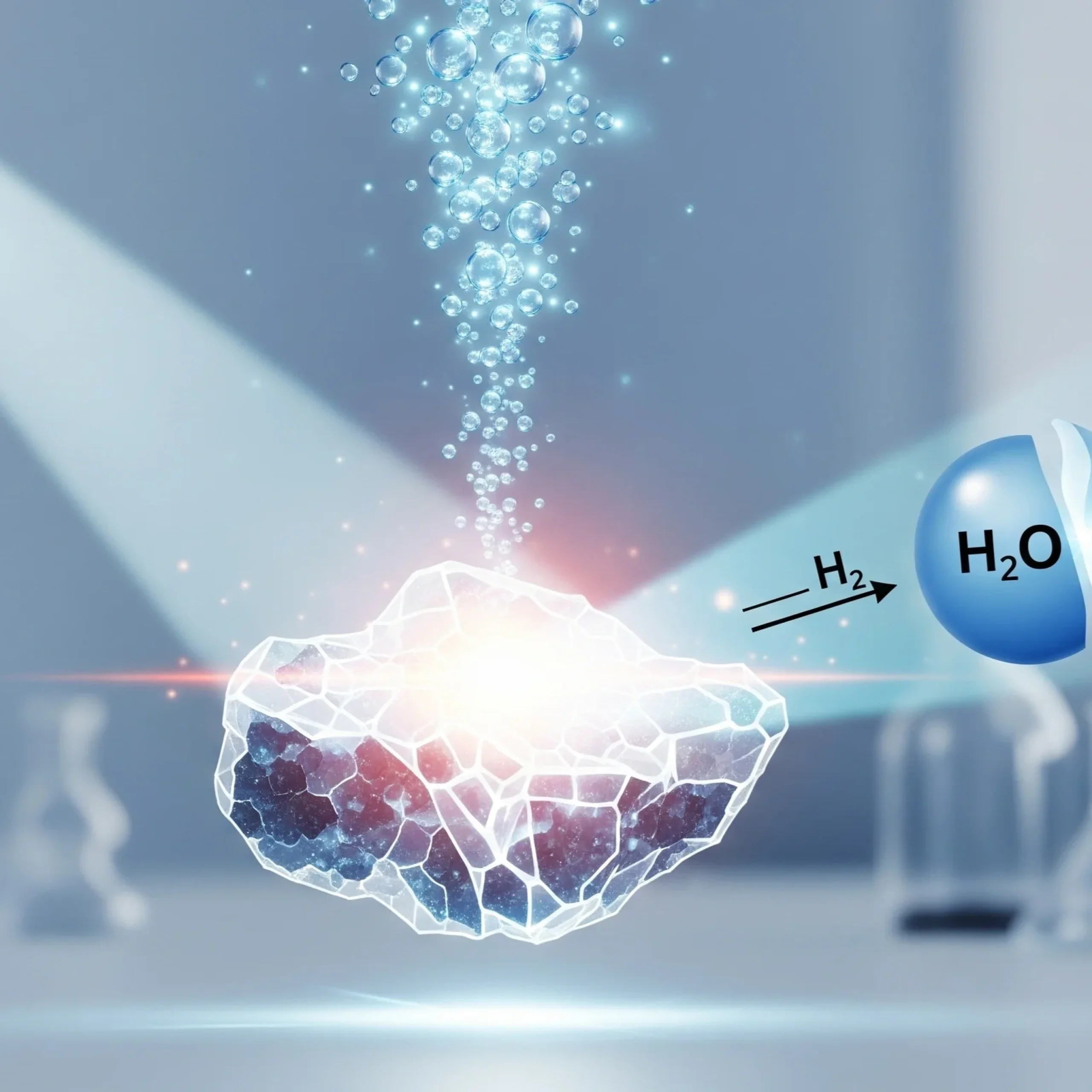
Hydrogen is often called the fuel of the future. It is a clean energy source, as its combustion produces only water, not carbon. However, most current methods of hydrogen production are “dirty,” requiring fossil fuels and generating significant carbon emissions. Recently, scientists from the University of Texas at Austin made a breakthrough by discovering a new material that allows hydrogen to be produced from water using only sunlight. This discovery is a key step toward creating a completely carbon-free hydrogen economy.
How does photocatalysis work?
The new material’s operating principle is based on photocatalysis-a process in which a material accelerates a chemical reaction using light energy without expending any energy itself. In this case, the material acts as a catalyst, helping to split water molecules (H2O) into their two components-hydrogen (H2) and oxygen (O2). Think of this process as a “solar battery” that doesn’t generate electricity but directly converts sunlight into the chemical energy contained in hydrogen. The new material is a semiconductor and has a unique structure that allows it to absorb a broad spectrum of sunlight, making it more efficient than previous analogs.
Advantages of the new material and its impact on energy
The discovery of a new material could completely revolutionise hydrogen production and accelerate the transition to green energy.
- Environmentally friendly: The process is completely clean and does not emit carbon dioxide, unlike the traditional method of producing hydrogen from methane.
- Cost-effectiveness: Using sunlight as the sole energy source for water splitting significantly reduces production costs. This method could make clean hydrogen competitive with “grey” (derived from fossil fuels) and “blue” (derived from carbon capture).
- Decentralization: Since sunlight is available almost everywhere, hydrogen production can be decentralized. This will allow hydrogen to be produced locally, without relying on large factories.
Challenges and prospects of technology
While the discovery of the new material is a major success, much work remains. For commercial use, the technology must be scaled up from laboratory to industrial scale. Scientists must ensure the long-term stability of the material and its efficiency over many cycles. Efficient systems for collecting and storing the resulting hydrogen also need to be developed. However, even at this stage, this scientific breakthrough is extremely important. It points to a viable path to solving the problem of clean hydrogen production, which is key to combating climate change.
In summary, carbon-free hydrogen production is no longer a dream. Thanks to a new material that splits water using sunlight, humanity now has a tangible tool for the transition to clean energy. This technology has the potential not only to fuel transportation and industry but also to transform the global energy landscape, making it more sustainable and environmentally friendly. This is a striking example of how fundamental research can lead to revolutionary practical solutions that will impact the lives of billions of people.




0 Comments