
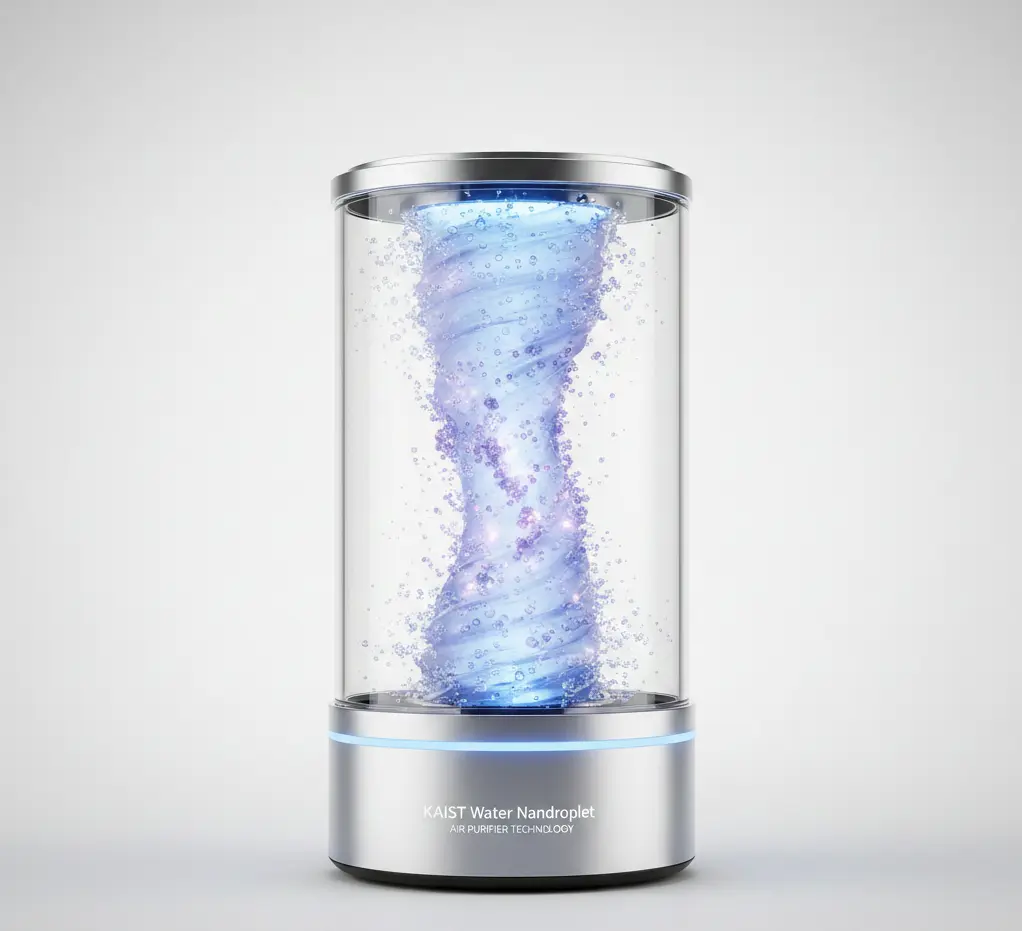
KAIST scientists have developed a revolutionary filter-free air purification technology. Learn how water nanodroplets replace HEPA filters and combat dust.
KAIST replaces filters with water nanodroplets
The world is on the threshold of a new era in environmental technology, thanks to a breakthrough by South Korean researchers. A team from KAIST has officially unveiled an air purification concept that completely rejects the classical understanding of filtration. Instead of using quickly clogging synthetic mesh, the scientists turned to nature, harnessing the fundamental properties of water. This solution not only increases efficiency, it opens the way to creating devices that operate for years without replacing key components.
Traditional air purifiers we’re accustomed to use HEPA filters-dense mats made of fiberglass or polymers. Despite their popularity, they have a significant drawback: over time, they become a breeding ground for bacteria and fungi. KAIST technology radically solves this problem. Air passes through a chamber where a special water environment is created, acting as an invisible yet highly durable trap for any contaminant. This transforms air purification from a mechanical process into a physical and chemical one.
The mechanism of operation of nanodroplets and AI
The innovation is based on electrostatic liquid atomization technology. Special nozzles generate billions of nanodroplets under high pressure, each of which is electrically charged either negatively or positively. When polluted air enters the system, fine particles of dust, soot, and allergens are instantly attracted to the charged droplets. This effect is similar to static electricity, but on a microscopic scale.
A key component of the system is its integrated AI. The AI analyzes the air composition thousands of times per second, adjusting the mist density. If a sudden source of pollution appears in the room, for example during cooking or opening a window in a large city, the AI instantly increases the mist intensity. This allows for maintaining an ideal microclimate without wasting water or energy. This flexibility is unmatched by any conventional filter with a constant flow rate.
Advantages over HEPA systems
- Deep purification from particles of PM2.5 and PM1.0 size, which can penetrate directly into the human bloodstream through the lungs.
- Complete absence of secondary contamination. In conventional filters, accumulated dust can be released back into the air if the filter is not replaced promptly.
- Low noise level. Since the airflow is unimpeded by the dense membrane, the fans operate much quieter and at lower speeds.
- Natural air humidification. In addition to purification, the system maintains a comfortable humidity level, which is critical during the heating season.
Impact on health and the environment
Scientists emphasize that fine dust causes millions of premature deaths worldwide each year. KAIST technology removes up to 99% of these pollutants. This is a real lifesaver for people with asthma or chronic allergies. Since the system is water-based, it does not emit any chemicals or ozone, which are sometimes found in older ionizers.
From an environmental standpoint, this development is a step toward a sustainable future. Instead of disposing of used filters, which take hundreds of years to decompose, the user only needs to periodically empty the dirty water from the tank. This water can be safely disposed of down the drain, as it contains no toxic components other than the dust already present in your home.
Energy efficiency and economics
Many people are accustomed to thinking that high-tech solutions are expensive. However, the economical KAIST model proves otherwise. The lack of consumables (filters) saves the owner significant amounts of money each year. While a standard, high-quality filter can cost between $50 and $150, your expenses are only equal to the cost of a few liters of tap water and minimal electricity.
The expected cost of the device itself in mass production is projected to be around $500. Given its service life, which is several times longer than that of conventional purifiers, this is an investment in your health that pays for itself within the first two years of use. It’s also important to note that the system’s power consumption in standby and active mode is 40% lower than that of competitors with similar performance.
The Future of Urban Spaces
The researchers don’t plan to limit their use to household appliances. They are considering scaling up the technology for use in subways, shopping malls, and large industrial facilities. Imagine entire walls of water mist at the entrances of public buildings, acting as an invisible shield against urban smog.
Using AI algorithms, such systems will be able to integrate into a single city network, sharing air quality data. This will allow for localized enhanced purification precisely where pollution peaks are detected. Thus, KAIST’s development is not just a home gadget, but part of the future smart city infrastructure, where everyone will have access to clean air.
Conclusions
KAIST’s nanodroplet technology is a powerful signal for the entire industry. It proves that the most effective solutions are often obvious and require only the correct application of the laws of physics and modern computing power. Clean air is becoming more accessible, safer, and more environmentally friendly. In the coming years, we will be able to see these devices on store shelves, forever changing our lives and attitudes toward the environment.



0 Comments