
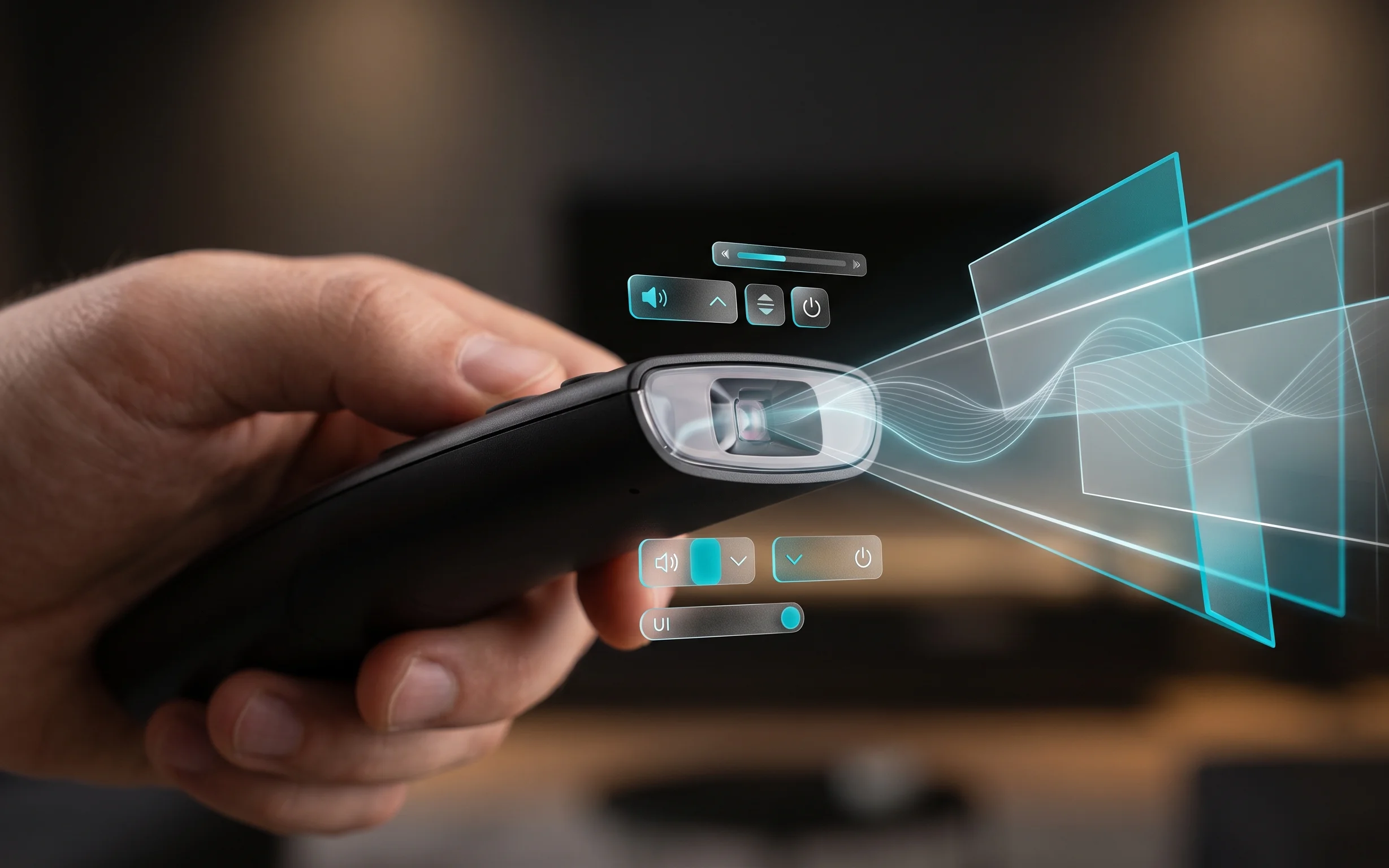
The Lasting Dominance of a Simple Technology
Despite the rapid advancement of wireless standards, the classic infrared remote control remains the primary tool for operating televisions. Developed more than forty years ago, this technology successfully competes with modern radio-frequency interfaces. The secret to such resilience lies in a combination of low manufacturing costs, high reliability, and the basic physical properties of the light spectrum.
Modern Smart TVs actively utilize Bluetooth for transmitting voice commands or operating in air-mouse modes. However, even in the newest premium segment models, manufacturers always duplicate the system with an infrared sensor. This is due to the technical limitations of more complex communication protocols and the architectural specifics of modern microprocessors.
Process Physics and Signal Encoding
The operation of an infrared remote control is based on the emission of a light-emitting diode working in a spectrum invisible to the human eye. Typically, a wavelength between 850 nanometers and 950 nanometers is used. Each button press activates a microcontroller that converts the command into a sequence of binary pulses. This digital packet is transmitted via modulation of a carrier frequency.
Modulation is necessary so that the receiver on the TV can distinguish the useful signal from the natural infrared background created by lighting lamps, sunlight, or home heaters. Most often, the industry uses a carrier frequency of 36 kilohertz or 38 kilohertz. The TV receiver module contains a bandpass filter that ignores all other frequencies, ensuring high command recognition accuracy even on a sunny day.
Advantages and Disadvantages of Control Technologies
To understand why the infrared standard remains viable, it is worth comparing it with its main competitor, Bluetooth. Both solutions have clearly defined operational characteristics.
The main disadvantage of infrared radiation is the requirement for a direct line of sight between the transmitter and the receiver. Any physical obstacle, such as a book on a table or a decorative panel, completely blocks the signal. However, this disadvantage turns into an advantage in multi-apartment buildings, the remote is guaranteed not to switch channels on a neighbor’s TV through the wall.
The Power Sleep and Power-On Issue
Modern ecological standards require consumer electronics to consume minimal electrical power in standby mode. To achieve this, the main boards of the TV enter a deep sleep state where power is supplied only to a minimal number of components. The power consumption of an infrared photodetector in standby mode is a matter of microamperes.
With Bluetooth, the situation is more complex. For a TV to turn on via a radio signal, its Bluetooth module must constantly scan the airwaves and maintain a connection with the remote. This requires additional energy expenditure and a more complex power circuit. Therefore, most manufacturers use a hybrid scheme where the power-on command is sent via the infrared port, and further control of the Smart TV interface switches to Bluetooth.
Economic Factors and Universality
Production cost remains the key factor for the mass market. An infrared LED and the simplest encoding chip cost mere cents. This allows budget equipment to be equipped with reliable remotes without increasing the final price of the device for the buyer. Replacement is also simplified, a universal infrared remote can currently be purchased for 5-10 USD, and it will work with dozens of brands.
The compatibility of encoding protocols, such as the widespread NEC standard, has not changed for decades. This allows older remotes to work with new TVs, and new home theater systems to easily integrate into existing infrastructure without software updates or purchasing special licensed adapters.


0 Comments