
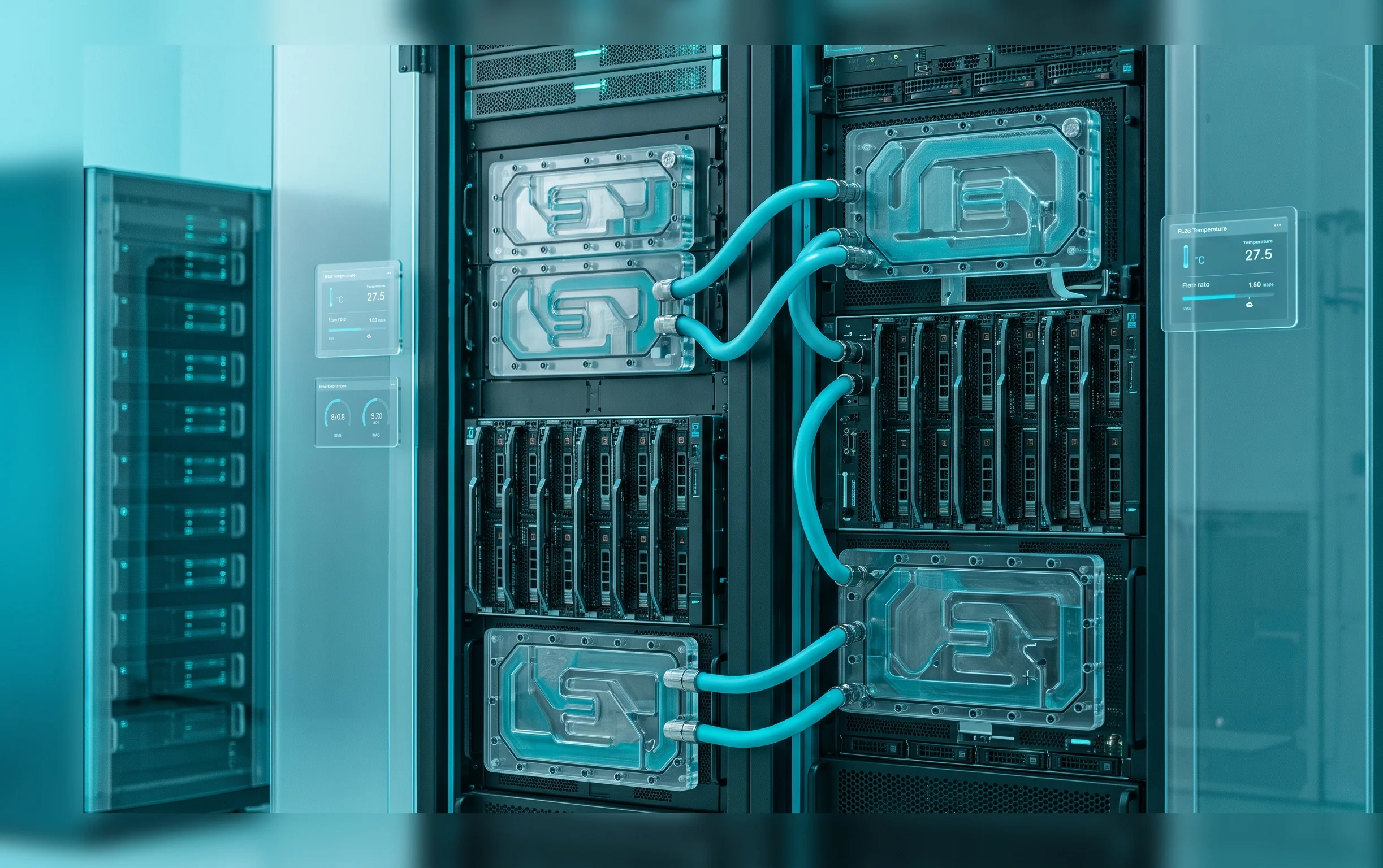
A Shift in Thermal Management for Computing Systems
The rapid advancement of artificial intelligence models requires massive computational power. Modern GPUs and specialized accelerators draw kilowatts of power per chip, converting most of that energy into heat. Traditional air cooling and conventional liquid cooling setups in data centers face physical constraints that hinder further scaling of high-density server racks.
NVIDIA introduced an architectural solution that reshapes thermal management in high-load data centers. The new concept relies on circulating coolant at temperatures around 45°C, which is hotter than a standard hot tub. Utilizing liquid at this temperature eliminates the need for energy-intensive chillers and evaporative cooling towers, streamlining facility infrastructure.
Physical Principles of Warm Liquid Cooling
Using warm or hot water to cool electronic components might seem counterintuitive at first. However, cooling efficiency is driven by the temperature differential between the component and the coolant, as well as the heat capacity of the medium. Water transfers heat far more effectively than air, maintaining safe junction temperatures on silicon chips even with elevated fluid inlet temperatures.
The architecture employs closed primary and secondary loops. Inside the server chassis, liquid flows directly through cold plates mounted on GPUs, CPUs, and HBM memory modules. The heated coolant is then routed directly to external heat exchangers for dissipation.
2>System Architecture and Eliminating Evaporative Towers
The primary advantage of this approach is the ability to rely entirely on dry coolers. Because the fluid leaves the server racks at elevated temperatures, the delta between the liquid and ambient outdoor air remains sufficient for passive heat rejection, even during hot summer months, without requiring water evaporation.
- Zero Water Consumption. Conventional data centers consume millions of liters of fresh water daily through evaporative cooling. A closed-loop design eliminates ongoing water depletion.
- Lower Infrastructure Costs. Removing refrigeration chillers decreases initial capital expenditure and simplifies ongoing facility maintenance.
- Improved PUE Metrics. Reducing auxiliary power drawn by cooling equipment brings the Power Usage Effectiveness ratio closer to optimal levels.
Comparing Cooling System Metrics
To understand the engineering advantage, it is helpful to compare key performance metrics across different data center cooling methods.
2>Corrosion and Leak Protection in Liquid Loops
Operating with warm coolant introduces strict requirements regarding material compatibility and fluid chemistry. Higher temperatures accelerate potential corrosive processes and increase scale formation risks. To ensure long-term reliability, specialized water-propylene glycol mixtures containing advanced corrosion inhibitors are utilized.
Engineering Safety Controls
Liquid cooling modules feature industrial-grade No-Drip Quick Disconnect fittings. This design enables hot-swapping server blades or individual modules without shutting down the system or risking fluid discharge onto live electronics.
- Dual-layer leak detection systems utilizing optical and electrical sensors along pipe routes.
- Real-time telemetry monitoring fluid pressure and volumetric flow rates.
- Automated isolation of compromised loops via software-controlled valves during anomalies.
Impact on Future Data Center Infrastructure
Adopting warm liquid cooling alters geographical requirements for constructing new computing facilities. Historically, large data centers were built in colder climates to leverage ambient air for free cooling. This technology reduces dependency on external air temperatures, enabling facilities to be built in warmer climates closer to renewable energy sources.
Furthermore, the high temperature of the exhaust fluid creates opportunities for waste heat reuse. Harvested thermal energy can be redirected to district heating networks, industrial facilities, or agricultural applications, further improving overall operational efficiency.



0 Comments