
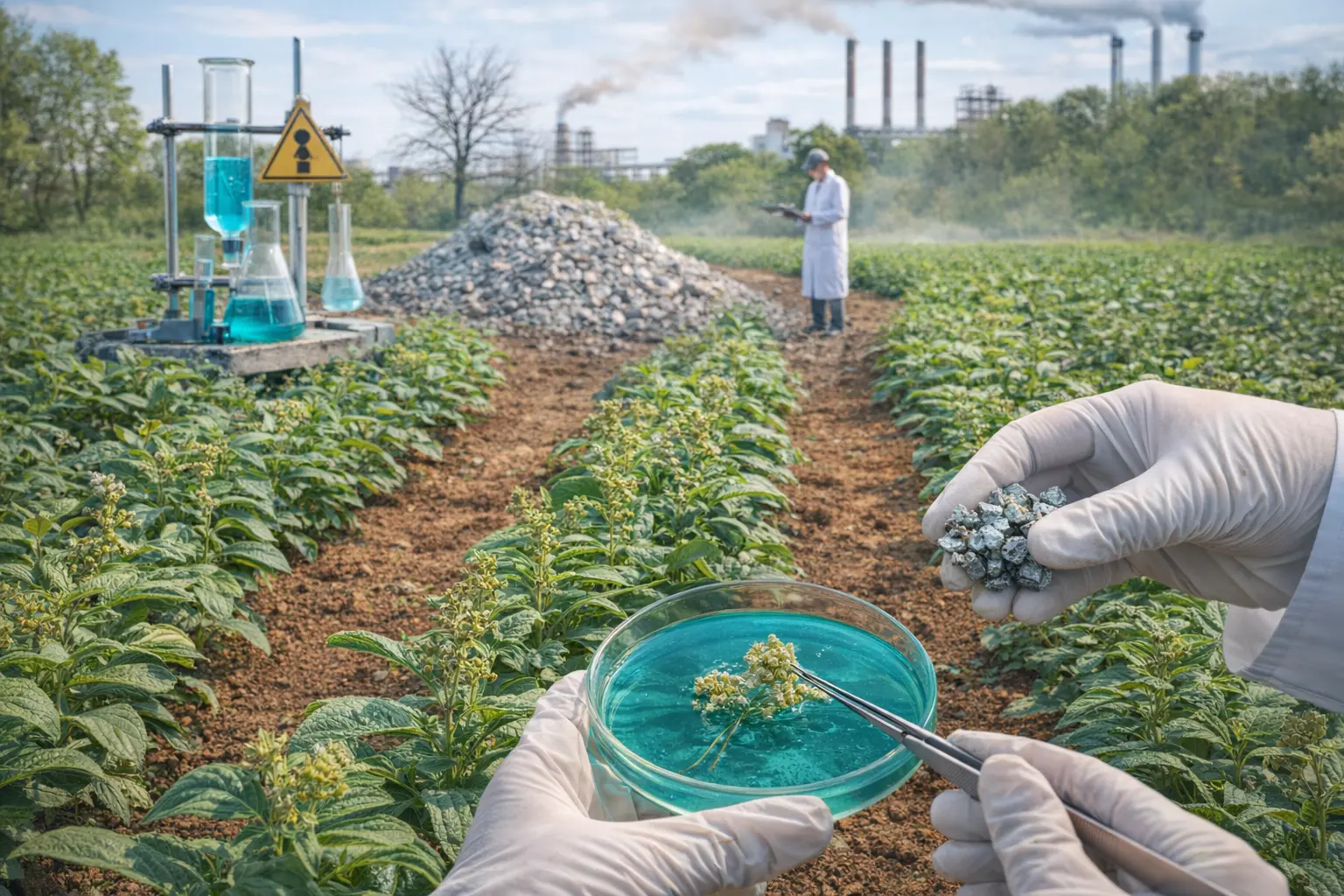
Learn how phytomining technology allows for the extraction of nickel and gold using plants. An environmentally friendly alternative to mining and the future of agromining.
Phytomining: A Revolution in Metal Mining
The world is on the threshold of a new technological era, where traditional mines could give way to endless green fields. Phytomining is an innovative method of extracting valuable resources that utilizes the natural ability of certain plants to absorb metals from the soil. This is not just a scientific experiment, but a real opportunity to extract nickel, cobalt, and even gold without damaging the environment.
How does a green fossil work?
The technology is based on hyperaccumulator plants. Unlike ordinary flora, for which high concentrations of heavy metals are toxic, these species have evolved to accumulate them in their tissues. The root system acts as a living pump, extracting microparticles of metals and concentrating them in the leaves and stems. The nickel concentration in some species can reach 5% of the dry weight, significantly exceeding the metal content in the ore of many active deposits.
- Planting seeds of special plants in metal-bearing or contaminated areas.
- The period of active growth during which metal absorption occurs.
- Harvesting (biomass) and thoroughly drying it.
- Controlled combustion of biomass at approximately 550°C to produce bio-ore.
- Chemical extraction to obtain pure metal salts or concentrates.
Economic benefit and financial efficiency
Traditional mining requires huge investments in heavy equipment and mine construction. Phytomining offers a much cheaper model. Experts estimate that nickel mining this way can generate profits exceeding those of traditional farming. For example, one hectare of a “metal farm” can yield up to 150-200 kg of nickel. With the metal price on the global market at around $20,000 per ton, the gross income per hectare can range from $3,000 to $4,000 per cycle.
Besides nickel, the extraction of rare earth elements, critical for the production of electronics and AI systems, is of particular interest. The maintenance costs of such a farm are minimal, including fertilizers, harvesting, and logistics. This makes the technology ideal for countries with depleted deposits, where building new quarries costs hundreds of millions of dollars.
Plants that work for science
The most famous “worker” in this field is Alyssum bertolonii. This small plant is capable of accumulating enormous amounts of nickel. However, scientists aren’t resting on their laurels. Using modern AI algorithms, they can analyze the genomes of thousands of species to find the most effective combinations for different soil types.
- Alyssum murale is a leader in nickel accumulation in depleted soils.
- Dicranopteris dichotoma is a fern that specializes in rare earth metals.
- Berkheya coddii is a tall grass that produces large amounts of biomass with high cobalt content.
Environmental impact and land restoration
The main advantage of agromining is phytoremediation. After the mining cycle is complete, the soil becomes cleaner because plants remove toxic compounds. This allows former industrial zones to be used for agriculture after 10-15 years of operation as phytomines. The process produces no toxic waste and does not require the use of cyanides or acids typically used in traditional metal leaching.
Using AI in plant growth monitoring allows for accurate harvest timing predictions, minimizing water and energy use. This creates a closed-loop production cycle, where even the ash from biomass combustion is used as concentrated fertilizer or industrial raw material.
Challenges and the future of industry
Despite its enormous potential, phytomining has its limitations. The main factor is time: plants require a season to grow, whereas mechanical mining produces results instantly. Efficiency also depends on climate conditions-drought or flooding can destroy the “metal harvest.”
However, with the development of genetic engineering and the integration of AI systems to optimize photosynthesis, the rate of metal accumulation could increase exponentially. By 2030, the market share of “green” metals is projected to grow to 5%, changing supply chains for smartphone and electric vehicle manufacturers. Phytomining is the path to a sustainable future, where humanity extracts resources from nature without destroying its home.




0 Comments