
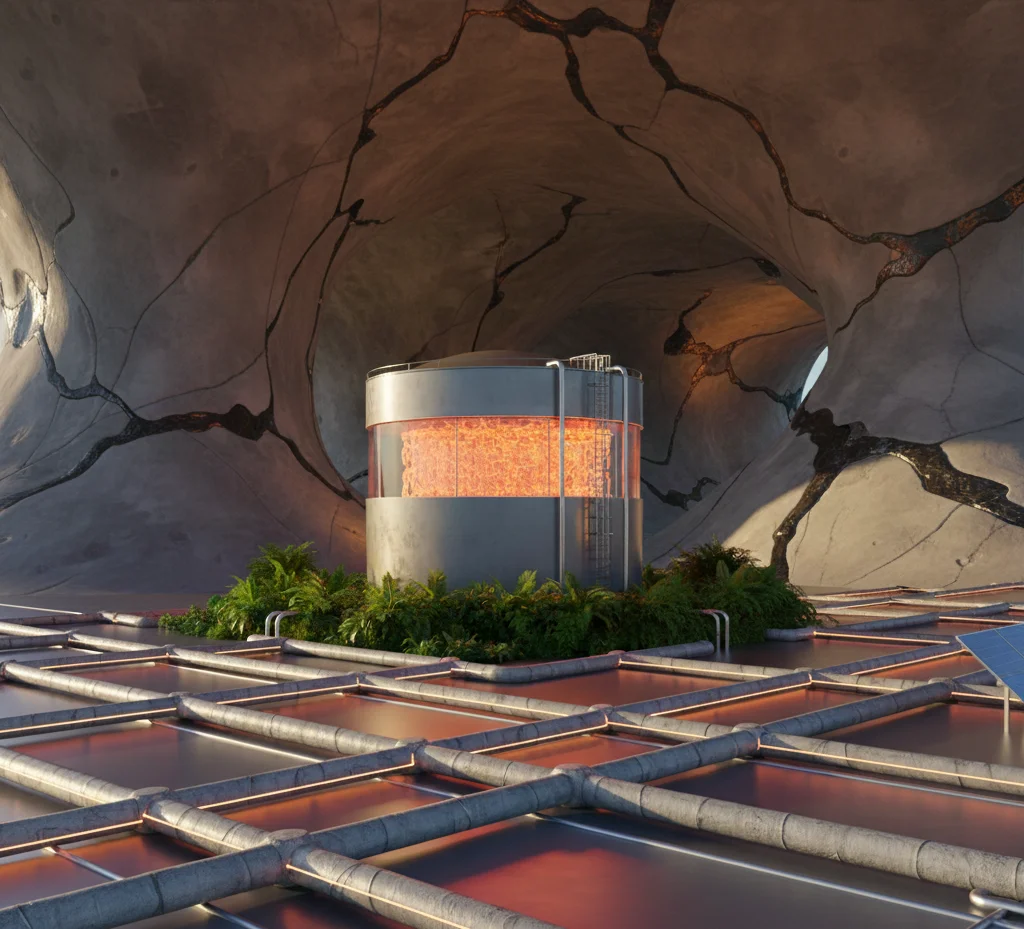
Learn how old oil tanks are being converted into giant thermal batteries. Swedish expertise, energy-saving technologies, and environmental benefits are explored.
Oil Storage Instead of Batteries: How Old Infrastructure Saves the Energy Sector
The world stands on the threshold of a global energy transformation, where the main challenge is not only energy generation but also efficient energy storage. While AI developers create algorithms to optimize grids, engineers have turned their attention to an industrial legacy of the last century: oil storage tanks. It turns out that large steel and concrete tanks, previously used to store fossil fuels, could become a key element of the “green” transition.
Technology for turning tanks into giant thermoses
The concept of using oil storage facilities as heat accumulators is based on the principle of thermal inertia. Instead of building new, expensive storage facilities, it is proposed to modernize existing facilities. The process involves several critical steps that enable the system to operate at maximum efficiency. The basic idea is to store excess heat from solar collectors, wind farms, or waste incineration plants in massive volumes of water.
- Deep cleaning and degassing of internal surfaces to remove residual petroleum products.
- Installation of high-tech thermal insulation that minimizes energy loss to the environment.
- Installation of heat exchanger systems and pumping stations to control charging and discharging cycles.
- Integration of temperature control sensors into AI systems for demand forecasting.
Thanks to their large capacity, these tanks can maintain water temperatures at 90°C for weeks or even months. This makes them ideal for seasonal energy storage: the heat accumulated in the summer is used to heat entire areas in the winter.
Swedish breakthrough in the city of Västerås
Sweden became a pioneer in this field, implementing one of the most ambitious projects in the city of Västerås. The local energy company converted old underground oil storage facilities into a massive thermal storage facility. This storage facility holds 300,000 cubic meters of water, equivalent to the volume of over 100 Olympic-sized swimming pools. The project addressed the city’s need for a stable heat supply without increasing fuel combustion.
These rock caverns were previously used as a strategic fuel oil reserve. Today, they are filled with water, which is heated during periods of low electricity demand. When the outside temperature drops below -15°C, the system begins releasing the stored heat into the city grid. This saves the city over $5 million annually on fuel costs alone.
Economics and comparison with other methods
Comparing the cost of building a new thermal storage facility with upgrading an existing oil depot, the benefits are clear. The cost of retrofitting ranges from approximately $40 to $60 per cubic meter of volume, while building a new facility costs at least $100 per cubic meter. Furthermore, oil terminals typically already have existing infrastructure: roads, power grids, and sometimes railways.
- Reduction of capital investment by 50% compared to new construction.
- The service life of such systems exceeds 40 years without significant capacity degradation.
- Possibility of fast zoom by using several tanks simultaneously.
Unlike lithium-ion batteries, thermal storage does not require the use of rare metals such as cobalt or lithium. This makes them more environmentally friendly and resilient to fluctuations in raw material prices on global markets.
Technical Challenges and the Role of AI in Management
Despite the obvious advantages, the transformation of oil storage facilities faces technical challenges. One of the most challenging aspects is combating corrosion of metal walls caused by hot water and maintaining temperature stratification. Hot water is lighter than cold water, so it naturally rises. Effectively exploiting this thermocline effect requires complex hydraulic systems.
This is where AI comes in. State-of-the-art algorithms analyze weather forecasts, real-time electricity prices, and residents’ heat consumption patterns. AI helps determine when to start charging the storage tank and when to release energy to maximize profits and ensure occupant comfort. Thanks to automation, the efficiency of stored heat utilization increases by 15-20%.
The environmental aspect and the future of technology
Revitalizing industrial facilities is a shining example of the circular economy. Instead of leaving old metal structures to rust, we give them a second life. This prevents soil contamination with oil residues, as the modernization process involves complete site remediation.
In the future, such projects could become standard for every major city with an old industrial zone. Using oil storage facilities to conserve heat helps smooth out peaks in demand and make the energy system more flexible. This is especially important for integrating wind and solar power, which are inherently unstable.
Conclusions for energy security
Converting oil reservoirs into heat accumulators is not just an engineering feat, but a strategic step toward energy independence. Sweden’s experience demonstrates that, with the right approach, even outdated technologies of the past can become the foundation for a clean future. Implementing such solutions can significantly reduce CO2 emissions and make heating more affordable for millions of people.




0 Comments