
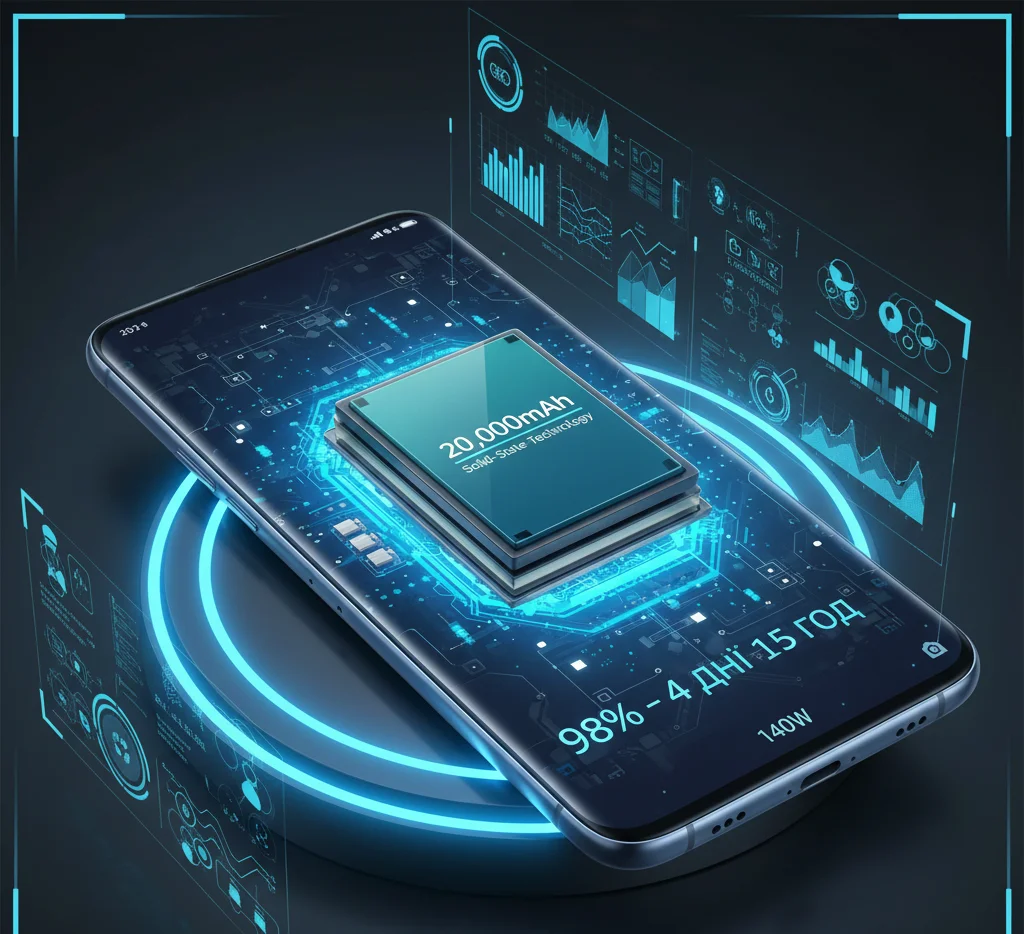
Samsung is preparing a revolution: 20,000 mAh batteries for smartphones. Learn about the Solid-State and Stacked Battery technologies that will change the market.
Samsung’s 20,000mAh batteries will be a game-changer.
The world of mobile technology is on the brink of major changes. Samsung, a leader in innovation for years, has officially confirmed its work on a fundamentally new battery. We’re talking about an incredible 20,000 mAh battery for mainstream smartphones. This isn’t just another update, but a genuine attempt to solve the main problem with modern gadgets: low battery life.
Solid-State Technology as the Basis for a Breakthrough
The main barrier to creating large batteries has always been their physical size. Standard lithium-ion solutions with such capacity would turn a smartphone into a heavy brick. However, Samsung is betting on solid-state batteries. Unlike liquid electrolyte, a solid component allows for significantly higher energy density.
- High safety: solid electrolyte is non-flammable.
- Compactness: the ability to pack more energy into the same space.
- Durability: Such batteries can withstand 2-3 times more recharge cycles.
Stacked Battery Multilayer Structure
Another important step is borrowing technologies from the electric vehicle industry. The stacked battery technique (multilayer packaging) allows for a more dense arrangement of the battery’s internal plates. This optimizes the smartphone’s internal space, allowing for increased capacity without radically changing the device’s dimensions. Even with a capacity of 20,000 mAh, the device’s thickness can be as thin as 10 mm.
Energy Consumption and AI Challenges
Why is there a need for such a massive capacity now? The answer lies in the development of AI. Modern Galaxy AI algorithms, real-time photo processing, and generative functions require enormous processor resources. This leads to accelerated battery drain. The new power standard will allow users to forget about the charger for 4-5 days of active use, even with AI features always enabled.
Fast charging with a power of over 100W
Charging a 20,000 mAh battery with a standard 25W power supply would be impossible-it would take a full day. Samsung is simultaneously developing new charging protocols capable of delivering 100W and even 140W. A full charge cycle for such a massive device is expected to take approximately 60-80 minutes. This is important for user comfort.
Economic aspect and cost
The use of such technologies will inevitably impact the price of flagship devices. According to preliminary analyst estimates, the cost of new batteries could increase the price of a device by $150–$250. However, the market is prepared for such an increase, as battery life has become a key consideration for professional users and travelers.
Impact on the ecosystem and market
If Samsung is the first to mass-produce a product with such a capacity, it will force competitors to reconsider their strategies. Apple and Chinese manufacturers are already developing their own equivalents, but the Korean giant has the most advanced research and development base in the chemical power supply segment through its Samsung SDI division.
Conclusion on the future of mobility
A revolution in batteries is what the industry has been waiting for for the past decade. A 20,000 mAh battery in a smartphone will transform it into a fully-fledged workstation, independent of a power outlet. Thanks to solid-state technologies and intelligent AI optimization, we’ll have devices that last for weeks while remaining thin and light. This is a new era where energy is no longer a scarce resource.



0 Comments