
- The Shift Toward On-Device Multimodal AI Systems
- Technical Specifications and Architectural Design of Gemma 4 12B
- Evaluating Performance on Mobile and Desktop Processors
- Core Benefits of Edge-Based Offline Processing
- Real-World Application Scenarios for Local Multimodal Engines
- Integration Frameworks and Ecosystem Support
The Shift Toward On-Device Multimodal AI Systems
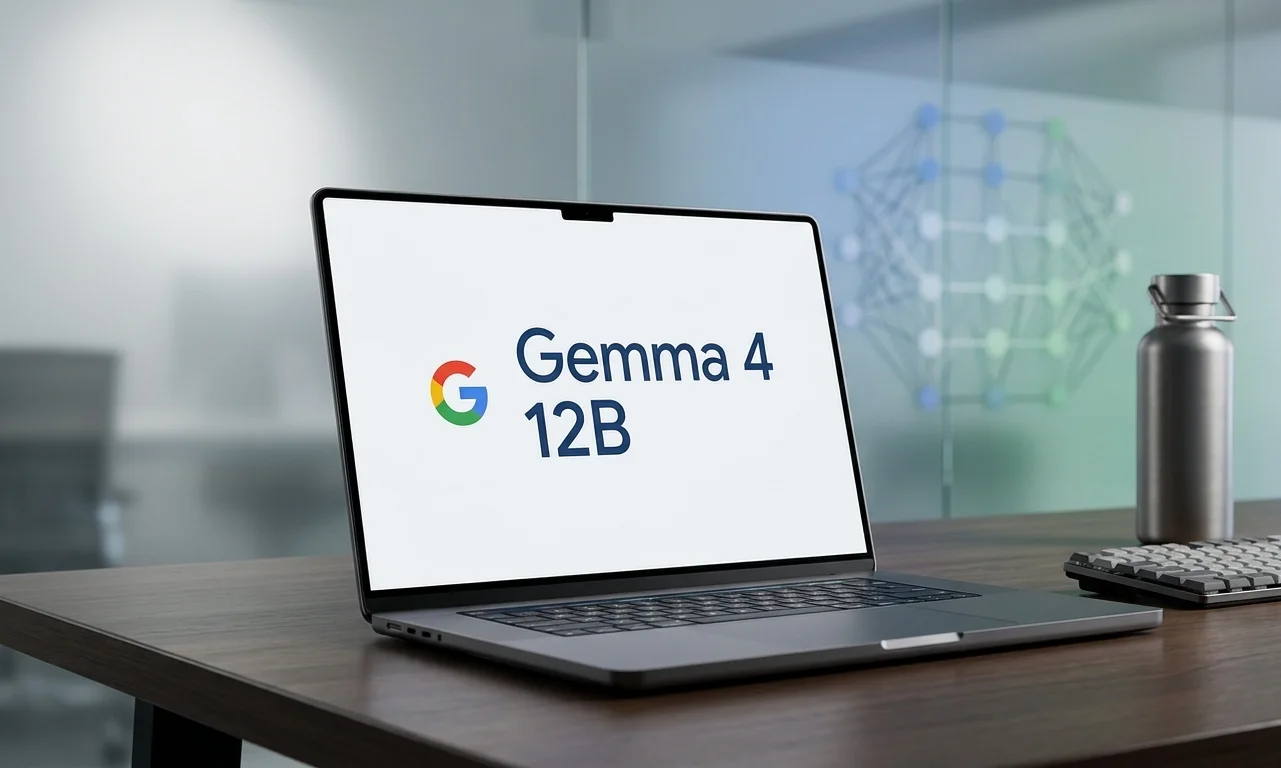
The evolution of generative artificial intelligence shows a clear pivot from massive cloud-based models toward compact, highly efficient local alternatives. For a long time, multimodality remained a primary challenge since processing text, images, and audio simultaneously demanded immense compute infrastructure. Google has addressed this by introducing the new Gemma 4 12B model, a 12-billion-parameter network tailored specifically for local deployment on mainstream laptops and desktop workstations without requiring an active internet connection.
The defining aspect of this release lies in its architectural adaptations for consumer-grade hardware, including integrated and discrete graphics processing units along with Dedicated Neural Processing Units. Through aggressive quantization and a redesigned attention mechanism, the model delivers fast inference speeds while maintaining a small memory footprint and minimal power consumption.
Technical Specifications and Architectural Design of Gemma 4 12B
The new model relies on a transformer core with several modifications aimed at operating efficiently under hardware resource constraints. The implementation of Grouped-Query Attention significantly minimizes the memory needed for storing the KV cache, which is vital when navigating long context windows. The architecture natively supports a context window of up to 32000 tokens, enabling users to process large text files or lengthy audio inputs locally.
Multimodality is handled natively via a single shared embedding space, where text tokens, visual patches, and audio spectrograms are passed through the core neural network layers without depending on individual external encoders. This reduces latency when switching between input types and enhances context understanding where text and graphics are heavily intertwined.
Evaluating Performance on Mobile and Desktop Processors
To assess the real-world capabilities of Gemma 4 12B, developers executed benchmarks across notebooks powered by recent x86 and ARM architectures. Testing focused heavily on integrated graphics and specialized NPU blocks found in modern processors. Due to optimizations through XNNPACK and vLLM frameworks, the model maintains stable operational throughput without demanding top-tier discrete desktop GPUs.
When running under 4-bit or 8-bit weight compression, the model fits neatly inside the standard memory capacity of a typical modern ultrabook. For instance, an INT4 quantized version requires roughly 7.5 gigabytes of free RAM, making it practical for setups with 16 gigabytes of total system memory. Inference speeds stay within a comfortable range of 40 to 50 tokens per second during standard interactions.
Core Benefits of Edge-Based Offline Processing
- Absolute privacy for sensitive personal or corporate data since all processing stays within the local storage of the machine.
- Zero API costs or subscription fees, allowing developers to embed the model into software pipelines without managing infrastructure overhead.
- Independence from network access, ensuring seamless execution in remote fields, transit, or areas with poor cellular service.
- Ultra-low latency for token generation because requests avoid round-trips over web servers.
Real-World Application Scenarios for Local Multimodal Engines
Blending text, computer vision, and audio diagnostics into a single compact footprint unlocks unique avenues for day-to-day productivity tracking. A prime use case involves building intelligent local agents that can monitor screen states, interpret voice instructions, and instantly produce structured documentation or software code fragments on demand.
Software engineers can point the model at large local codebases to build internal documentation, spot logic errors, and get refactoring advice without exposing proprietary assets to public cloud environments. The model also excels at local audio transcription, parsing multi-hour recordings while auto-generating concise summary points and action items for work groups.
Integration Frameworks and Ecosystem Support
To simplify deployment pipelines, Google updated its MediaPipe ecosystem with native handling for the new multimodal layers. Software teams can deploy the model inside native C++, Python, or web applications leveraging WebGPU. Delivered with open weights, Gemma 4 12B supports deep fine-tuning workflows on niche datasets, helping organizations adapt its vocabulary to industry-specific terminology or bespoke workplace structures.



0 Comments