
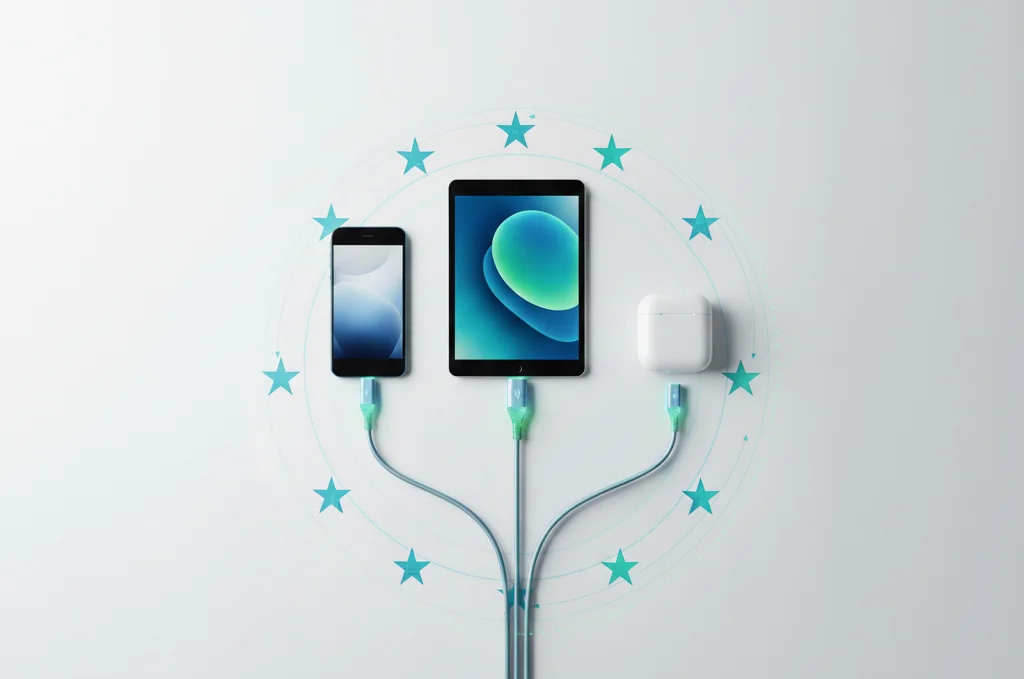
- Key Dates: When Will USB-C Become Mandatory for All Gadgets?
- What devices are covered by the EU USB-C law?
- Categories covered by the law from 2024
- Devices that will join the network from 2026
- Exceptions
- Environmental and economic benefits for consumers
- Technical Details: The Role of USB Power Delivery (PD) and Mandatory Labeling
- USB Power Delivery: Unifying Charging Speeds
- Common Charger Labeling Requirements
- Impact on global manufacturers: the transition to USB Type-C
- How does this affect Apple?
- The Future: Wireless Charging Standardization
The European Union has taken a decisive step toward simplifying consumer life and significantly reducing e-waste by adopting a unified charging standard. This historic decision means that USB Type-C will become the mandatory charging port for nearly all portable electronic devices sold in the EU market. The goal is simple: to eliminate the mountain of old, unnecessary chargers cluttering our drawers and to ensure maximum convenience for users with a universal charger.
Key Dates: When Will USB-C Become Mandatory for All Gadgets?
The implementation of a unified EU charging standard is taking place in stages. It’s important to clearly distinguish between the terms used for different product categories to understand when changes will occur. This decision is part of the updated Radio Equipment Directive (RED), which aims to standardize charging devices.
- From December 28, 2024: This date is the cutoff date for most small and medium-sized electronic devices, including smartphones, tablets, digital cameras, headphones, portable speakers, and others.
- Effective April 28, 2026: The requirement applies to more power-hungry devices, specifically laptops. This gives manufacturers more time to transition to USB Type-C as the primary or single charging port.
- 2028: This is the estimated date when the European Commission is expected to review the Directive, possibly to include new categories of devices or standardise wireless charging.
What devices are covered by the EU USB-C law?
The Universal Charging Standard applies to any portable electronic device that charges via a cable and has sufficient power to support the standard. This is the broadest scope ever applied to charging standards, ensuring consumers no longer have to buy new chargers.
Categories covered by the law from 2024
- Smartphones and tablets;
- Digital cameras, camcorders and portable consoles;
- Headphones, headsets and portable acoustic systems;
- Electronic books (e-readers), keyboards, mice and navigation systems.
Devices that will join the network from 2026
- All new laptops sold in the EU will be required to support charging via USB Type-C.
Exceptions
The requirement does not apply to devices that are too small to physically accommodate a USB-C port (such as some smartwatches or fitness trackers). Devices that charge exclusively wirelessly are also exempt.
Environmental and economic benefits for consumers
Switching to USB-C for all devices isn’t just a matter of convenience; it’s a powerful tool for combating e-waste. The European Commission has provided clear estimates of the resources and costs this move could save.
- Waste Reduction: Implementing a unified charging standard is expected to reduce the volume of electronic waste associated with chargers by approximately 11,000 tons per year. This significantly reduces the carbon footprint of the electronics industry.
- Cost savings: Consumers will no longer be forced to buy a new charger when purchasing a new gadget. The EU estimates this will save citizens up to $250 million annually.
- Ease of use: The ability to charge your smartphone, tablet, and even your laptop with the same cable significantly increases mobility and eliminates cable clutter.
Technical Details: The Role of USB Power Delivery (PD) and Mandatory Labeling
The use of USB-C extends beyond the physical port. A new law requires all devices that support fast charging to use unified USB Power Delivery (PD) technology. This ensures that, regardless of manufacturer, users can achieve optimal charging speeds using any compatible USB Type-C charger.
USB Power Delivery: Unifying Charging Speeds
- Power Optimization: USB PD technology allows devices to negotiate with the charger for the optimal power output (up to 100W with the old standard and up to 240W with the new EPR). This ensures both safety and maximum charging speed for any gadget.
Common Charger Labeling Requirements
- Graphic designation: The packaging must contain an icon informing whether a charger is included in the sales package to avoid unnecessary purchases.
- Wattage: The minimum and maximum wattage supported by the device must be specified. This is important for selecting a compatible universal charger.
Impact on global manufacturers: the transition to USB Type-C
This law is most significant for companies that have traditionally used their own proprietary standards. Global leaders, including Apple, must adapt to EU requirements, effectively establishing a new global standard for universal charging.
How does this affect Apple?
For a long time, Apple used its Lightning port for iPhones and some iPads. A new law requires all future iPhone models sold in the EU after 2024 to be equipped with a USB-C port. This has led the company to begin transitioning to USB Type-C in its new products, a direct consequence of EU legislation.
The Future: Wireless Charging Standardization
While the focus is on wired charging, the European Commission is looking to the future. Under the Directive, the Commission has been mandated to standardize wireless charging protocols to ensure interoperability and prevent a new wave of market fragmentation.
This means that if wireless charging technologies become dominant, the EU could introduce requirements to ensure compatibility between devices from different manufacturers and the same wireless charging station. This is another step toward completely eliminating electronic chaos.
The EU’s legislation on a unified charging standard sets a global precedent, not only introducing USB-C as a physical port but also standardizing USB Power Delivery (PD) technology and mandating the Common Charger label. This will bring tangible savings and environmental benefits to millions of consumers starting in 2024 and, for laptops, starting in 2026.




0 Comments