
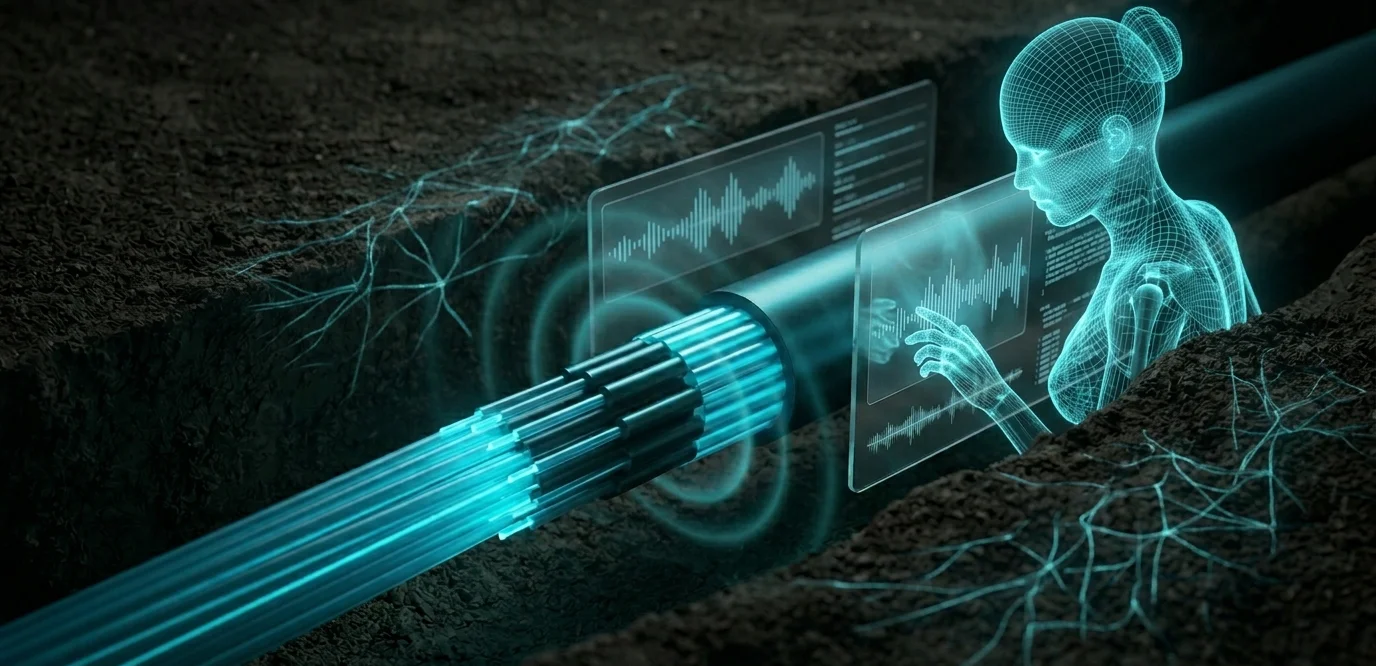
Transforming Light Guides into Acoustic Sensors
Distributed Acoustic Sensing (DAS) technology is based on measuring the backscattering of light inside a fiber optic core. When sound or vibration affects the cable, microscopic deformations occur, altering the phase of light pulses. A coherent reflectometer records these changes, allowing them to be interpreted as acoustic oscillations across the entire length of the cable, which can reach tens of kilometers.
The Role of AI in Seismic Data Processing
By itself, fiber optics capture a massive amount of noise where the useful signal is often lost. To isolate human speech, researchers apply complex machine learning algorithms and neural networks. AI can filter out low-frequency ground vibrations and traffic noise, focusing on the frequency range of 300 to 3400 Hz, typical for the human voice. Experiments in 2026 demonstrated the ability to recognize individual words at a distance of up to 5 meters from a cable buried under a layer of soil.
Technical Specifications and Detection Conditions
The efficiency of this method depends on many factors, including soil density, cable insulation type, and laser source power. To understand the scale of the technology’s impact on infrastructure, consider the system parameters.
Applications in Geophysics and Urban Infrastructure
Geophysicists use this method to monitor microseismic activity in cities without the need for drilling wells for expensive seismographs. Fiber optics already under the asphalt become a ready-made network of sensors. This allows for monitoring the condition of underground utilities, detecting water or gas leaks by a specific acoustic profile, and even analyzing traffic intensity in real-time.
Privacy Risks
Using telecommunication lines to collect acoustic information raises questions about the security of private conversations. Since cables pass by office buildings and residential houses, potentially any point along the line could become a source of information leakage. Cybersecurity experts emphasize the need for protection methods such as physical encryption or creating special acoustic isolation zones around communication nodes.
Future of Technology and Standardization
International protocols are expected to be developed in the coming years to regulate the use of DAS technology. This is necessary to distinguish legitimate scientific monitoring from unauthorized information collection. Integrating such systems into the Smart City concept will significantly reduce city network maintenance costs but will require transparent legislative regulation.
Source: Science / Slashdot




0 Comments