
- The Mystery of the Human Gaze and the Evolutionary Sclera Paradox
- The Cooperative Eye Hypothesis and Its Scientific Background
- Social Benefits of an Exposed Gaze
- Why Dark Sclera Benefits Animals in the Wild
- Comparative Analysis of Human and Primate Eye Morphology
- Exceptions to the Rule – Domestication and Domestic Animals
- Anatomical Implications of White Sclera for Human Health
The Mystery of the Human Gaze and the Evolutionary Sclera Paradox
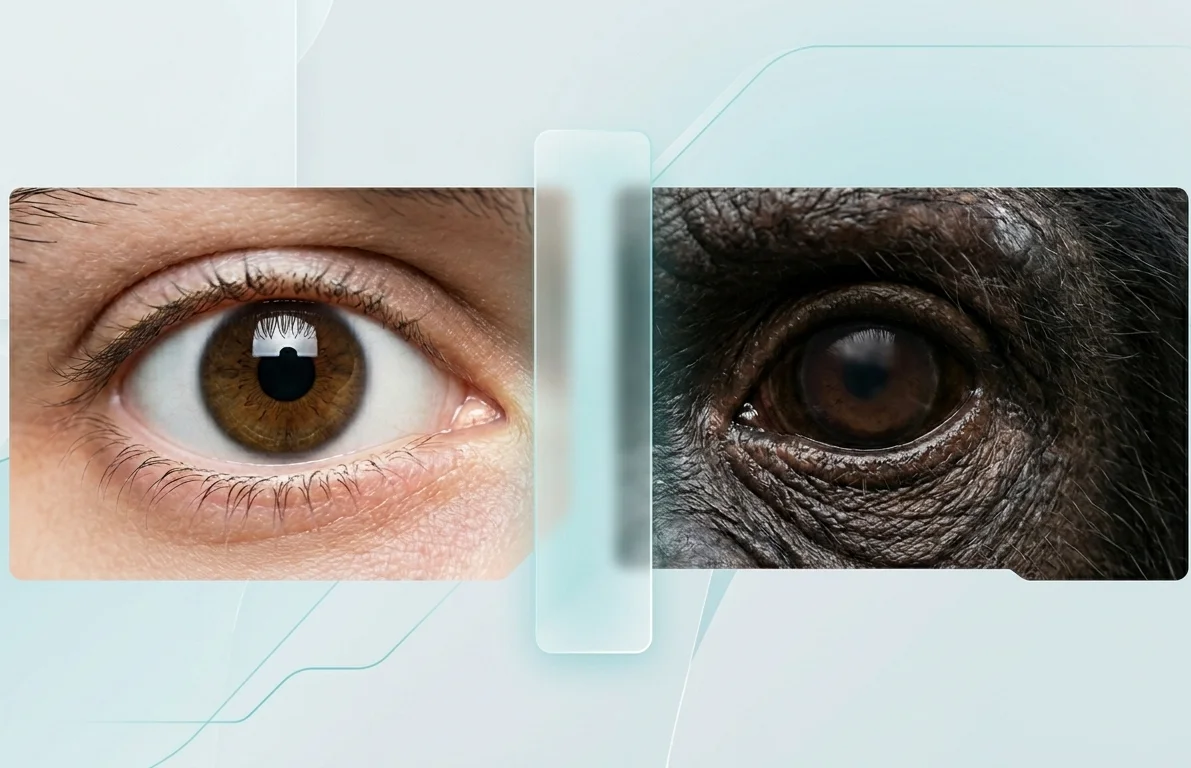
The human eye is an exceptional anatomical phenomenon in the animal kingdom. If you observe most mammals, especially our closest relatives such as chimpanzees, gorillas, and orangutans, you will notice a striking difference in the structure of their visual organs. In non-human primates, the visible part of the eye surrounding the iris, known as the sclera, is dark brown or yellowish. In contrast, the human sclera completely lacks dark pigment and is pearly white. This sharp visual contrast between the white background, the colored iris, and the black pupil played a pivotal role in the development of human civilization.
For a long time, biologists and anthropologists sought to understand why evolution took such a risky path with humans. A bright white sclera makes the eye visible from afar, which directly contradicts the fundamental rules of survival in the wild. However, this specific anatomical trait laid the groundwork for the sophisticated social communication that sets humans apart from all other biological species.
The Cooperative Eye Hypothesis and Its Scientific Background
In 1997, Japanese researchers Hiromi Kobayashi and Shiro Kohshima formulated a groundbreaking scientific concept known as the Cooperative Eye Hypothesis. The scientists conducted an extensive comparative analysis of eye morphology across nearly thirty primate species. Their findings revealed that humans are the only primates possessing a completely unpigmented, exposed sclera due to the unique horizontal elongation of the human eye outline.
The core principle of this hypothesis suggests that the white sclera evolved to enhance communication and cooperation between individuals. Due to the high contrast between the dark iris and the white background surrounding it, the direction of a person’s gaze can be determined instantly, even from a distance. In animals with dark sclera, discerning exactly where they are looking is nearly impossible unless they turn their entire head.
Social Benefits of an Exposed Gaze
The establishment of complex human societies required a silent, highly accurate non-verbal communication framework. White eyes allowed early humans to perform several critical survival tasks.
- Coordination During Hunting. Primeval hunters could alert each other to prey or imminent danger solely by moving their eyes, maintaining absolute silence without attracting the attention of predators or targets with loud vocalizations or heavy gestures.
- Childrearing and Early Learning. Infants as young as a few months old possess the unique ability to focus on their parents’ gaze. Research by the Max Planck Institute demonstrated that human infants follow the movement of the eyes, whereas chimpanzee infants respond only to the movement of the entire head.
- Building Trust and Empathy. Being able to see where a partner’s gaze is directed reduces aggression within a group. It allows individuals to read emotional states, detect hidden intentions, or spot deception much more effectively.
Why Dark Sclera Benefits Animals in the Wild
For most wild fauna, having prominent white eyes would be an evolutionary disadvantage. Natural selection shaped the dark pigmentation of the sclera as a vital protective mechanism that serves two main purposes – predator camouflage and prey protection.
Large predators like tigers, lions, and wolves rely heavily on the element of surprise. If a prey animal notices that a predator’s gaze is fixed directly upon it, the target will flee long before the attack begins. Dark eyes conceal the direction of the gaze, allowing the predator to calculate its ambush vector covertly.
Conversely, for herbivorous prey, masking the direction of their gaze helps confuse pursuers. Many birds and mammals feature elongated pupils or heavily pigmented sclera so that a chasing predator cannot anticipate which way the prey intends to dart in the next split second. This provides a crucial window for escape during a high-speed chase.
Comparative Analysis of Human and Primate Eye Morphology
To better grasp these differences, it is useful to examine the specific anatomical parameters investigated by anthropologists testing evolutionary theories of vision.
Exceptions to the Rule – Domestication and Domestic Animals
Interestingly, some domestic animals also display visible white sclera. The most notable example is found in domestic dogs. Unlike their wild wolf ancestors, many dog breeds show distinct white patches in their eyes, particularly when looking sideways or upward.
Scientists attribute this phenomenon to thousands of years of artificial selection and domestication. Humans unconsciously preferred breeding individual animals that maintained better eye contact and whose emotional states were easier to interpret. Dogs adapted to use their gaze to communicate with humans, mimicking our social feedback loop, which eventually led to a partial reduction of pigment in their sclera.
Anatomical Implications of White Sclera for Human Health
Beyond evolutionary and social advantages, the lack of pigment in the human sclera serves an essential medical function. The white tissue acts as an immediate indicator of a person’s overall health status. Because the sclera is filled with numerous microvascular blood vessels, systemic changes in the human body are reflected on its surface almost instantly.
A yellowing sclera points to liver malfunction or elevated bilirubin levels. Redness indicates inflammation, lack of sleep, or high blood pressure, while a bluish tint can suggest connective tissue pathologies. In the wild, displaying internal vulnerabilities would be dangerous, but within a cooperative human society, it became a valuable tool for diagnostic awareness and mutual care.
Ultimately, the white color of our eyes is not a random mutation, but a fundamental evolutionary mechanism. It transformed the visual organ from a simple receiver of environmental data into a powerful transmitter of social signals, without which the development of human language, culture, and collective intelligence would have been impossible.




0 Comments