
What Norway has decided
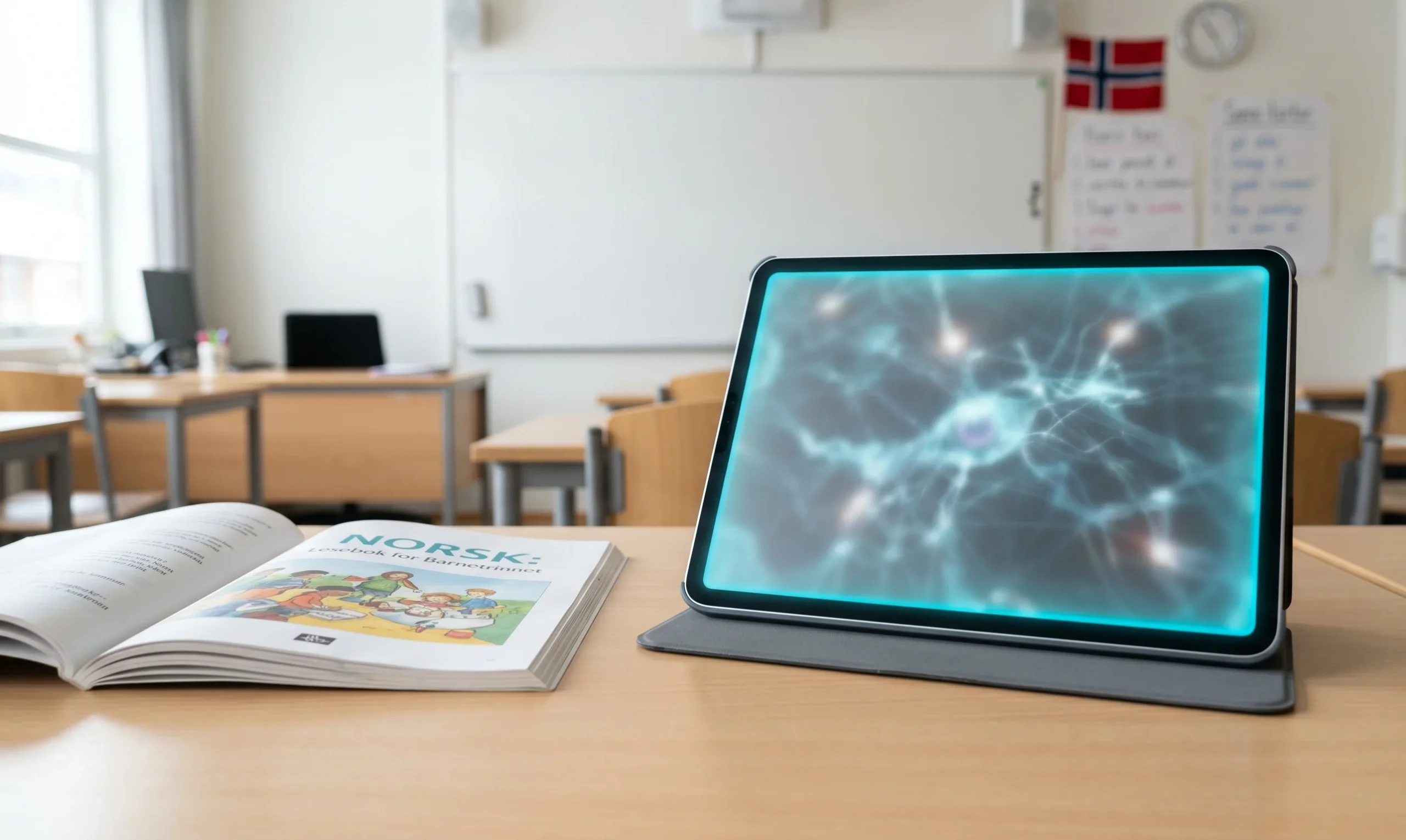
Norway has announced new national guidance for the use of generative artificial intelligence in schools. The strictest part of the policy applies to younger pupils: children in grades 1-7 should generally not be given access to generative AI tools for schoolwork. For grades 8-10, the approach is less absolute but still restrictive. Pupils may use these tools only gradually, with a clear educational purpose and under teacher supervision.
This should not be described as a total ban on AI in education. The official wording is more precise. In elementary school, pupils should in most cases not be given access to generative AI, but Norway’s education authorities are expected to consider possible exceptions, including cases where AI-based tools can support pupils with specific learning needs. That distinction matters because the policy is not aimed at removing all technology from schools. It is aimed at preventing premature and uncontrolled use of systems that can generate finished answers before pupils have built the basic skills needed to judge them.
The issue became public on 19 June 2026, when the Norwegian government published its announcement on the new recommendations. Reuters described the move as a near ban on AI in elementary school. That wording is more accurate than calling it a blanket prohibition, because it reflects the limited exceptions and the continued possibility of using AI as a teacher-managed tool rather than as a direct shortcut for younger pupils.
Why the government is acting now
The official rationale is the protection of basic learning. This is not only a debate about ChatGPT or any one chatbot. It is a broader question about what schools must guarantee before digital automation enters the classroom. Children need to learn to read, write, calculate, explain their reasoning, compare sources and solve problems without immediately outsourcing the task to a model. If generative AI appears too early, it can become a substitute for learning rather than a support for it.
That concern is strongest in the early years. Pupils in grades 1-7 are still developing literacy, handwriting, reading comprehension, basic mathematical logic and the habit of working through problems independently. A generative model can produce a polished paragraph, a summary, a plan or a solution, but the child may not understand how the result was produced. Norway’s approach therefore looks less like a rejection of technology and more like an attempt to separate two stages: first basic learning, then controlled digital competence.
Assessment is another reason for the restriction. If pupils use generative AI outside clear rules, teachers cannot reliably determine whether a piece of work reflects the pupil’s own ability. This affects homework, written assignments, creative projects and any task completed outside direct classroom supervision. For schools, that is not a small technical problem. It touches the credibility of grades and the fairness of assessment.
A wider return to printed textbooks
The AI restriction is part of a larger change in Norway’s education policy. The government is also pushing to secure access to physical textbooks in primary and lower secondary schools. The logic is straightforward: digital platforms can be useful, but they should not displace books, handwriting, sustained reading and focused work with stable learning materials.
Many education systems moved quickly toward digital resources over the past decade. That shift brought convenience, accessibility and flexibility. It also created risks: fragmented attention, dependence on commercial platforms, too much screen time, weaker control over the learning environment and difficulty separating study from distraction. Norway is now trying to rebalance those priorities rather than simply adding more technology because it is available.
A printed textbook in this context is not a nostalgic symbol. It has a practical function. It offers a stable learning environment without notifications, extra tabs, recommendation feeds or instant AI-generated answers. For younger pupils, that stability can be more valuable than the flexibility of a screen.
How the rules differ by age
The Norwegian guidance is based on an age-sensitive logic. The younger the pupil, the weaker the case for direct access to generative AI. The older the pupil, the more important it becomes to teach responsible use, limitations, source criticism and the difference between assistance and substitution.
This approach is more coherent than a universal ban. Completely blocking older students from AI would be unrealistic, since these tools are already entering universities, offices, software development, research workflows and media production. But allowing unrestricted use would be equally weak. The policy therefore emphasizes sequence: basic skills first, digital literacy second, responsible AI use third.
What earlier data showed
In January 2026, Norway’s Ministry of Education had already reported that AI use in schools was growing quickly. According to official figures, AI tools were being used in almost three out of four primary schools and in more than 90% of upper secondary schools. That means the new policy is not responding to a hypothetical risk. It is responding to a practice that had already spread through the education system.
The use of AI is not automatically harmful. The problem is uncontrolled and uneven use. One school may actively encourage pupils to use chatbots. Another may prohibit them. A third may have no clear policy at all. In such conditions, pupils, teachers and parents do not share the same expectations. National guidance is meant to reduce that inconsistency and set a baseline for responsible practice.
Key risks for learning
Generative AI creates several risks in a school setting. The first is substitution. A pupil can receive a text, outline, solution or explanation without doing the cognitive work. The second is error. Models can produce confident but incorrect answers, and younger children are often not equipped to detect those mistakes. The third is privacy. Schools must be careful about what child-related data enters external digital services.
There is also an equity issue. If some pupils have access to more capable AI tools at home while others do not, results may reflect unequal tool access rather than learning. Schools must either provide equal conditions or limit the tools where they undermine fair assessment. For younger pupils, restriction is often the simpler and safer option.
What this means beyond Norway
Norway’s decision is relevant beyond its own school system. It offers an example of a more pragmatic approach to AI in education. The key question is no longer whether AI belongs in schools at all. The better questions are more specific: at what age, for which tasks, under whose supervision, with what data protections and with what effect on basic skills.
For other countries, the lesson is clear. A school system can recognize the usefulness of AI while still limiting it for younger children. It can teach older students how to use generative tools critically without turning every writing task into a prompt-writing exercise. It can also slow down digital adoption when screens begin to weaken attention, reading stamina or assessment integrity.
Practical conclusion
Norway is not rejecting AI. It is trying to prevent generative models from doing the work that children must do themselves in order to learn. For elementary school, that means keeping direct pupil access highly limited. For older students, it means controlled introduction. For teachers, it means a new responsibility: not simply to approve or ban a tool, but to decide when it supports learning and when it replaces it.
The strongest part of the Norwegian approach is its age differentiation. Younger children should first learn to think, read, write and calculate without algorithmic assistance. Older pupils can use AI, but they need to understand its limits, its errors, its privacy risks and its impact on academic integrity. That is a restrained policy, but it is also a practical one for a school system facing real pressure from fast-moving technology.



0 Comments