
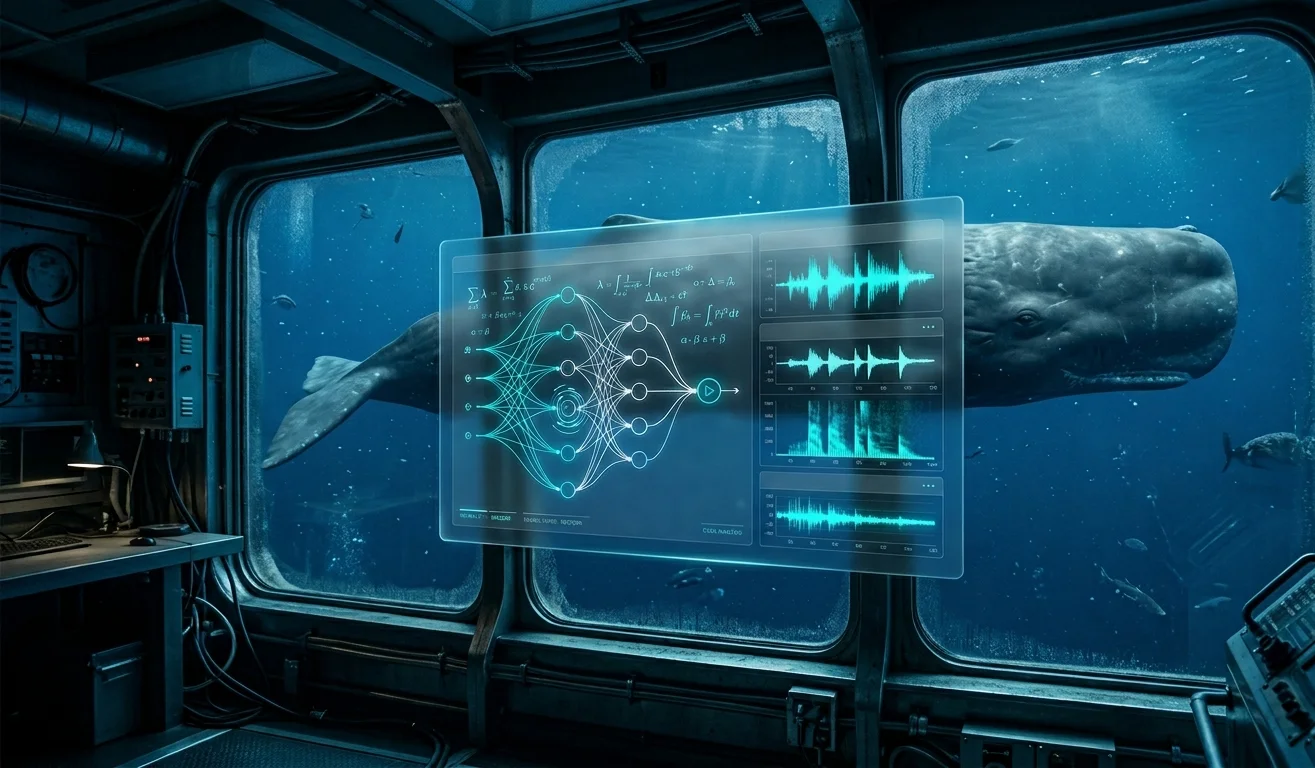
Discovery of the Sperm Whale Phonetic Alphabet
Animal communication research has reached a new level with the application of machine learning methods. The international Project CETI (Cetacean Translation Initiative), launched in 2020, has presented significant results in the analysis of acoustic signals of sperm whales (Physeter macrocephalus). Scientists, including experts from MIT, Harvard University, and other leading institutions, are using artificial intelligence to process large datasets of audio data in an attempt to identify structural patterns in the communication of these mammals.
Sperm whales communicate using series of short broadband clicks called “codas”. For a long time, these codas were considered relatively simple identification signals. However, the analysis of more than 8,700 recordings using deep learning algorithms revealed a complex combinatorial system. Researchers claim to have discovered a structure analogous to a phonetic alphabet, consisting of basic elements that can be combined in various ways.
Structural Elements of Communication
AI algorithms have helped to isolate three key characteristics that form the acoustic signals of sperm whales and likely carry semantic meaning:
- Tempo: Changes in the intervals between clicks within a single coda. AI detected patterns in the acceleration or deceleration of the tempo that correlate with specific behavioral patterns of the group.
- Rubato: Smooth variation in the duration of the entire coda. This element adds variability to standard signals, similar to intonation in human language.
- Ornamentation: The presence of additional clicks at the end of a coda. Researchers hypothesize that this may serve as a marker for the end of an utterance or an identifier of a specific individual.
The most significant discovery was the identification of acoustic structures that scientists compare to vowels and diphthongs (two vowels pronounced together). The recorded frequency modulations indicate that sperm whale codas are not discrete units but can smoothly transition into one another, creating complex semantic structures.
Technological Basis of Research
Project CETI relies on modern data collection and processing technologies. Stationary buoys and autonomous bio-loggers, attached to the back of sperm whales with harmless suction cups, are used to record acoustic signals. These loggers (weighing about 2.5 kg) not only record high-frequency audio but also capture depth, water temperature, and the animal’s movements in three dimensions.
The collected data is fed for analysis to neural networks whose architecture is based on Transformer models, similar to those used in modern Large Language Models (LLMs). This allows AI not only to classify sounds but also to detect contextual relationships between different codas within extended “dialogues”.
Context and Behavior Analysis
Recent publications by the research group indicate successes in correlating acoustic patterns with behavioral context. By analyzing data from bio-loggers and audio recordings, AI has learned to predict with high accuracy certain actions of a sperm whale group, such as the initiation of a cooperative hunt or synchronous surfacing, based solely on preceding acoustic signals.
Future of the Project and Challenges
Despite significant progress, scientists from Project CETI emphasize that it is too early to speak of a complete understanding of sperm whale language. The discovery of a phonetic structure is only the first step. The next stage involves compiling a “dictionary” and understanding syntax, which requires the analysis of even larger volumes of data and consideration of a wide range of ecological factors.
An important ethical aspect of the project is the principle of non-interference. Researchers use passive acoustic monitoring and self-releasing tags, minimizing stress to the animals. The ultimate goal of Project CETI is not to create a tool for training but to ensure a better understanding and conservation of these highly developed marine mammals in their natural habitat.




0 Comments