
A New Direction for Premium Vehicles from Ferrari and LoveFrom
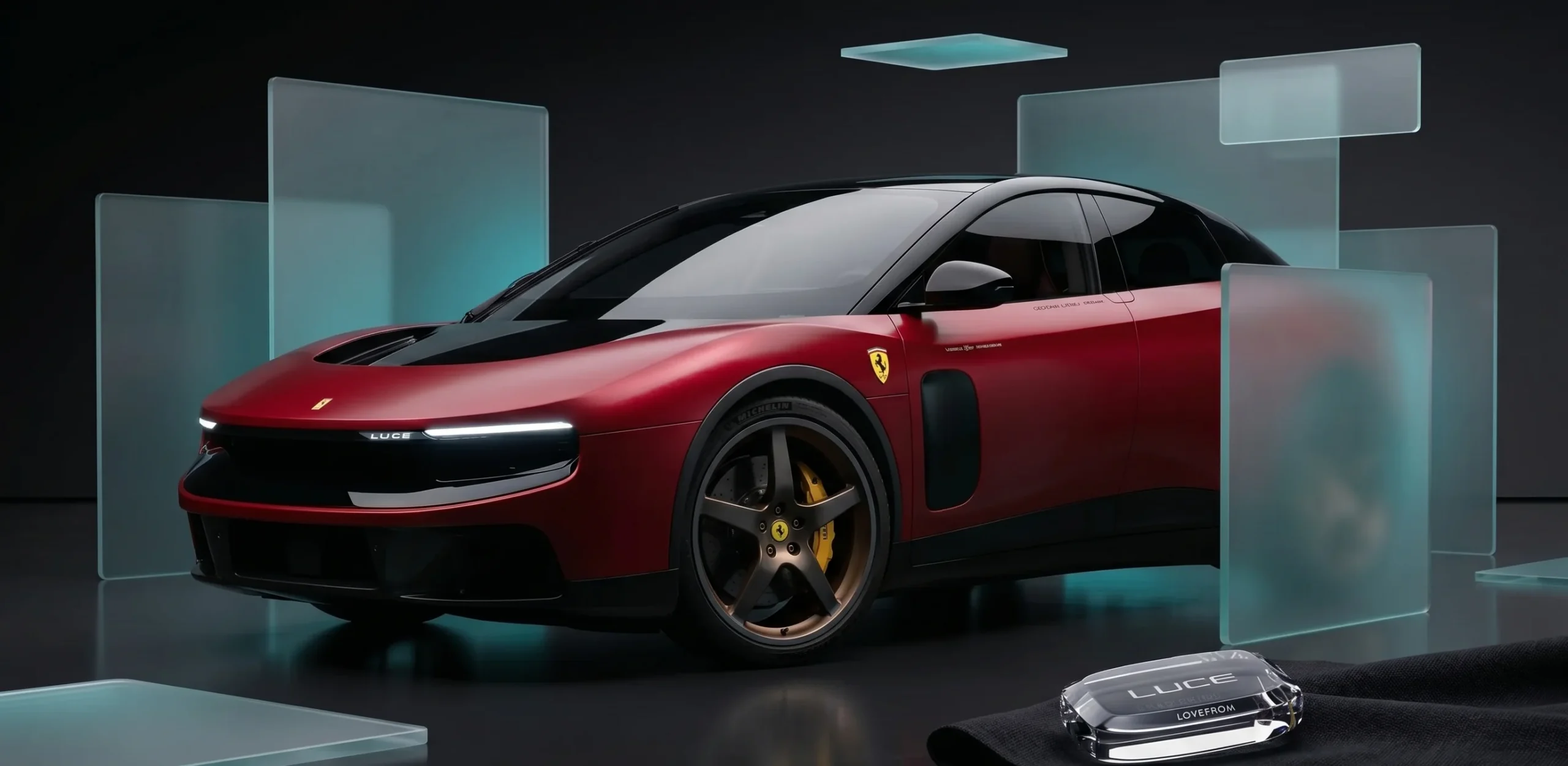
Italian sports car manufacturer Ferrari has disclosed details regarding the development of its all-electric supercar named Luce. The main highlight of the project is not just the transition to a new powertrain, but the involvement of the independent studio LoveFrom to create the visual code. This team is led by former Apple Chief Design Officer Jony Ive and acclaimed industrial designer Marc Newson. The result of their three-year joint collaboration is a radical reimagining of classic sports car proportions for adaptation to new engineering solutions.
The Ferrari Luce departs from the brand’s traditional visual language. Instead of aggressive body lines and massive air intakes, the developers utilized a monolithic silhouette with smooth surface transitions. The car received a four-door body style unconventional for track models, featuring a full five-seat cabin layout. Special attention is drawn to the integration of the rear doors, which open against the direction of travel. This engineering solution allowed removing the central B-pillar, simplifying access to the passenger space and shifting the focus toward comfort during long-distance journeys.
The Philosophy of Reduction in Body Construction
Jony Ive’s influence is evident in every single detail of the Ferrari Luce exterior. The method of radical reduction of form, which the designer previously used in consumer electronics, has been applied here to large body panels. The vehicle surfaces appear seamless due to the minimization of joints. Conventional door handles are completely absent. Their function is performed by touch-sensitive zones integrated into the side pillars. They react to the owner’s approach via wireless sensors. Even the brand’s iconic logo is now integrated into the front bumper using laser milling, eliminating separate overlay elements.
Maintaining high aerodynamic efficiency with such a clean form required the development of new solutions. Instead of installing massive spoilers, engineers implemented an active aerodynamic system hidden within the underbody and rear diffuser. Airflows pass through internal channels under the hood and exit at the rear, reducing the drag coefficient. The body panels are manufactured using an innovative alloy based on recycled aluminum and carbon fiber. This allowed reducing the overall weight of the vehicle and offsetting the mass of the heavy battery pack.
Interior Concept and the Return to Physical Controls
Significant shifts occurred in the organization of the electric vehicle’s interior space. Contrary to the modern trend of installing large touchscreens that occupy the entire dashboard, the developers of the Ferrari Luce applied a different approach. The center of the interface is a compact 10.2-inch display. It is equipped with a pivoting mechanism and can completely slide inside the front panel when not needed. When the screen is retracted, the driver sees only minimalist instrument dials, helping to focus on the road during high-speed driving.
Control of primary vehicle functions has been transferred to physical switches. All toggles, rotary controllers, and climate control levers are crafted from anodized aerospace-grade aluminum. Every movement of a controller is accompanied by a crisp mechanical click, providing tactile feedback. This solution aims to bring back the physical control that is gradually disappearing due to the mass introduction of touch panels. Even the steering wheel has retained its classic round shape and has no built-in touchpads. Two analog joysticks are used to alter driving parameters.
Sustainable Materials and Platform Engineering Features
Great attention during the design process was paid to sustainable manufacturing and the use of recyclable materials. Glossy plastic is completely absent from the Ferrari Luce interior. The textile elements of the seats are created from a material based on ocean waste and recycled materials, which does not yield to traditional fabrics in durability. The leather for finishing console elements undergoes exclusively vegetable tanning without the use of heavy metal compounds. All metal components inside the cabin are engineered to be easily dismantled and recycled after the vehicle’s lifecycle ends.
The technical part of the vehicle was developed taking into account the experience of the brand’s racing division. The battery pack is integrated directly into the structural chassis cage. This allowed obtaining a low center of gravity and optimizing the weight distribution across the axles at a 49 to 51 percent ratio. The electric car is driven by four independent electric motors located on each wheel. This solution ensures the operation of the torque vectoring system in real time. The system automatically redistributes torque, allowing the vehicle to maintain a stable trajectory when cornering.
Project Impact on the Premium Automotive Segment
The announcement of the Ferrari Luce project triggered debates among automotive industry experts and collectors. Some fans of classic models criticize the company for abandoning internal combustion engines and the signature exhaust system sound. However, the manufacturer’s management notes that the Luce does not replace the existing line of track models, but opens a new direction of development in the luxury electric vehicle segment aimed at comfortable daily use.
The joint work with the LoveFrom team demonstrated the possibility of creating a technological vehicle without turning it into a soulless digital gadget. The return to mechanical control elements, attention to natural textures, and geometry of forms shape a new approach to ergonomics. It is expected that the solutions applied in the Ferrari Luce will become a benchmark for other premium transport manufacturers. The project shows that the high cost of a vehicle is now determined not by the number of monitors, but by the design quality of details and the sophistication of human-machine interaction.


0 Comments