
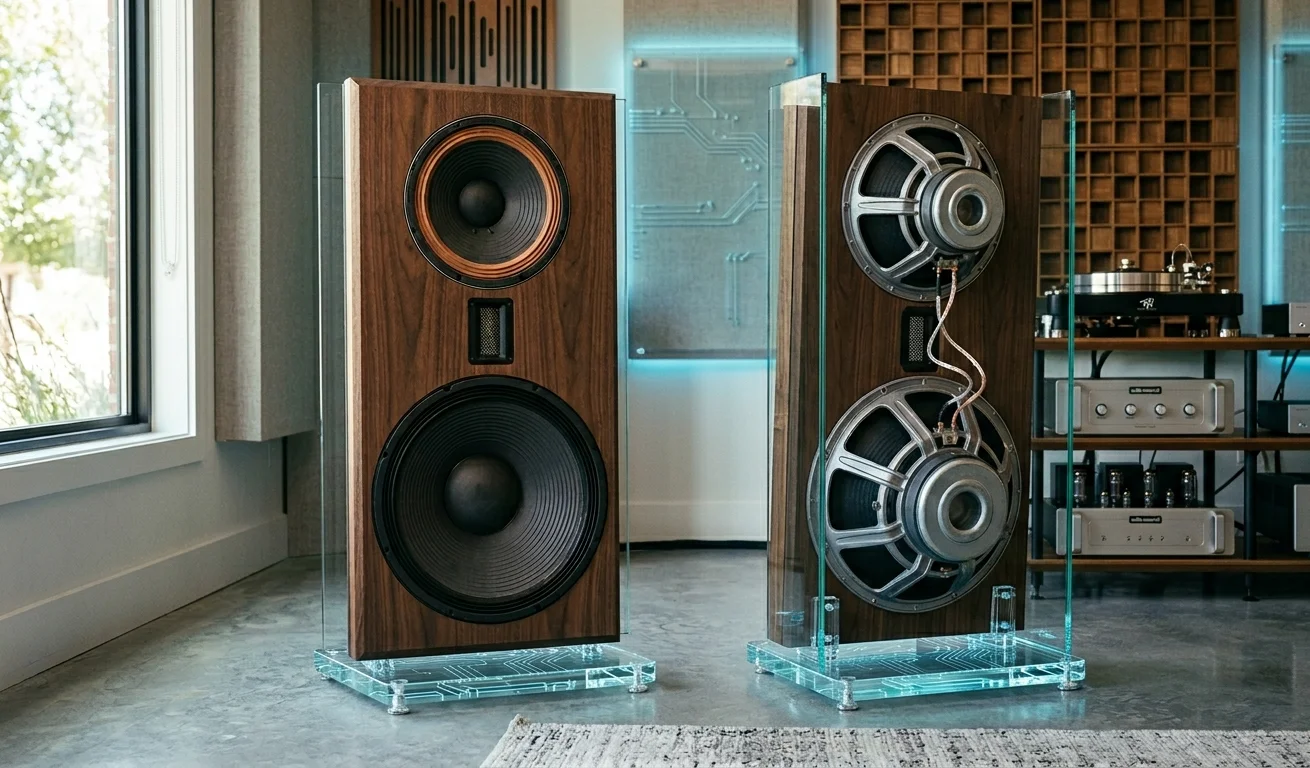
The Nature of Sound Without Cabinet Constraints
Traditional loudspeaker designs rely on sealed or ported enclosures to isolate the rear wave of the driver. However, the Open Baffle concept operates on a fundamentally different principle. The driver is mounted on a flat panel with no side or rear walls, allowing the sound wave to radiate freely both forward and backward. This creates a unique figure-eight radiation pattern, also known as a dipole response.
The primary advantage of this approach is the total elimination of box-induced resonances. In conventional speakers, the internal air volume acts as a spring, which can color the sound and create standing waves within the enclosure. An open construction is entirely free from these issues, ensuring high transient speed and tonal naturalness, particularly in the critical midrange frequencies.
Physics of Dipole Radiation and Acoustic Cancellation
The main challenge in Open Baffle design is the phenomenon of acoustic cancellation. Since the front and rear waves are out of phase, they tend to cancel each other out at low frequencies. The efficiency of bass reproduction depends on the physical size of the baffle: the wider the panel, the lower the roll-off frequency where the amplitude begins to drop.
To compensate for this effect, engineers select drivers with a high total quality factor (Qts), typically ranging from 0.7 to 1.2. This allows for a natural boost at the resonance frequency, flattening the overall frequency response without requiring complex electronic equalization. Often, arrays of large woofers (15 to 18 inches) are used to move enough air and generate the necessary sound pressure levels.
Room Interaction and Placement Strategy
Open baffle acoustics are highly sensitive to their distance from the rear wall. Optimal performance is usually achieved when placed at least 3 to 5 feet away from boundaries. The rear wave reflected from the wall arrives with a slight delay, creating a sense of scale and airiness that is difficult to replicate with traditional monitors. However, an untreated room with excessive reverb can lead to a loss of clarity, so acoustic panels or diffusers are often recommended behind the speakers.
The baffle material itself also plays a significant role. Common choices include solid wood, birch plywood, MDF, or even acrylic. Each material has its own damping characteristics that affect micro-dynamics. Heavy and inert baffles help minimize vibrations transmitted from the driver frame to the panel surface, preserving detail and preventing unwanted coloration of the sound.
Component Selection for Open Baffle Builds
Building a successful Open Baffle system requires more than just any driver. The best results are often achieved with full-range drivers featuring light paper cones and powerful magnets. These provide seamless reproduction of the critical 200 Hz to 10 kHz range. High-frequency transducers (tweeters) are also frequently configured as dipoles to maintain the radiation characteristics of the main band.
- High Qts drivers (0.7+)
- Large diameter paper cones for LF
- Minimalist first-order crossovers
- Heavy-duty stands for structural stability
In modern high-end installations, active crossovers using DSP (Digital Signal Processing) are increasingly common. This allows for precise correction of the low-frequency roll-off, taking the specific room acoustics into account, and perfectly aligning the phase between drivers. Such an approach makes Open Baffle a more versatile solution, suitable not only for jazz or vocals but also for more dynamic genres where bass texture and impact are vital.




0 Comments