
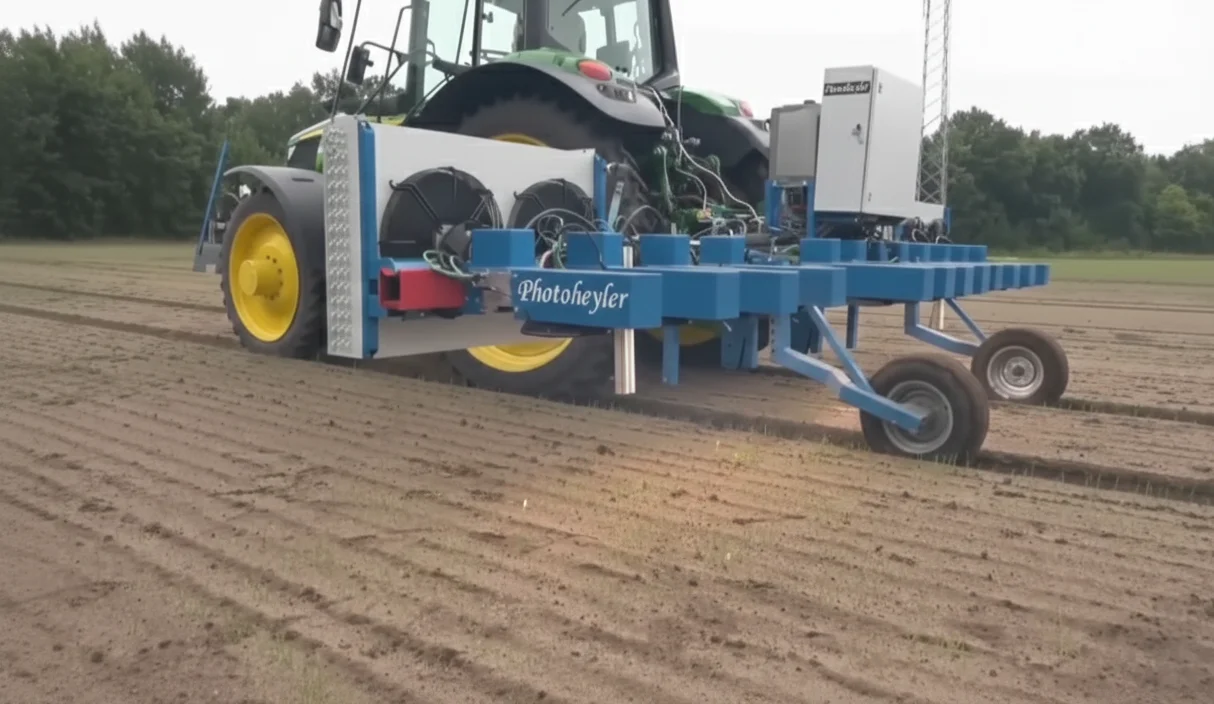
Learn how laser weeding and AI are replacing herbicides. Revolutionary German technologies for farmers: from laser tractors to crop sorting.
Lasers Instead of Chemicals: A New Era of Weed Control
Agriculture is on the brink of a massive transformation. Traditional methods of pest control, which for decades relied on chemical herbicides, are gradually becoming a thing of the past. They are being replaced by high-tech solutions, where AI and concentrated light energy play a key role. Using lasers to kill weeds is no longer science fiction, but a real practice being implemented in fields across Europe and the United States.
Laser Evaporation Technology: How It Works
The method uses high-power laser beams that precisely target weeds. Unlike mechanical weeding, lasers do not disturb the soil structure, and unlike chemicals, they leave no toxic residue. When the beam hits a plant’s growth point, it causes deep thermal burns to the tissue in a matter of seconds, resulting in the immediate death of the pest.
- Optical power of the system: modern installations produce about 24 kW of total power.
- Individual power of emitters Each laser module has a power of 2 kW.
- Reaction speed: the impulse lasts for milliseconds, which allows operation while the tractor is moving.
- Accuracy: deviation is no more than a few millimeters.
AI as the intellectual center of the system
Laser power alone is worthless without ultra-precise targeting. This is where AI comes into play. Software developed by leading experts utilizes sophisticated computer vision algorithms. A camera system, mounted under the machine’s body, scans the field surface in real time.
Thanks to trained neural networks, the system can recognize agricultural crops, such as onions or carrots, and distinguish them from hundreds of weed species. The program takes into account each plant’s growth stage, leaf shape, and even lighting conditions. This allows the laser to focus exclusively on the target without damaging the crops. The technology processes millions of bits of data every second, making it a true revolution in agronomy.
Economics and benefits for farmers
Implementing innovations requires significant investment, but the payback is rapid. The main advantage is the complete elimination of expensive manual labor and pesticide purchases. In regions where the cost of hired labor is constantly rising, automation is becoming the only way for businesses to survive and increase profitability.
- Savings on chemicals: herbicide costs are reduced to zero.
- Eco-friendliness: products are given organic status, which increases their market price.
- 24/7 operation: Autonomous platforms can operate day and night using satellite navigation.
Crop sorting with AI
AI’s capabilities aren’t limited to the field. The technology is successfully used in post-harvest processing facilities. For example, specialized potato sorting machines demonstrate remarkable efficiency. Using similar recognition algorithms, they instantly identify rotten fruit, stones, and clods of soil among otherwise healthy crops.
The capacity of such a sorting line allows it to process 40 tons of product per hour. This is equivalent to the work of four experienced workers, but at a much higher speed and with consistent quality. Such systems cost thousands of dollars, but for large-volume production, they are becoming a new standard of quality.
The Future of Agricultural Technologies
The journey from a garage prototype to large-scale production demonstrates that the market is ready for radical change. Although AI- and laser-based systems are still in the early stages of global adoption, their potential is undeniable. The use of clean energy and intelligent systems makes agriculture not only more profitable but also safer for the planet. In the coming years, we’ll see even more solutions where AI takes the heavy lifting, leaving farmers in the role of strategic managers.



0 Comments