
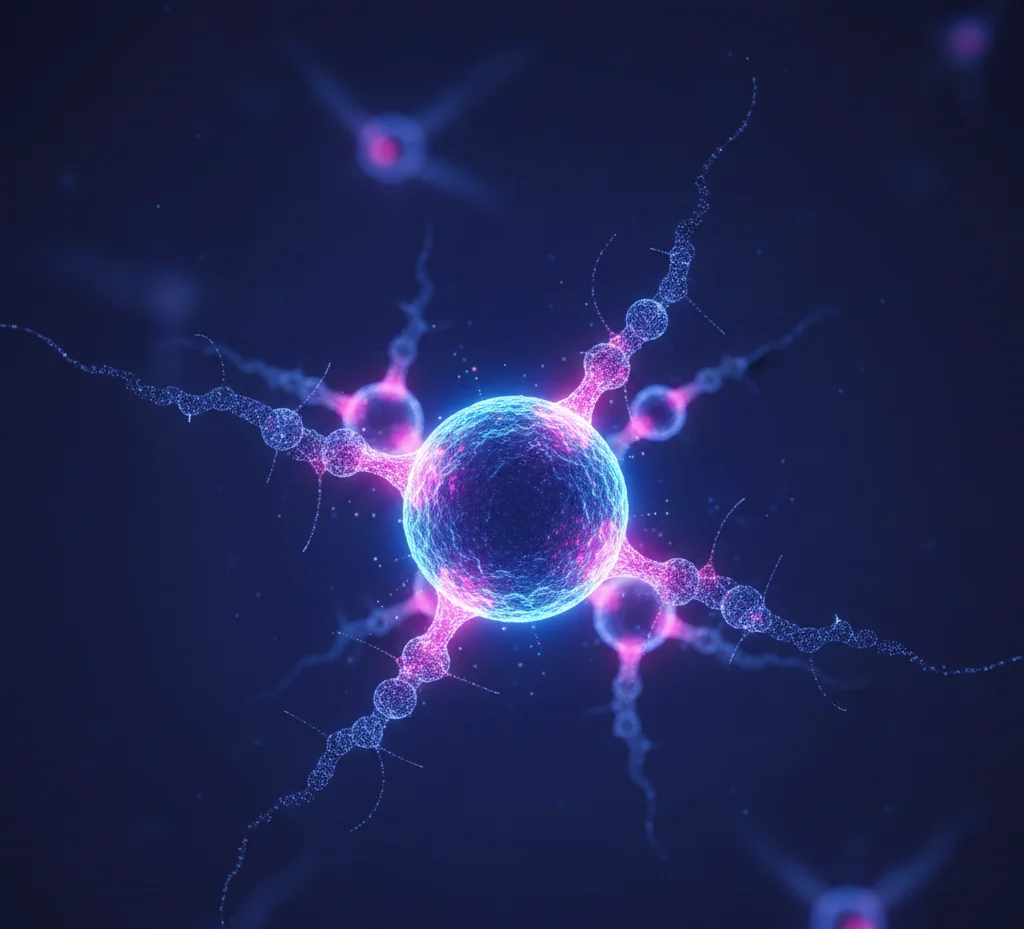
Learn about a breakthrough in the world of LEDs: the use of lanthanides in non-conductive nanoparticles. Overcoming barriers, advantages over OLEDs, and the future of the technology.
A New Era of LEDs: Lanthanides Change the Rules of the Electronics Game
LED technology has come a long way from dim indicator lights to vibrant 4K screens. However, modern OLED and Quantum Dot displays have limitations, ranging from organic compound fading to the difficulty of rendering pure colors in non-visible spectra. A recent breakthrough by an international team of scientists has opened the door to an entirely new class of emitters-lanthanide-activated nanoparticles. This technology enables the use of materials previously considered unsuitable for electronics due to their non-conductivity.
Why couldn’t scientists harness the lanthanides for years?
The main challenge lay in the physical nature of the materials. Lanthanides (rare earth elements) have unique optical properties: they emit a very narrow, pure light and do not “flicker.” However, they thrive inside insulators-crystals that do not produce electrical current. To create an LED, you need to pass a current through the material, but electrons simply cannot move in a non-conducting matrix.
- High energy barrier: Insulating matrices have a band gap of about 8 eV, making charge injection almost impossible.
- Weak absorption: The lanthanide ions themselves are poor absorbers of energy directly, requiring enormous amounts of power to excite them.
- Stability problem: Attempts to make particles guides often destroyed their unique light properties.
The solution has been found: molecular antennas
Rather than combat the crystal’s nonconductivity, the scientists decided to create a workaround. They surrounded nonconducting nanoparticles with specialized organic molecules that act as antennas. These antennas capture electrical energy and transfer it to the lanthanide ions inside via a process called “triplet energy transfer.” This allows the nanoparticle to glow while remaining a perfect insulator. The energy transfer efficiency in such systems exceeds 98%, a remarkable figure for nanoscale objects.
Advantages over modern LED and OLED
This new technology has the potential to completely replace traditional solutions in specific niches, and then in mass production. The main difference is the purity of the spectrum. Modern LEDs often have a broadband emission, which leads to “polluted” colors. Lanthanides, on the other hand, produce perfectly clear colors.
- No degradation: Unlike OLEDs, lanthanide LEDs do not fade over time. Their lifespan is measured in decades.
- Infrared imaging: This is critical for medicine. NIR-II light penetrates skin and tissue to a depth of several centimeters, allowing tumors and blood vessels to be visualized without surgical intervention.
- Energy efficiency: The new excitation circuit operates at low voltage, which significantly saves battery power in gadgets.
Disadvantages and challenges of implementation
Despite success in laboratories, the technology still needs to be commercialized. The main drawback is cost. Rare earth elements are expensive, and the synthesis of complex core-shell structures requires precision equipment.
- Scalability Difficulty: Producing millions of nanometer-scale structures with identical characteristics is a complex engineering challenge.
- Toxicity of Excipients: Although lanthanides themselves are safer than cadmium, organic antennas require careful testing for environmental friendliness.
Applications: from smartphones to biomedicine
In the near future, we may see the use of lanthanide LEDs in secure communications and medical scanners. Thanks to their infrared capabilities, these devices will become the basis for non-invasive glucometers and health monitoring systems. In the entertainment industry, this will enable the creation of displays with color depths previously only available to professional equipment costing thousands of dollars. The market for such components is valued in the billions of dollars, and investor interest is only growing.
The development of AI and nanotechnology
The integration of AI into the development of new materials has accelerated this breakthrough. Modeling the interaction of triplet excitons with a crystal surface allowed scientists to immediately find the optimal molecular structure of the “antenna,” rather than manually sorting through thousands of options. This demonstrates that the future of electronics lies at the intersection of rigid-state physics, chemistry, and computing power.




0 Comments