
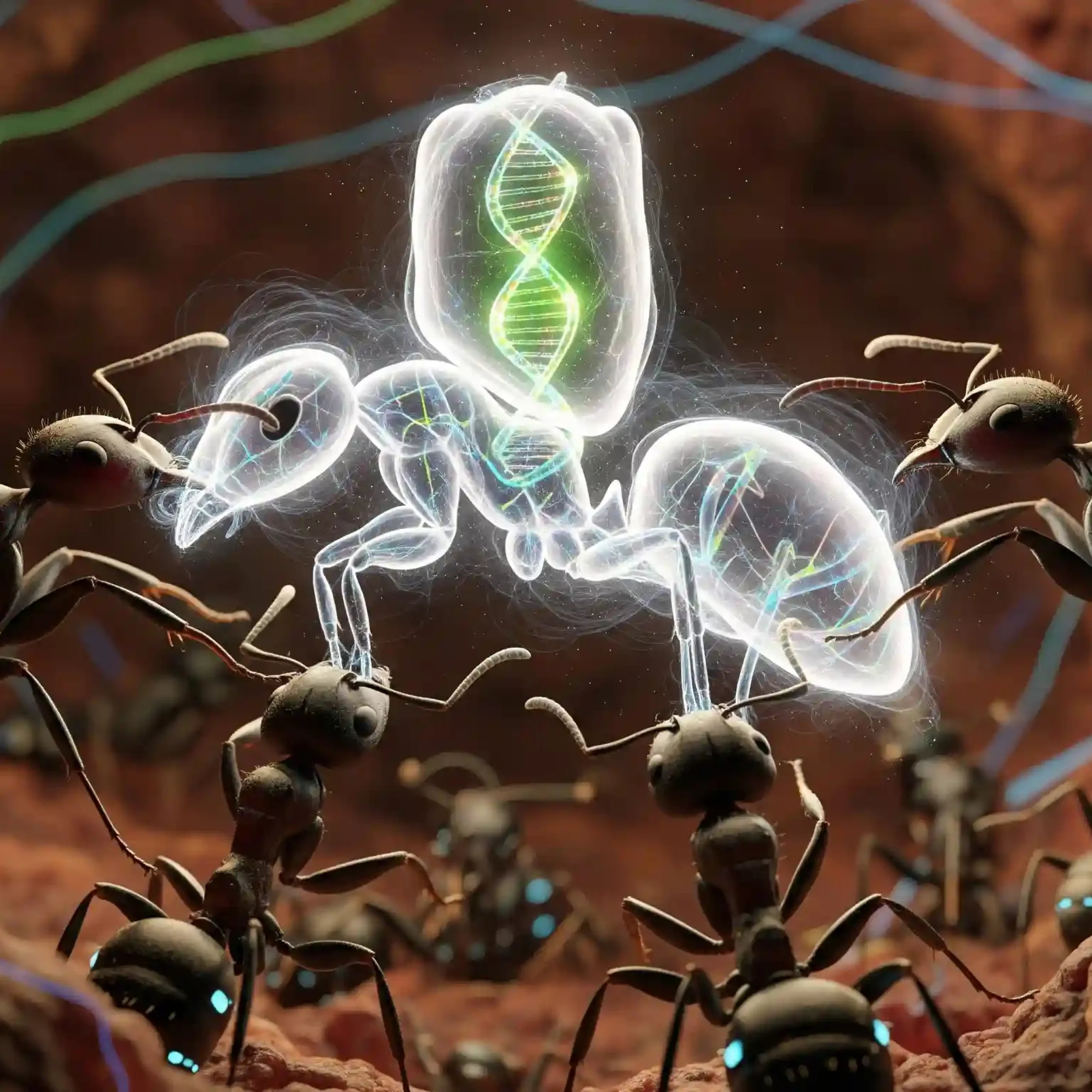
The world of ants has long fascinated scientists with their remarkable social organization and complex behavior. However, a recent discovery challenges all known notions of biological norms. Scientists have discovered a rare species of ant whose queens not only invade other ant nests but also force local worker ants to reproduce asexually in order to clone new queens of their own species. This phenomenon can be described as an “evil” of biology, changing our understanding of ant social parasitism and evolutionary survival strategies.
The complex world of ant parasitism
In the insect world, ant parasitism is quite common. Some ant species, called social parasites, invade the nests of other species, kill their queen, and force the worker ants to raise their own offspring. However, in most cases, these offspring are produced sexually. The discovery of a new mechanism for ant cloning opens a completely new field of entomology. In this case, parasites not only exploit the labor of others but also appropriate their biological processes for their own purposes.
System Breakdown: How Does Cloning Happen?
At the center of this strange phenomenon are two species of ants: the parasite Pheidole sp. and its prey, the fungus ant Mycocepurus smithii. The latter is known for its unique ability to reproduce asexually, or parthenogenesis. This means that worker ants are capable of laying eggs, which develop into exact genetic copies of themselves. This process is typically used to raise new workers for the colony.
However, when parasitic queens infiltrate a Mycocepurus smithii nest, they kill the host queen and begin using the workers to raise their own offspring. Most surprisingly, the host ants, instead of simply raising parasitic larvae, begin laying eggs containing the parasitic queen’s genetic material. Thus, the cloned workers raise new parasitic queens that are exact genetic copies of their invader.
This phenomenon is extremely rare and complex. It goes beyond the usual social parasitism and demonstrates that some species can develop mechanisms to “hack” the reproductive systems of others. It’s a striking example of how evolution finds new, unpredictable ways to survive.
Biology Without Rules: The Scientific Significance of Discovery
The discovery of this phenomenon is of enormous significance for biological research and entomology. It confirms that nature is far more complex than we can imagine, and that mechanisms exist that seem improbable from the perspective of traditional biology. This unique case of parthenogenesis in insects demonstrates how one species can not simply parasitize on the resources of another, but utilize its biological functions to reproduce its own species.
Research into this phenomenon could provide new insights into how genes responsible for reproduction function and how they can be manipulated. This could pave the way for a deeper understanding of the evolution of parasitism and how the unique behavior of ants shapes complex ecosystems. This discovery confirms that evolution has no clear rules, only a continuous search for effective survival strategies.
Conclusion: Lessons from the Ant World
The discovery of this phenomenon, where ants defied biological laws to clone alien queens, reminds us of the power of adaptation in nature. This isn’t just a scientific curiosity, but a lesson for us all. It demonstrates that the most unexpected tools can be used to achieve goals. The parasitic ants couldn’t reproduce in the usual way, so they invented a new one.
This case once again proves that we still know very little about the world around us. Every day brings new, sensational discoveries, forcing us to rethink existing paradigms. The cloning of ant queens is a striking example of how the unique behavior of ants can surprise. Perhaps this discovery will be the key to understanding other, as yet unknown mechanisms in nature and will help us understand how life can adapt to any conditions.
Key facts:
- Cloning: Worker ants clone parasitic queens through parthenogenesis.
- Hypermanipulation This is a rare case where one species uses the reproductive system of another.
- Asexual reproduction: The ant species Mycocepurus smithii, which is capable of asexual reproduction, is used.
- Social parasitism The parasite Pheidole sp. enters the nest and kills the host queen.
- Scientific significance: The discovery has significant implications for biological research and understanding of evolution.


0 Comments