
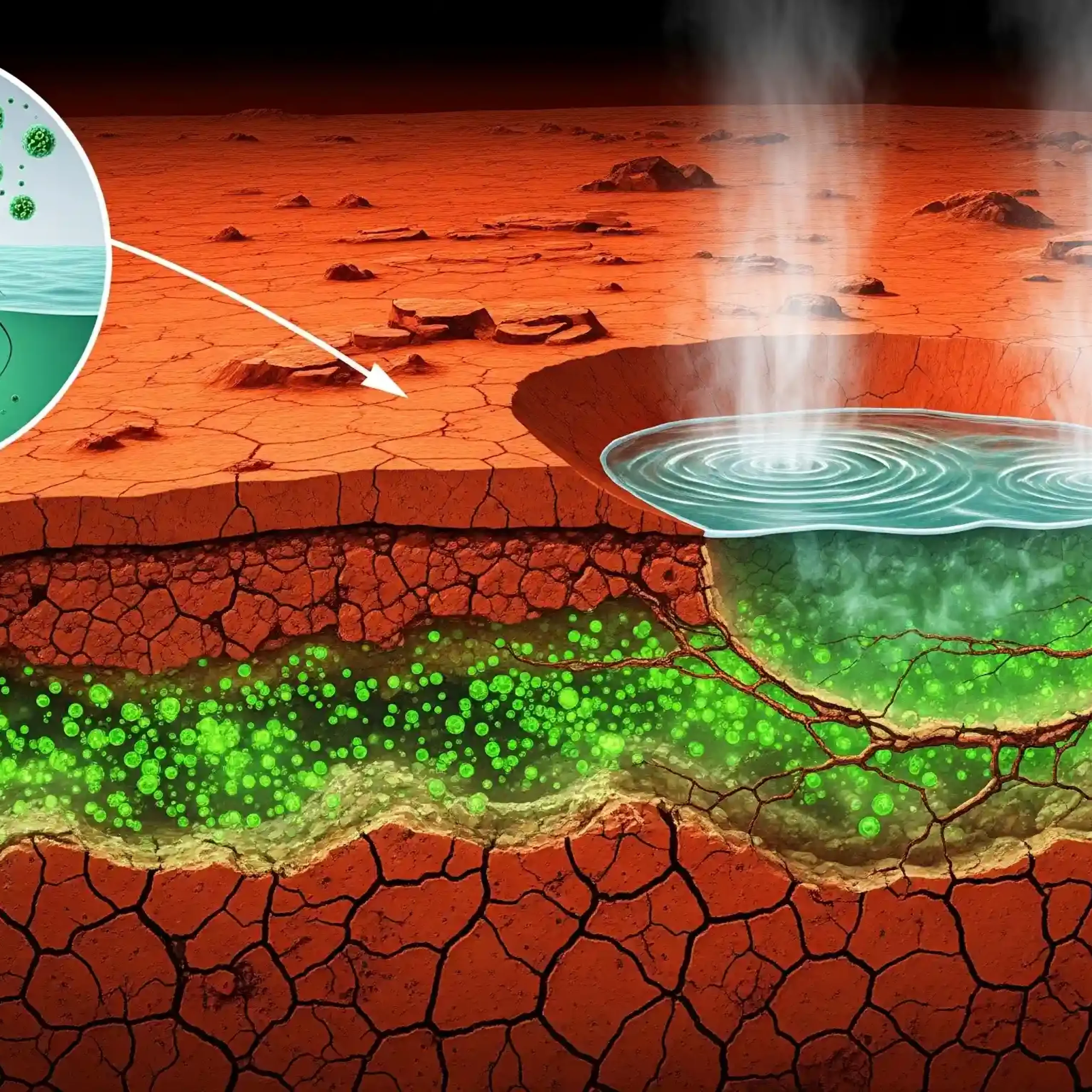
People’s imaginations of Mars are often shaped by science fiction. The Red Planet is portrayed as a harsh but colonizable world, where the main challenges are extreme cold, low pressure, and cosmic radiation. These barriers to life on Mars are real, but reality has proven far more complex. Recent scientific studies of Mars have revealed that the most insidious threat lurks right under the feet of future colonists, in the soil itself. This problem is so serious that it could completely ruin many plans for settling the planet.
The Real Enemy: Mars’ Toxic Soil
For a long time, it was believed that Martian soil was simply inert dust that simply needed to be moistened to become suitable for growing plants. However, NASA and other space agencies, through their robotic missions, discovered that the soil’s composition was far more hazardous. It turned out that the Martian surface contains high concentrations of chemical compounds toxic to most organisms.
These toxic substances represent the main, yet little-known, barrier to life on Mars. They are capable of harming both potential microbes and any terrestrial organisms introduced to the planet. This discovery has forced scientists to reconsider their understanding of the possibility of life on Mars and adjust plans for future manned missions.
A chemical bomb underfoot: what are perchlorates?
The primary cause of the toxicity of Martian soil is the presence of perchlorates (ClO_4^-). These are salts of chloric acid, which in high concentrations are extremely dangerous to living organisms. Their presence on Mars was confirmed by data obtained from the Phoenix and Curiosity rovers. When perchlorates are heated, they become even more dangerous, releasing toxic gases such as chlorine.
Moreover, perchlorates on Mars are more than just a passive poison. Under the influence of intense ultraviolet radiation, which easily penetrates the planet’s thin atmosphere, these compounds can decompose, forming highly reactive radicals. These substances destroy organic molecules and cells, rendering the Red Planet’s surface sterile. Therefore, Mars exploration must consider not only physical but also chemical barriers.
Temperature, pressure and water: additional barriers
Even if Mars’ toxic soil is neutralized, that’s only the beginning. Popular science fiction often understates the complexity of other factors. The average temperature on Mars is approximately -63°C, but it can range from -140°C in winter to +20°C in summer near the equator. Such extreme fluctuations are detrimental to most known life forms.
The second, no less important problem is pressure. Atmospheric pressure on the surface of Mars is only about 1% of Earth’s. Under such conditions, liquid water cannot exist stably: it would either freeze instantly or begin to boil at temperatures above 0°C. This physical barrier makes the presence of liquid water on the planet’s surface, which is critical for life, virtually impossible.
Furthermore, the water found on Mars isn’t pure H2O. It contains large amounts of dissolved salts, including perchlorates, making it unsuitable for biological processes. Scientists use the concept of water activity, which measures the amount of free water available for chemical reactions. On Mars, this value is very low. This means that although ice exists on the planet, it is completely inaccessible to microbes and plants and is toxic.
How to live on a toxic planet?
The discovery of perchlorates and other extreme conditions poses serious challenges for the future colonization of Mars. First, any construction of habitable modules and infrastructure will require a complex soil decontamination process. Second, growing life-sustaining plants will be impossible without prior purification, which will require significant resources and energy.
Scientists are exploring various solutions to this problem. One is the development of biological decontamination methods, such as bacteria capable of breaking down perchlorates. Another option is developing technologies that would allow the soil to be used without purification, possibly using hydroponic systems. Regardless, this previously unknown threat has forced scientists to reconsider their approaches to Mars exploration. Unlike radiation issues, which can be addressed with protective shields, combating toxic soil will require comprehensive and innovative solutions.
Key challenges that science fiction ignores:
- Toxic Soil: High concentrations of perchlorates make the Martian surface poisonous to most organisms.
- Chemical reactivity: When exposed to ultraviolet light, perchlorates decompose, forming aggressive chemical compounds.
- Low pressure: Water cannot exist in a liquid state, making life impossible on Mars.
- Poisonous Water: The water available on Mars is salty and contains toxic compounds, making it unsuitable for use.
- Temperature fluctuations: Extreme cold and sudden temperature changes are lethal to most species.
- Terraforming Challenge: Cleaning up billions of tons of soil is a massive undertaking that will require significant resources.

0 Comments