
- A Chocolate Egg with a Criminal Past and Present
- An Import Regulation Law from the Great Gatsby Era
- Consumer Safety Psychology and the Choking Hazard Concept
- Financial Sanctions and Real Cases at the Border
- A Commercial Compromise in the Form of Kinder Joy
- Other Gastronomic Taboos on the American Market
A Chocolate Egg with a Criminal Past and Present
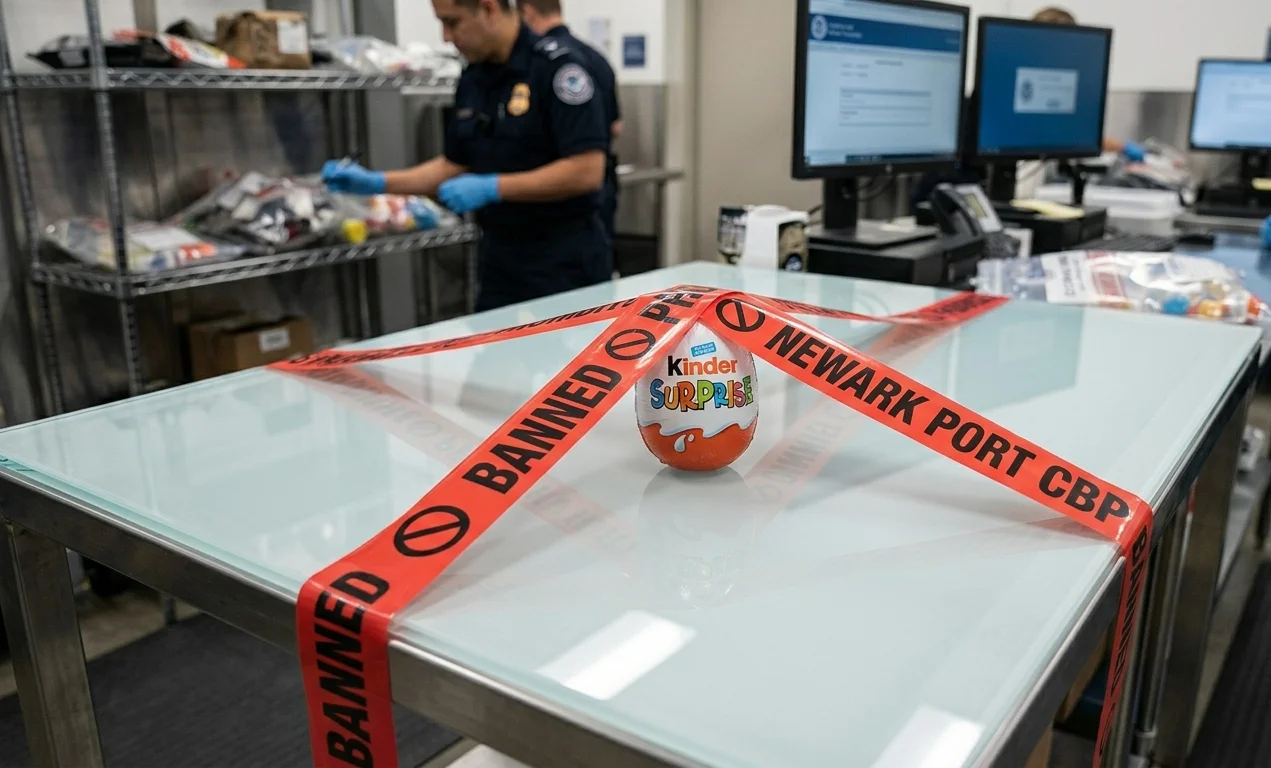
For a European consumer or a resident of the post-Soviet space, buying a confectionery product with a toy inside is a completely ordinary everyday occurrence. However, crossing the United States border with a classic Kinder Surprise in your luggage instantly turns a traveler into a lawbreaker. The US Customs and Border Protection (CBP) seizes tens of thousands of these items at checkpoints every year, classifying them as illegal products for import. A simple souvenir for children can turn into hours of detention, a meticulous interrogation, and confiscation of property.
The scale of the fight against chocolate eggs at the American border looks absurd only at first glance. Official reports from regulatory authorities indicate that seizures of Ferrero confectionery products are recorded both at major aviation hubs and at automotive checkpoints. Travelers trying to bring a batch of sweets for relatives face the full spectrum of strict federal regulation, where each individual egg is considered an independent unit of contraband with corresponding financial consequences.
An Import Regulation Law from the Great Gatsby Era
The root of the Kinder Surprise ban lies not in the biased attitude of the American government toward the Italian confectionery giant Ferrero, but in a strict historical document. The main legal instrument in this case is the Federal Food, Drug, and Cosmetic Act (FD&CA), passed by the US Congress back on June 25, 1938. This normative act was created during the Great Depression era to radically cleanse the market of dangerous adulterated goods, poisonous cosmetics, and low-quality food, which at that time led to mass fatalities among the population.
Section 402(d) of the law attracts special attention, as it clearly regulates confectionery products. According to this clause, any sweet product is considered unfit for consumption and is automatically banned if it contains non-nutritive elements embedded directly inside the food. The only exceptions are cases where this non-nutritive item has practical value for the product itself (like a wooden stick in ice cream) and does not pose a health hazard. Since the plastic capsule with a toy inside the chocolate shell performs no technological function for preserving the sweets, Kinder Surprise directly falls under this rule.
The 1938 law has been in effect without significant changes for almost a century due to the conservatism of the American legal system. The US government takes the position that allowing the import of one such product would create a legal precedent that would allow other manufacturers to hide any foreign objects inside food products, completely destroying the consumer safety control system.
Consumer Safety Psychology and the Choking Hazard Concept
The American model of consumer protection is based on the absolute minimization of potential risks. The central concept in the regulation of children’s goods is the choking hazard. The US Consumer Product Safety Commission (CPSC) conducts regular research and imposes extremely strict requirements on the dimensions of items that can fall into the hands of a child. The problem with the European version of the chocolate egg is that the dangerous object is hidden from direct visual inspection.
The technological structure of the classic Ferrero product dictates that a child bites off a piece of chocolate without seeing what is inside. American safety experts argue that a young child might not chew but reflexively swallow a piece along with part of the plastic container or a small toy part, leading to an airway obstruction. Ferrero’s attempts to adapt instructions and labeling for the European market, indicating an age restriction (for children from 3 years old), did not convince US regulators from the FDA, since the labeling on the wrapper does not eliminate the physical risk inside the product itself.
Financial Sanctions and Real Cases at the Border
Violation of US federal law entails strict administrative sanctions. According to current customs regulations, the illegal import of prohibited confectionery products is punishable by a monetary fine. The official fine can be up to 2500 dollars for each detected chocolate egg. In practice, the amount depends on the customs officer’s classification of the offense (intentional commercial import or accidental household introduction), but even the minimal financial losses are substantial.
The history of US customs has recorded hundreds of high-profile cases where ordinary citizens became victims of this law. In 2011, a Canadian traveler, Lindsee Wilson, was detained at the automobile border between Canada and the US in Minnesota because an individual chocolate egg worth less than two dollars was found in her car. Customs officials confiscated the product, filed an official report, and warned the woman that a repeated attempt would lead to an automatic 2500 dollar fine and visa revocation. Another famous case involved two men from Utah returning from Canada with six Kinder Surprise eggs for their families. They spent over two hours at customs control, and the seized contraband was destroyed in a special chamber under the supervision of officers.
A Commercial Compromise in the Form of Kinder Joy
The capitalization of the American confectionery market is too large for international business to ignore. Ferrero spent decades trying to find a legal way to bypass the restrictions of the 1938 law without changing the global concept of the brand. The result of lengthy engineering and legal searches was the Kinder Joy product, which officially debuted on the US market in 2017 after obtaining all permit documents from the FDA and CPSC.
The constructive difference between the two versions of the sweet is fundamental from the perspective of American law. The design of Kinder Joy is divided into two completely isolated airtight plastic halves, which are connected to each other only by an outer film. One half contains a dessert in the form of cream with wafer balls, while the other, completely dry part, holds a toy and a special plastic spoon. This structure completely negates the effect of Section 402(d) of the FD&CA law, since the non-nutritive item is no longer integrated inside the food and is not covered with chocolate. The consumer first opens the packaging and only then gains access to the food, making accidental swallowing of plastic impossible.
Other Gastronomic Taboos on the American Market
Strict FDA regulations extend to a significant number of European and Asian food products that are considered completely safe in other regions of the world. The American control system often blocks goods due to bacteriological threats or specific production technologies. Below is a list of products that cannot be legally purchased in US stores.
- Authentic Scottish Haggis. This national dish has been banned from import since 1971 due to a US Department of Agriculture (USDA) decree prohibiting the use of animal lungs in food products for mass consumption.
- Raw Unpasteurized Dairy and Casu Marzu Cheese. Federal law prohibits the sale of cheeses that have not been pasteurized and have an aging period of less than 60 days. Sardinian rotten casu marzu cheese is completely blocked due to the presence of live cheese fly larvae.
- Traditional French Boudin Noir Sausage. Black blood sausage and similar products from many European countries are not allowed on the market due to strict sanitary restrictions on the import of products containing fresh animal blood.
- Marine Fugu Fish. The import and preparation of this dangerous Japanese fish are permitted only to a limited number of licensed restaurants in New York under special quotas, and free retail sale is strictly prohibited throughout the country.




0 Comments