
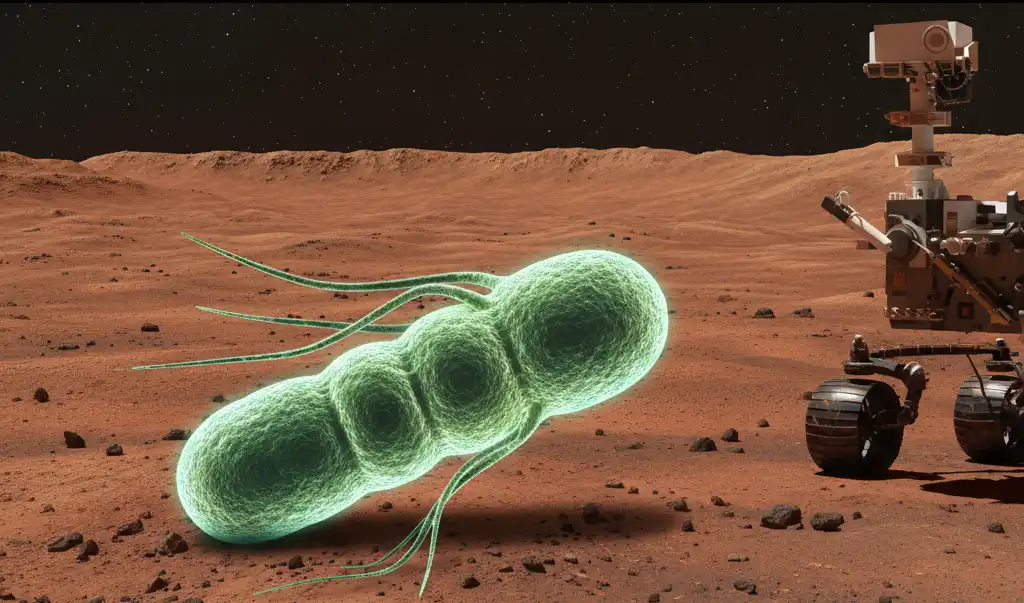
New scientific research is raising serious concerns in the global community regarding the fate of Mars and the purity of its environment. Recently released data suggests that NASA may have inadvertently, despite strict measures, introduced Earth bacteria to the Red Planet. This potential biological contamination of Mars could have far-reaching implications for the key goal of astrobiology-the search for life on Mars and its exploration.
The Risk Hidden in Cleanrooms: Superhero Bacteria
Spacecraft traveling to other planets undergo extremely rigorous sterilization. However, experience has shown that some microorganisms are so resilient that they can survive even in seemingly perfectly clean rooms where robots are assembled. These include terrestrial spore-forming bacteria of the genus Bacillus (for example, Bacillus safensis or Bacillus pumilus). These organisms are capable of entering a state of suspended animation by creating protective spores, making them resistant to high temperatures, radiation, and chemical treatments.
It is these microscopic “superheroes” that pose the greatest threat. They could have “hidden” in microcracks in the components of spacecraft subsequently delivered to the Martian surface. Given that the spacecraft frequently interact with the soil and atmosphere, these “passengers” have a chance to adapt and survive in a new, hostile environment.
Planetary Defense Protocols: Why Are They Failing?
To prevent biological contamination of Mars and other bodies in the Solar System, international regulations known as planetary protection protocols are in place. These are regulated by the Committee on Space Research (COSPAR), which sets strict standards for the number of viable microorganisms permitted per unit area of a spacecraft.
- For missions to Mars that have a high risk of encountering potential habitable zones (such as subsurface ice), the strictest restrictions are in place.
- Sterilization methods include heat treatment (baking at high temperatures), chemical treatment, and ultraviolet irradiation.
However, the scientific community acknowledges that achieving absolute sterility is impossible; it’s too expensive and could damage the spacecraft’s sensitive electronics. Contamination often occurs after sterilization, during final assembly or transport. New data highlights that even minimal amounts of Earth bacteria could be sufficient for colonizing Mars.
Implications for the search for extraterrestrial life
The most pressing concern is how to distinguish terrestrial bacteria from indigenous Martian life. If future missions find microorganisms, it will be very difficult for scientists to prove their extraterrestrial origin. This problem is known as forward contamination-the transfer of microbes from Earth to another celestial body.
Any discovery, even the smallest, could be challenged, as there’s a risk that it’s simply contamination of Mars from our own planet. This would significantly complicate the work of devices searching for biosignatures (signs of life) and could negate the billions of dollars spent on NASA’s Mars missions.
It’s also important to consider backward contamination-the hypothetical possibility of dangerous Martian microbes returning to Earth. However, the problem of Mars being contaminated by terrestrial life forms is considered more pressing and realistic.
Can Earth microbes survive in Martian conditions?
To pose a real threat, terrestrial bacteria on Mars would need to be able to survive in the extreme local conditions. Mars is known for its thin, cold atmosphere, high levels of ionizing radiation, and the near absence of liquid water on the surface. The average temperature on Mars is about -63°C, and radiation levels are significantly higher than on Earth.
Experiments conducted in simulated Martian environments have shown that some terrestrial extremophile microorganisms can indeed survive. Bacterial spores can remain viable beneath a layer of soil, protecting them from radiation. Even small amounts of brine or meltwater during the summer (even if it’s only enough to produce 100 grams of pure liquid, which would cost over $500,000) can provide a source of sustenance for some resistant strains.
This survivability potential confirms that contamination of Mars is not only a hypothetical risk, but also a real possibility that requires a revision of planetary protection standards.
History lessons: was there a precedent?
Concerns about NASA are not unique. Historically, there have been cases where biological contamination has been suspected. One of the most famous examples is the Surveyor 3 mission to the Moon in 1967. When the Apollo 12 astronauts dismantled part of the spacecraft and returned it to Earth two and a half years later, scientists claimed to have discovered viable terrestrial bacteria (Streptococcus mitis) inside the chamber.
Although later studies questioned the purity of the laboratory where the analysis was performed, this story served as a stark reminder of the extreme resilience of microbes. It underscored the need for continuous improvement of planetary protection protocols, especially for critical missions searching for life on Mars.
The Future of Astrobiology: Can We Avoid the Risks?
To ensure the scientific integrity of future discoveries, space agencies, including NASA, must continue investing in new sterilization methods that are effective against extremophiles but do not damage sensitive equipment. The key challenge is not only preventing contamination of Mars but also developing reliable identification methods.
- Scientists are working on microbiological passports for each spacecraft to know exactly what terrestrial bacteria were on it before launch.
- New, more accurate biosignature detectors are being developed that can detect indigenous Martian life by unique characteristics not found in terrestrial organisms.
Ultimately, new data on the possible arrival of Earth bacteria on Mars serves as a wake-up call. It’s a reminder that space exploration poses not only engineering challenges but also a profound moral responsibility to preserve the unique environments of other planets. Protecting Mars from biological contamination remains a top priority for all those seeking to unlock the secrets of life on Mars.
Raising planetary protection standards is the only way to ensure the integrity of scientific experiments and a reliable search for life on Mars.


0 Comments