
- Why LPDDR is Displacing DDR5: Technical Benefits for AI Workloads
- Impact on the DRAM Market: Is a Crisis Ahead for DDR5 Module Manufacturers?
- Environmental and Economic Dimension: Green Data Centers and Savings
- Long-Term Implications: The Future of AI Memory and Nvidia’s Strategy
- Summary: The LPDDR Era and New Challenges for the DRAM Industry
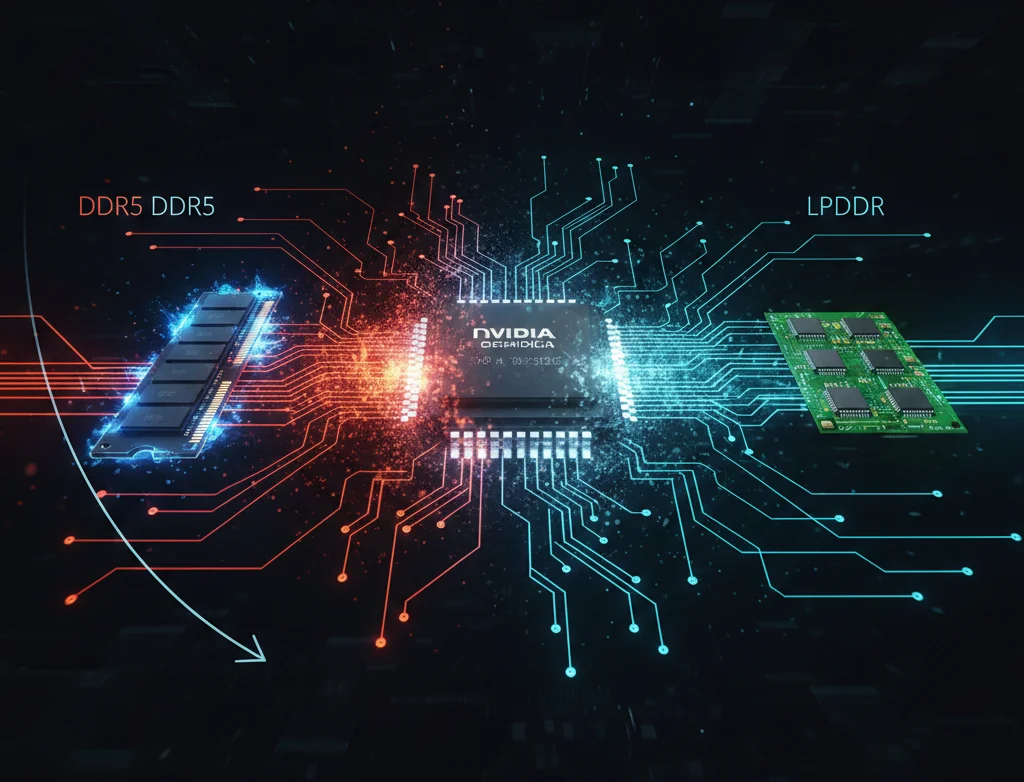
Nvidia, the undisputed leader in high-performance computing and AI infrastructure, announced a strategic design change for its AI servers. Instead of the traditional DDR5 memory, the giant is switching to LPDDR (Low-Power Double Data Rate). This decision is more than just a technical modification, but a seismic shift that could radically alter the DRAM market landscape, improve the energy efficiency of AI servers, and pose significant challenges for DRAM manufacturers.
Why LPDDR is Displacing DDR5: Technical Benefits for AI Workloads
The primary reason for this decisive step is the unprecedented demand for energy efficiency in modern data centers. Computational workloads associated with training and deploying large language models (LLMs) and other AI tasks are extremely intensive and energy-consuming. Using LPDDR, including the LPDDR5 and LPDDR5X standards, significantly reduces overall memory power consumption.
- Power Consumption: LPDDR memory, as its name suggests, is designed for low power consumption. Compared to reference DDR5 modules, LPDDR5X can reduce module power consumption by 25% to 40%. At the scale of thousands of servers, this translates into millions of dollars in savings in data center operating expenses (OPEX).
- Density and form factor: LPDDR chips are soldered directly to the motherboard or dedicated GPU board, eliminating the need for large DIMM slots. This enables the creation of more compact and high-density servers, which is critical for Nvidia’s latest multi-GPU architectures.
- Bandwidth: Modern versions of LPDDR5X deliver competitive and, in some configurations, higher peak bandwidth than standard DDR5, optimizing data transfer between high-performance NVIDIA GPUs and system memory, which is key to NVIDIA AI technology.
Impact on the DRAM Market: Is a Crisis Ahead for DDR5 Module Manufacturers?
Nvidia’s decision to transition its servers to LPDDR will inevitably trigger a wave of changes across the entire semiconductor industry. Until now, a significant portion of demand for high-performance DDR5 memory has come from the AI and data center segments. The shift to LPDDR will create a surplus of DDR5 supply and force DRAM suppliers to urgently adapt.
- Declining DIMM Demand: Manufacturers of traditional DDR5 memory modules (DIMMs) will face a sharp drop in orders from one of their largest customers, Nvidia. This could lead to lower prices for DDR5 modules and negatively impact company profits.
- Growing Demand for LPDDR5X. On the other hand, there will be a pressing need to produce high-capacity, reliable server-grade LPDDR5X chips. Companies like Samsung, SK Hynix, and Micron must quickly repurpose their production capacity to meet the growing demand for LPDDR5X in data centers.
- New testing standards: The transition to LPDDR memory also requires data centers to review their maintenance and replacement procedures. This impacts warranty obligations and overall server lifecycle costs.
Environmental and Economic Dimension: Green Data Centers and Savings
The environmental factor is no less important. Growing energy consumption by global data centers is causing concern among governments and investors. Companies are striving for so-called “green” technologies. The use of LPDDR directly contributes to these goals.
- Reduced Carbon Footprint: Improving the energy efficiency of Nvidia AI servers through LPDDR helps data centers reduce their overall PUE (Power Usage Effectiveness) and consequently reduce their carbon footprint.
- Operational savings: Although the cost of soldered LPDDR chips may be higher per gigabyte than DDR5 DIMMs, the energy savings over the life of the server often outweigh the initial capital expenditure (CAPEX). Energy savings are projected to amount to tens of thousands of dollars per rack over several years.
Long-Term Implications: The Future of AI Memory and Nvidia’s Strategy
This strategic decision by Nvidia is a clear signal: the future of high-performance computing and AI belongs to energy-efficient, high-density integrated solutions. The company is investing in its ecosystem, making its AI platforms even more unique and difficult for competitors to replicate.
- Integration and Customization: The move to LPDDR allows Nvidia to better control and optimize the memory architecture for the specific needs of its GPUs and AI accelerators, delivering maximum performance.
- Strengthening Nvidia’s leadership: This change to Nvidia’s memory standards not only improves efficiency but also strengthens their market dominance, as other server manufacturers will have to navigate the difficult process of adapting their systems to the new standard. This is part of their strategy to invest in AI-powered server memory.
- DRAM Diversification: This decision stimulates further diversification of the DRAM market. Manufacturers need to invest not only in DDR modules for PCs and standard servers, but also in highly reliable, high-capacity LPDDR for specialized AI platforms. This addresses the DRAM market’s overreliance on a single form factor.
Summary: The LPDDR Era and New Challenges for the DRAM Industry
Nvidia’s strategy of incorporating LPDDR into its AI servers is a logical and progressive step, driven by the pursuit of maximum performance and energy efficiency. While this creates market power for Nvidia and significant challenges for DRAM manufacturers, forcing them to refocus their production, it also opens up new opportunities for memory innovation.
In summary, the question “why is Nvidia using LPDDR?” has a simple answer: it’s a step toward creating faster, more compact, and, most importantly, more environmentally friendly AI systems of the future. This is just the beginning of a new era of memory in data centers.



0 Comments