
Digital Voyeurism Facing Privacy Protection
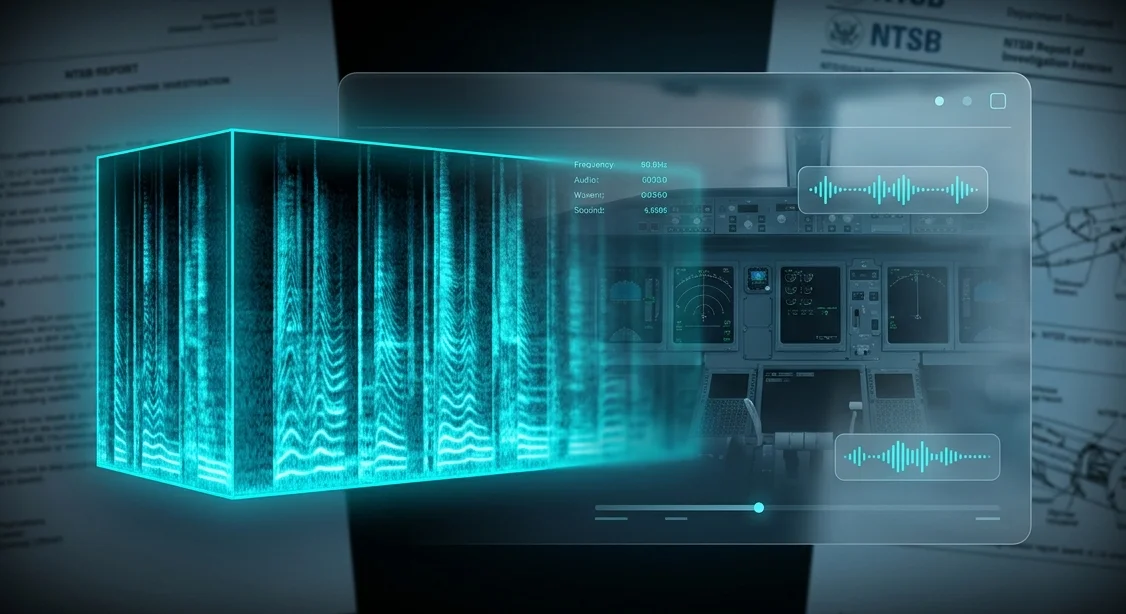
The US National Transportation Safety Board (NTSB) has faced an unexpected challenge that forced the agency to urgently revise its rules for publishing aviation accident investigation reports. The shift was triggered by generative artificial intelligence enthusiasts. Users trained neural networks to reconstruct the final moments of deceased aircraft crews utilizing public text transcripts and visual sound frequency charts from the regulator’s open archives.
Official Cockpit Voice Recorders (CVR) audio files are strictly protected by US federal law and are never released to the public. However, modern speech synthesis technologies have proven capable of analyzing indirect technical data to recreate a person’s voice with high fidelity. The issue gained widespread attention after AI-generated audio reconstructions of a tragic 2013 UPS cargo plane crash surfaced online.
The Technology Behind Decoding Audio From Visual Spectrograms
To analyze background noises, engine performance, and cockpit alarms, NTSB specialists traditionally include spectrograms in their final public reports. A spectrogram is a visual representation of the spectrum of frequencies of a sound signal as it varies with time. Generative AI models using Spectrogram-to-Speech architecture have learned to decode these images back into audio waves.
By combining the visual frequency map with the text transcript of the dialogue, the algorithms reconstruct the tone, timbre, and speech patterns. The result is an audio file that an average listener cannot distinguish from an actual flight recorder tape. This allowed internet users to bypass the statutory ban on publishing original audio evidence.
Safety Measures and Aviation Community Response
The regulator called these actions by the AI community a gross violation of ethical standards that inflicts unwarranted pain on the families of deceased aviators. Since deleting thousands of already published historical documents from archives is legally and technically impractical, the NTSB is changing its approach to shaping future public reports. The agency is implementing the following restrictions:
- Complete cessation of publishing high-resolution sound spectrograms in open digital archives.
- Reducing the resolution of graphic materials to a level that prevents AI algorithms from reading frequencies accurately.
- Moving detailed acoustic reports to a restricted access category for certified experts only.
The US Department of Transportation, along with pilot unions, supported the NTSB decision. Aviation associations emphasize that flight recorders were created solely to improve flight safety and analyze mistakes, not to entertain audiences on video platforms.
Legal Vacuum and Generative AI Regulation
Current US federal law, specifically Title 49 of the United States Code, Section 1114(c), protects only the physical audio media and original digital files from the aircraft. Synthesized or reconstructed voice models do not technically fall under this prohibition, as they are generated from public data on users’ personal computers. The legal details of the current regulation are outlined below.
The US Congress has already initiated work on a bill to expand the concept of the Right of Publicity after a person’s death. The new rules envisage heavy financial fines and criminal liability for unauthorized AI cloning of the voices of crash and terror victims. Major technology companies were involved in drafting the guidelines to implement filters at the base level of audio generation models.



0 Comments