
- What is a sidereal day and how does it differ from a solar day?
- Why does the length of the day change?
- The History of Daylight Savings: From the Past to the Future
- Why is this important for life on Earth?
- How is time of day measured and controlled today?
- Discover the fascinating world of astronomy and the Earth’s natural cycles!
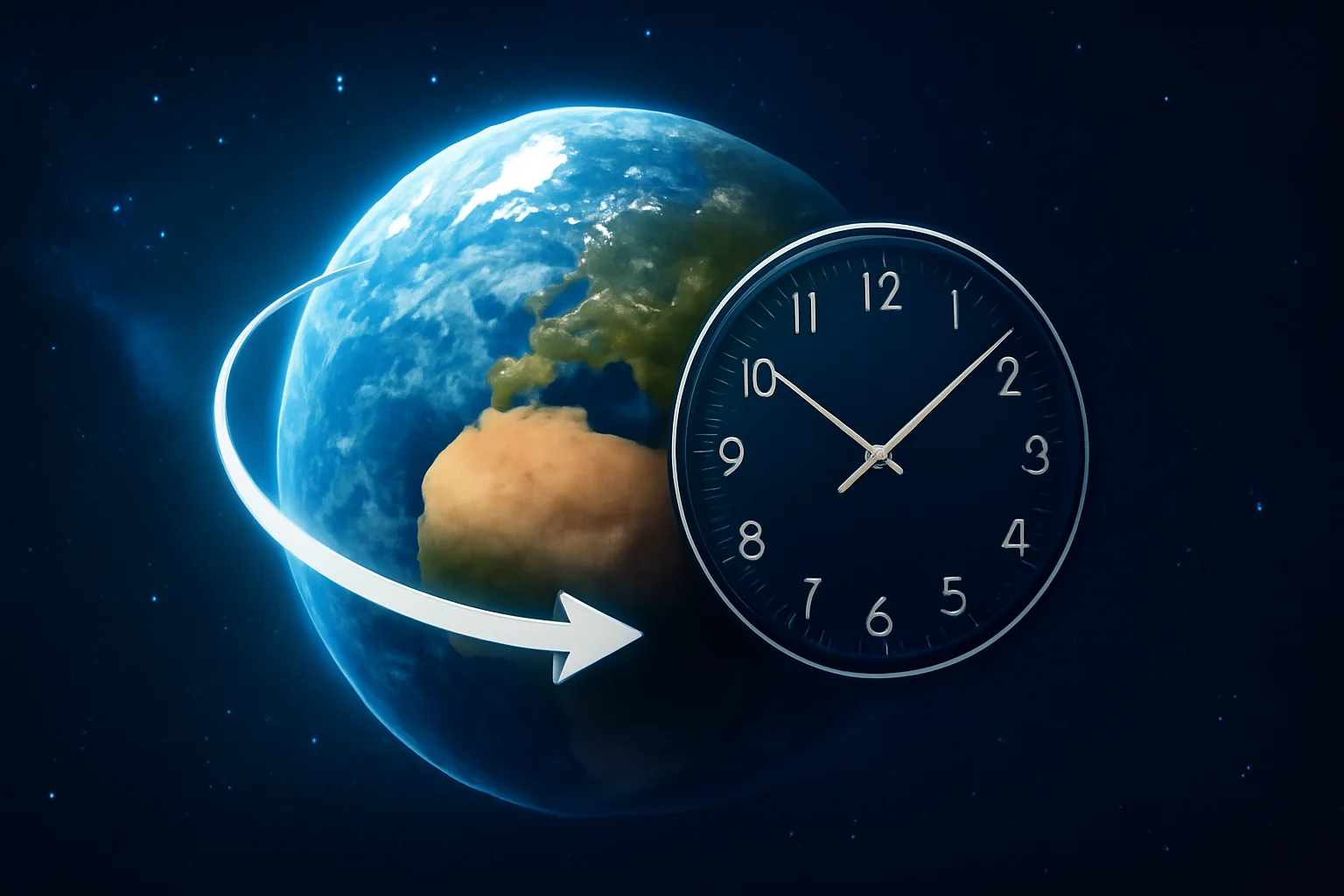
The length of a day on our planet is a question that often arouses curiosity and even surprise. The 24-hour day we’re accustomed to doesn’t correspond precisely to astronomical reality. Earth completes a full rotation on its axis in approximately 23 hours and 56 minutes-this period is called a sidereal day. Why does this happen, and what processes influence the length of a day? And when can we expect a day on Earth to extend to 25 hours? Let’s take a closer look.
What is a sidereal day and how does it differ from a solar day?
A sidereal day is the time it takes the Earth to complete a full rotation relative to distant stars and is approximately 23 hours and 56 minutes. A solar day, meanwhile, corresponds to the period between two consecutive passages of the Sun through the same point on the celestial sphere and lasts exactly 24 hours. This difference arises because the Earth moves in its orbit around the Sun, so it takes slightly longer for it to return to a position where the Sun is in the same direction.
This difference of 4 minutes per day results in solar and stellar time not coinciding, which is of great importance for astronomy and navigation.
Why does the length of the day change?
The Earth’s rotation rate gradually changes due to several natural processes. The most important is tidal dilation, caused by the interaction of the Moon and Sun’s gravitational forces with the Earth. This dilation increases the length of a day by approximately 1.7 milliseconds per century.
Furthermore, internal processes within the planet, such as mass movements in the mantle, tectonic movements, and changes in the magnetic field, also influence the rotation rate. Over time, these factors can either slow down or speed up the Earth’s rotation, but the overall trend is toward longer days.
The History of Daylight Savings: From the Past to the Future
According to geological research, billions of years ago, a day on Earth lasted only about six hours. Over time, due to tidal forces and dynamic processes within the planet’s interior, it slowly lengthened. Over the past hundreds of millions of years, the length of a day has increased by several hours.
Scientists predict that in 50-100 million years, the day may be 25 hours long, although this process will take a very long time and depends on many factors, including changes in the Earth’s orbit and its internal structure.
Why is this important for life on Earth?
The diurnal cycle is fundamental to the biorhythms of all living organisms. Changes in the length of the day can influence natural processes, ecosystems, and even climate. Understanding these changes helps scientists anticipate long-term changes in the environment.
How is time of day measured and controlled today?
Modern astronomical observation methods, including the use of atomic clocks and satellite systems, allow us to accurately measure the Earth’s rotation and record even the slightest changes. When necessary, international services adjust time using leap seconds to synchronize astronomical and civil time.
Discover the fascinating world of astronomy and the Earth’s natural cycles!
Follow the latest scientific discoveries and learn more about the mysteries of time and space. Stay with us to learn even more interesting things about our unique world!



0 Comments