
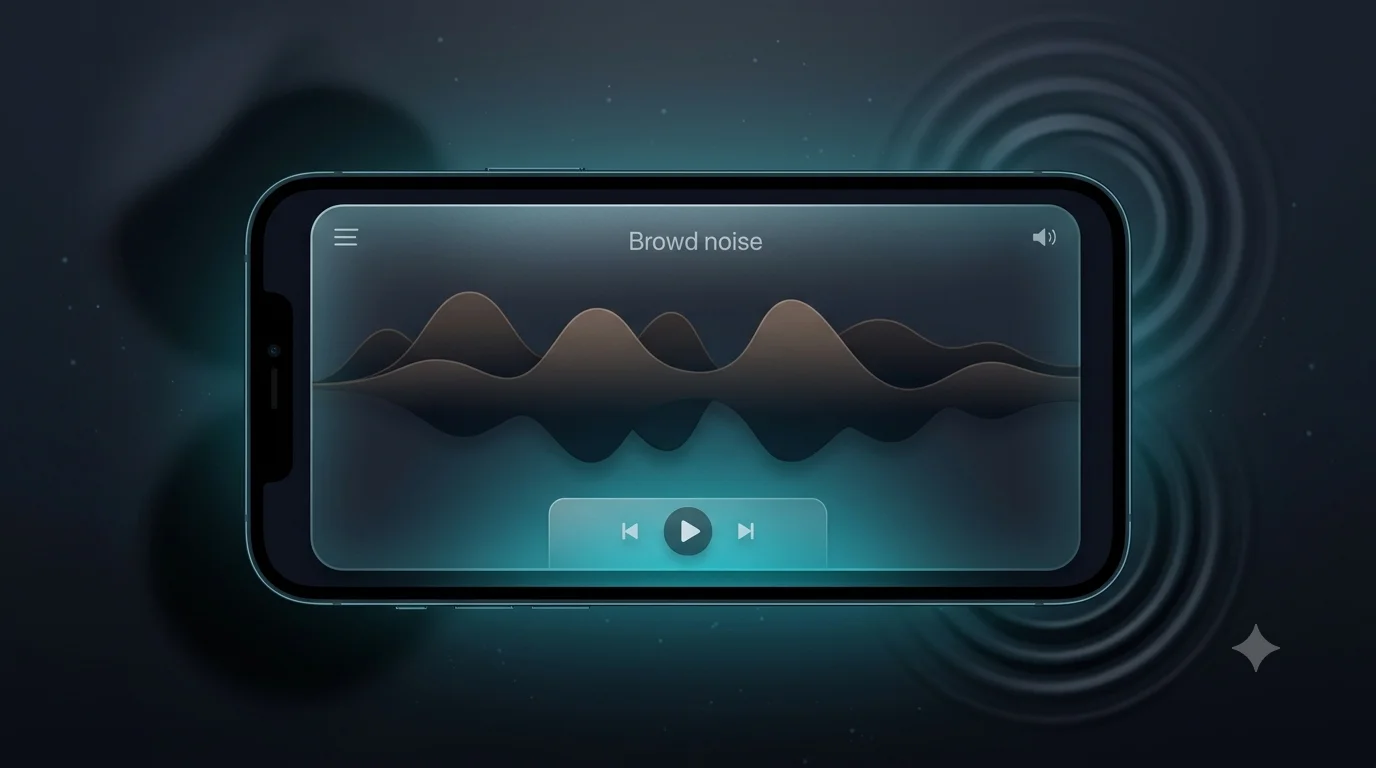
Acoustic Spectrum and the Physiology of Nocturnal Rest
In the search for effective methods to overcome insomnia and reduce stress levels, researchers are increasingly turning to sound therapy. For many years, white noise was considered the primary tool for masking nocturnal disruptions. However, recent clinical observations and spectral analysis of sound indicate that brown noise is significantly more effective for relaxing the nervous system and improving sleep structure.
The main problem with classic white noise lies in its equal distribution of energy across the entire frequency range from 20 to 20000 Hz. Because the human ear is evolutionarily more sensitive to high frequencies, white noise is often perceived as an intrusive hissing sound, which in some patients causes the opposite effect in the form of irritation. Brown noise, by contrast, is characterized by a shift of the energy spectrum toward lower frequencies, creating a deep, soft, and rumbling sound that is better received by the human central nervous system during rest.
The Physical Nature and Origin of Brown Noise
In acoustic classification, the name of this noise is derived not from color, but from the term Brownian motion. The mathematical model of such signals describes the chaotic trajectory of particles where the power density is inversely proportional to the square of the frequency. This means that with an increase in frequency per octave, a decrease in sound intensity by 6 dB occurs. In optics, such a spectral distribution corresponds to the red end of the spectrum, which is why brown noise is often called red noise in scientific literature.
In the environment, sounds with similar characteristics occur very frequently. This can be the distant roar of a waterfall, heavy continuous summer rain, a low hum in the cabin of a passenger aircraft at cruise altitude, or the low vibrations of ocean surf. The absence of sharp high-frequency spikes makes such a background sound maximally natural for perception.
Mechanism of Action on Sleep Phases and the Nervous System
To understand why the low-frequency spectrum helps one fall asleep better than other sound masks, it is necessary to examine the process of auditory masking. A person wakes up at night not from the mere fact of an external sound, but from its sudden appearance against the background of general silence. The sharp barking of a dog, slamming of a door, or a car siren creates a high-amplitude acoustic jump that the brain instantly identifies as a potential threat, triggering the awakening mechanism.
Brown noise creates a stable, dense sound curtain in the lower register. Thanks to the high energy of low frequencies, it effectively absorbs and neutralizes sudden external sounds. The brain stops registering micro-changes in the environment, allowing the body to pass unhindered from superficial sleep phases to deep delta sleep, which is responsible for physical tissue repair and memory consolidation.
Reduction of Cognitive Load in Hyperactivity
A separate line of research is related to the use of sound therapy for individuals with Attention Deficit Hyperactivity Disorder (ADHD). In this condition, patients often suffer from the inability to stop the flow of internal thoughts before sleep. The monotonous low-frequency hum acts as a constant auditory anchor. It fills the deficit of sensory information but carries no intellectual load, unlike audiobooks or music, allowing a reduction in anxiety levels and accelerating the onset of inhibition in the cerebral cortex.
Recommendations for Practical Application
To ensure that the use of sound masks brings only benefits, it is necessary to adhere to the basic rules of acoustic safety. First, it is strictly not recommended to use in-ear or over-ear headphones throughout the entire night shift. Prolonged mechanical pressure on the ear canal and lack of ventilation can lead to inflammatory processes or worsening of natural earwax clearance. The best solution is to use an external speaker system or a specialized noise generator.
Second, the volume level of the track being played near the bed should not exceed 50 dB. Too loud a sound, even in the low-frequency range, will force the auditory apparatus to operate in an active mode, which will interfere with a full rest. Many experts advise setting an automatic turn-off timer for 60 or 90 minutes so that the device stops operating after the user is guaranteed to have transitioned into a stable deep sleep phase.




0 Comments