
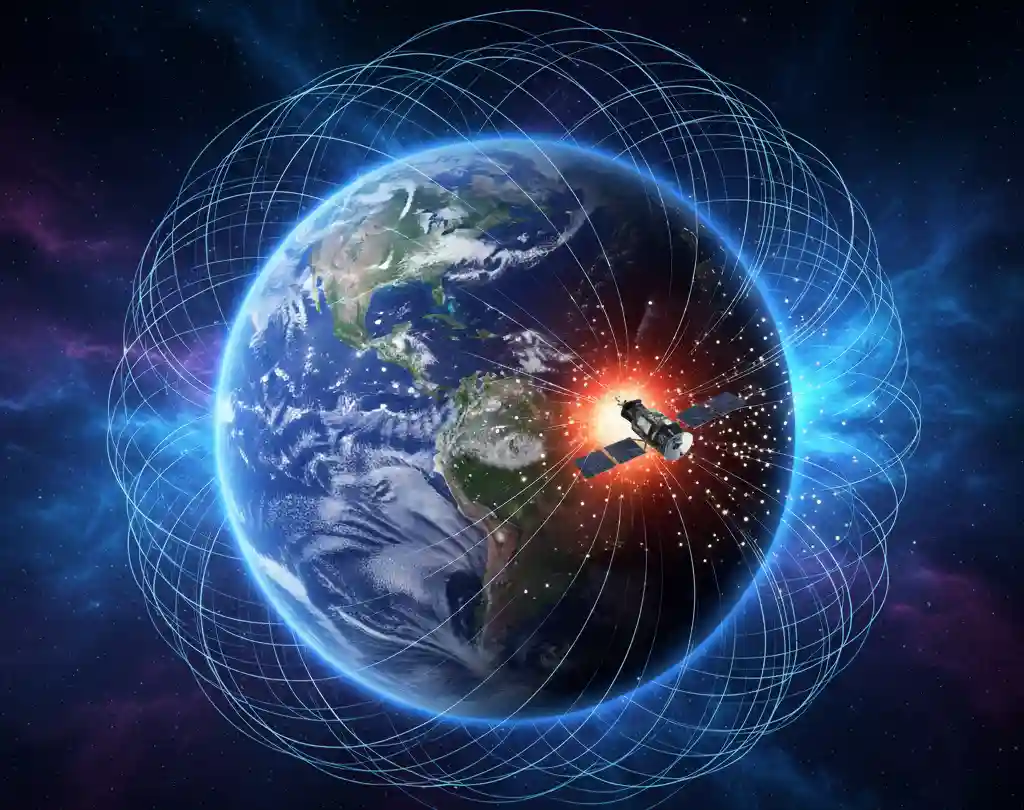
The South Atlantic Anomaly (SAA) is a zone above the planet, located between South America and the South Atlantic Ocean, where the Earth’s magnetic field is significantly weaker than in other regions. Scientists are alarmed that this region is rapidly expanding, encompassing an area now comparable in size to half of Europe. This phenomenon directly impacts spacecraft, posing real risks to satellites and electronic systems, while simultaneously shedding light on mysterious processes occurring deep within our planet.
What does the South Atlantic Anomaly look like and why does it occur?
Essentially, the PAA is a “hole” or “valley” in our protective magnetosphere. In this zone, magnetic field lines are not deeply buried but rather rise, allowing the Van Allen radiation belts to descend closer to the surface. Thus, charged particles, primarily protons, can penetrate to altitudes of 200-800 kilometers, where most low-orbit spacecraft typically orbit.
The dynamics of the weak magnetic field are directly linked to turbulent processes in the Earth’s liquid outer core. There, the geomagnetic field is generated by convective currents of molten iron. Research shows that the PAA is caused by reverse convective movements in this part of the core, which counteract the main field. This confirms that the anomaly is not an external phenomenon, but a reflection of internal, deep-seated dynamics.
Uncharted Speed: PAA Expands and Splits
According to data obtained from the ESA Swarm mission, the rate of increase in the PAA has accelerated in recent decades. Although the Earth’s magnetic field as a whole has weakened by approximately 9% over the past 200 years, the rate of weakening over this zone is significantly higher. In 2020, scientists recorded that the anomaly began to split into two distinct weak-field regions-two “minima.” This significantly complicates predictions of its behavior and creates additional challenges for space mission planning.
This bifurcation and accelerated growth coincides with the detection of so-called geomagnetic pulses-short-term, abrupt changes in the magnetic field occurring at the core-mantle boundary. This phenomenon confirms that very rapid and complex processes are currently occurring in the core, directly impacting the planet’s protective properties.
Technological risks: why satellites are “afraid” of anomalies
The PAA region is the most dangerous period for most spacecraft, especially those operating in low Earth orbit. Due to the weak magnetic field and the proximity of the Van Allen radiation belts, satellites are subject to intense bombardment by high-energy protons.
- Electronic Failures: Radiation can cause “Single Event Upsets” (SEUs) in computer chips, resulting in memory errors, system reboots, or temporary data loss.
- Solar Panel Damage: Long-term exposure to radiation reduces the efficiency of solar panels over time, shortening the life of the panels.
- “Safe Mode” Requirement: Satellite operators, including NASA and ESA mission managers, are required to put their satellites into “safe mode” during PAA transits. This means turning off sensitive scientific instruments to prevent damage, which would lead to data loss.
It is estimated that radiation damage to satellites as they pass through the PAA could cost operators millions of dollars in repairs, downtime, and data loss.
The Future of Earth’s Magnetic Field: Is This a Sign of Reversal?
The growth and division of the PAA once again raises the question of a possible reversal of the Earth’s magnetic field. This is a process in which the North and South magnetic poles swap positions. Although this process is natural and has occurred many times in the planet’s history (most recently about 780,000 years ago), scientists cannot accurately predict when it will begin again.
Currently, despite the accelerated weakening of the magnetic field, most paleomagnetic studies indicate that we are not on the threshold of an immediate reversal. However, the strengthening of the South Atlantic Anomaly is one of the most striking and widely studied manifestations of geomagnetic instability, which will continue for hundreds or thousands of years. Research using Swarm mission data is critical for creating accurate models describing the evolution and predictions of this protective shield for our planet.




0 Comments