
Flight Trajectory and Mars Flyby Mechanics
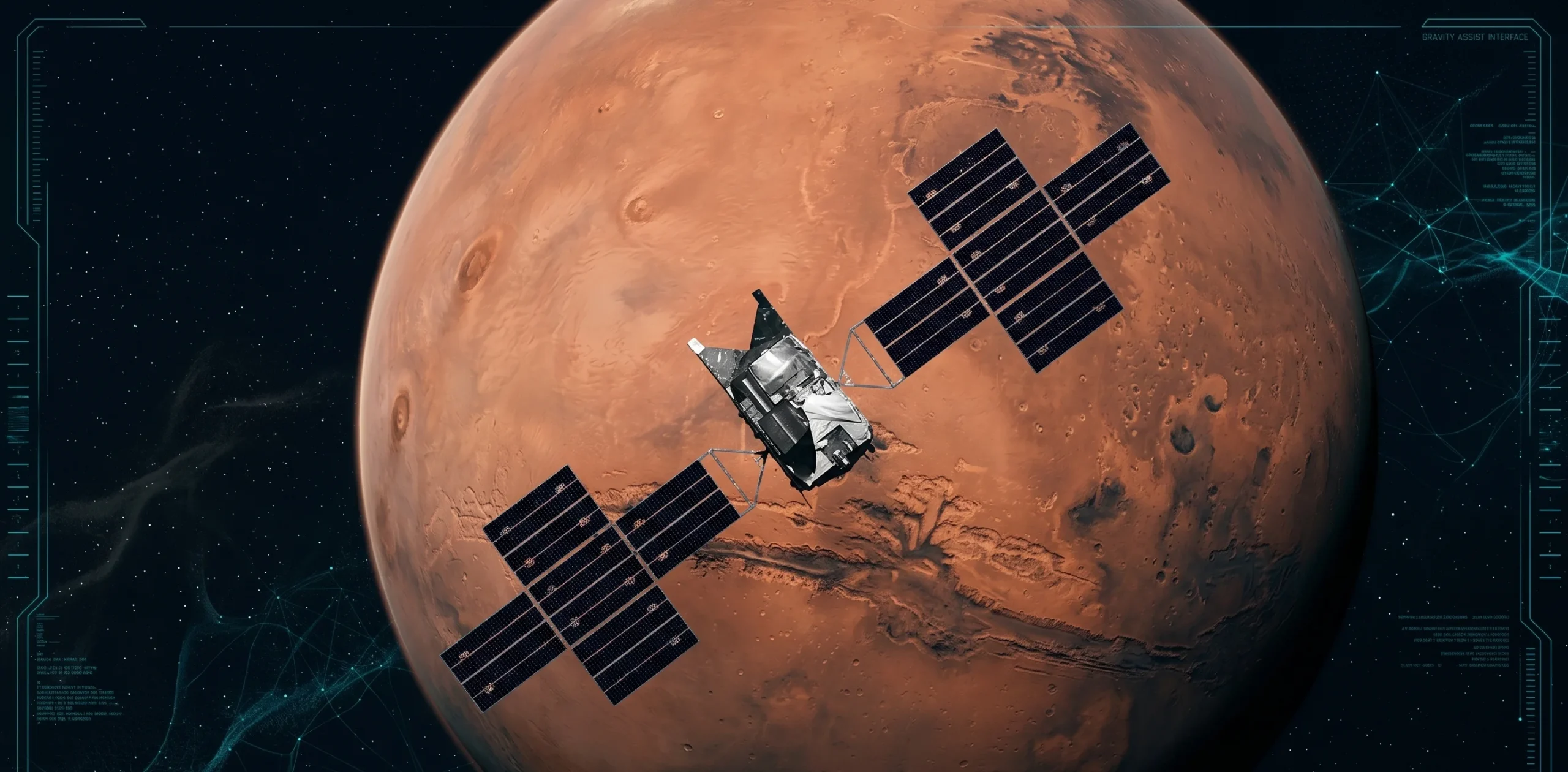
NASA’s Psyche spacecraft has successfully completed a critical phase of its multi-year journey by performing a planned gravity assist flyby of Mars. In May 2026, the deep-space probe approached the Red Planet at its closest point, utilizing the planetary gravitational field to gain significant velocity and alter its vector without expending additional onboard propellant. This orbital maneuver serves as a fundamental prerequisite for reaching its final destination – the unique metal-rich asteroid 16 Psyche.
During the closest approach, the spacecraft zipped past Mars at an altitude of approximately 2100 miles (3400 km) above the surface. To provide context, this trajectory placed the probe significantly closer to Mars than the orbits of its two natural satellites, Phobos and Deimos. Prior to this event, the spacecraft had already covered vast distances through interplanetary space utilizing its advanced solar-powered ion propulsion systems. However, the gravitational pull of the massive planet delivered the essential momentum shift required to direct the probe toward the outer boundaries of the main asteroid belt.
Technical Specifications and Acceleration Yield
The gravitational assistance provided by Mars allowed the Psyche probe to increase its speed relative to the Sun. Due to a meticulously designed ballistic trajectory, the planet’s gravitational pull functioned as an invisible sling. Experts at the Jet Propulsion Laboratory (JPL) in Pasadena confirmed that all telemetry data indicates optimal subsystem performance, with the trajectory aligning perfectly with initial pre-flight calculations.
Thanks to the momentum gained from this planetary flyby, the spacecraft conserves substantial amounts of xenon gas, which serves as the propellant for its cutting-edge Hall-effect ion thrusters. Conserving mass during intermediate phases ensures long-term operational stability once the spacecraft enters orbit around the target asteroid, where it will carry out extensive mapping, spectrometry, and magnetometry operations.
Ion Propulsion and Propellant Resource Optimization
The Psyche spacecraft relies on an exceptionally efficient solar-electric propulsion architecture. Its four ion thrusters operate by ionizing xenon gas using electrical energy generated by its massive cross-shaped solar arrays. Although highly efficient with an exceptional specific impulse, these thrusters generate very low instant thrust that accumulates gradually over months or even years of continuous operation. Consequently, a direct transfer trajectory to the remote asteroid would have required an unsustainable mass of propellant at launch.
By utilizing Mars as a gravitational accelerator, mission architects bypassed the limitations of liftoff mass constraints. Instead of carrying heavy supplementary xenon tanks, engineers mapped out a complex multi-loop trajectory. Now that the vehicle’s speed has been augmented by the planetary flyby, the ion thrusters will continue their steady operation, gradually adjusting the probe’s inclination relative to the ecliptic plane to prepare for final rendezvous operations.
Scientific Instrument Calibration and Optical Communications
During its high-speed transit past Mars, the mission team leveraged the close encounter to calibrate onboard scientific instruments. Operators activated the multispectral imager and the gamma-ray and neutron spectrometer, gathering vital test data and validating sensor functionality under real deep-space operating conditions. Particular focus was dedicated to the Deep Space Optical Communications (DSOC) system, an experimental technology demonstration integrated into the mission payload.
The DSOC system utilizes near-infrared laser signals to transmit high-bandwidth data back to Earth at unprecedented speeds. The spacecraft has previously demonstrated successful data link connections across millions of miles, and testing the system during the martian flyby confirmed the high precision of the laser pointing mechanisms, even when factoring in the high angular velocities experienced by the probe relative to ground receiving stations.
Next Station – The Metallic World of 16 Psyche
The spacecraft now faces three years of autonomous travel through the harsh environment of deep space. Its next and final target is asteroid 16 Psyche, located in the outer region of the main asteroid belt between the orbits of Mars and Jupiter. This specific celestial body commands immense attention from the global scientific community due to its highly anomalous composition.
Why Investigating 16 Psyche Matters to Science:
- Anomalous Composition: Unlike most typical icy or rocky asteroids, 16 Psyche appears to be comprised primarily of exposed iron and nickel.
- Protoplanetary Core Hypothesis: Scientists theorize that the object represents the exposed metallic core of an early protoplanet that lost its rocky mantle due to catastrophic high-velocity impacts during the chaotic formative stages of the early Solar System.
- Insights into Earth’s Interior: Because humanity cannot drill deep enough to sample Earth’s metallic core directly, studying 16 Psyche provides a surrogate laboratory to understand terrestrial planet formation and interior layer dynamics.
The overall mission cost, estimated near 1200000000 USD, is justified by the transformative scientific discoveries it promises. If the protoplanetary core hypothesis is validated, humanity will gain its first direct look at the primordial material that once constituted the deep interiors of rocky worlds like our own. Psyche is projected to achieve stable orbital insertion around its namesake asteroid in 2029, embarking on at least a two-year science campaign to map its magnetic properties, superficial topography, and chemical distribution.



0 Comments