
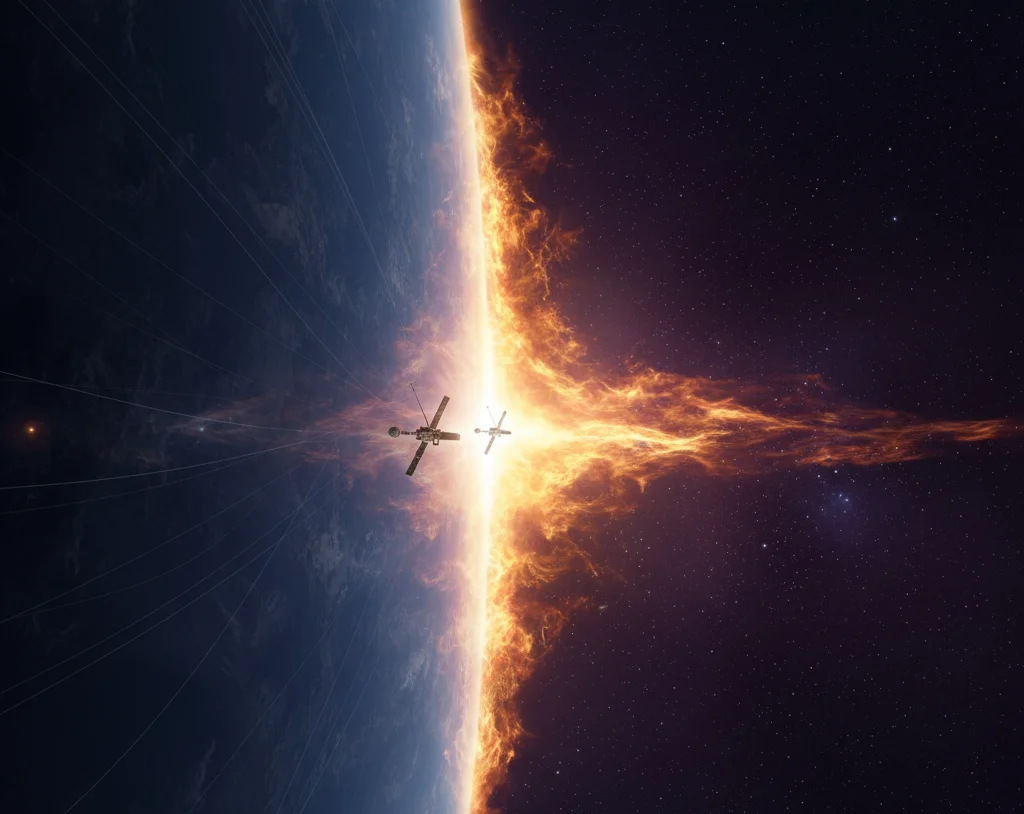
- Incredible discovery at the heliopause: 50,000 K of extreme heat
- Why Voyager Didn’t Burn Up: The Extreme Temperature Paradox
- The Heliosphere: Our Invisible Cosmic Shield
- Protection from cosmic radiation
- Surprises Abroad: Magnetic Fields and the Structure of Space
- Parallel magnetic field
- The Voyager Legacy: A Flight into Eternity
Almost five decades ago, in 1977, humanity launched two of the most ambitious projects in the history of space exploration-the Voyager 1 and Voyager 2 probes. Their mission went far beyond studying the giant planets; they were intended to reach the very edges of our solar system. Recently, these still-operational probes returned sensational data, discovering an incredible phenomenon at the very edge of the solar system, dubbed a “wall of fire” by the media.
Incredible discovery at the heliopause: 50,000 K of extreme heat
The Voyager probes were the only spacecraft to penetrate the heliopause-the dynamic boundary where the stream of particles known as the solar wind finally collides with the interstellar medium. It was here, at the outer edge of our stellar “bubble”-the heliosphere-that the Voyager probes recorded extremely high plasma temperatures, reaching 30,000 to 50,000 Kelvin. That’s about 50,000 degrees Celsius.
Why Voyager Didn’t Burn Up: The Extreme Temperature Paradox
The discovery of temperatures of 50,000 K raised a logical question: how could human-made devices survive such an “oven” unharmed? The answer lies in the fundamental difference between temperature and heat.
- Temperature vs. Density: 50,000 K truly reflects the high kinetic energy of individual plasma particles – they move at incredible speeds.
- Number of particles: However, in this border zone of space, the plasma is extremely rarefied. The number of hot particles per cubic centimeter is negligible.
- Heat Transfer: Due to such a low density of hot particles, the actual amount of heat that could be transferred to the Voyager probes during a collision is negligible. In fact, the probes would not have time to heat up to critical temperatures.
Thus, the “wall of fire” is more of a metaphor for the state of matter at the edge of the solar system than a literal barrier. It’s a hot but extremely tenuous cloud that could never melt the metal of a spacecraft.
The Heliosphere: Our Invisible Cosmic Shield
The discovery at the heliopause highlights the vital role of the heliosphere for life on Earth. The heliosphere is a vast magnetic and plasma “bubble” created by our Sun.
Protection from cosmic radiation
The heliosphere’s primary function is to protect against galactic cosmic rays (GCR). These high-energy particles, originating from supernovae and other distant cosmic events, are extremely dangerous to electronics and living organisms.
- The heliopause acts as a compression and deceleration zone. When the solar wind is slowed by the interstellar medium, it creates a shock wave and accumulates material.
- This dynamic limit deflects or scatters most of the intense cosmic radiation before it can penetrate deep into the Solar System.
Data from Voyager 1 and Voyager 2 show that when the spacecraft crossed the heliopause and entered interstellar space, cosmic radiation levels increased sharply. This is direct evidence of how effectively the heliosphere protects us.
Surprises Abroad: Magnetic Fields and the Structure of Space
In addition to the high plasma temperature, Voyager sent back another unexpected discovery that forced scientists to reconsider models of the Sun’s interaction with the Galaxy.
Parallel magnetic field
The probes found that the magnetic field lines inside the heliosphere (the Sun’s field) and the magnetic field lines of the surrounding interstellar space (the galactic field) are nearly parallel to each other.
This indicates that the two fields are closely linked and that our heliosphere may be more closely aligned with the galactic structure than previously thought. This discovery is critical for understanding how our solar system moves through the Milky Way and how energy and particles are exchanged.
The Voyager Legacy: A Flight into Eternity
Voyager 1 and Voyager 2, launched 16 days apart, are among NASA’s longest-lived and most successful missions. They have already traveled more than 160 astronomical units, making them distant man-made objects.
- Each probe carries a Golden Record-a kind of message in a bottle containing sounds, music, and images designed to tell potential extraterrestrial intelligence about life on Earth.
- Although their power units eventually deplete, the Voyager probes continue to send back valuable data about conditions in interstellar space, expanding humanity’s knowledge of the surroundings of our stellar home.
The discovery of 50,000 K plasma from the mysterious “wall of fire” is just one piece of evidence that the edge of the solar system is not a cold void, but a dynamic, complex, and unpredictable boundary that continues to surprise scientists even decades after the mission began. Every bit of information sent back by Voyager is invaluable for planning future long-term interstellar travel.




0 Comments