
The world continues to search for efficient and stable sources of renewable energy. Sometimes innovative solutions change our understanding of the capabilities of technology. The launch of the world’s first solar power plant in China, featuring a unique twin-tower design, is just such a breakthrough. This project is not only impressive in its scale but also demonstrates a new approach to collecting and storing solar energy, making it more reliable and accessible for 24/7 use.
How does a two-tower power plant work?
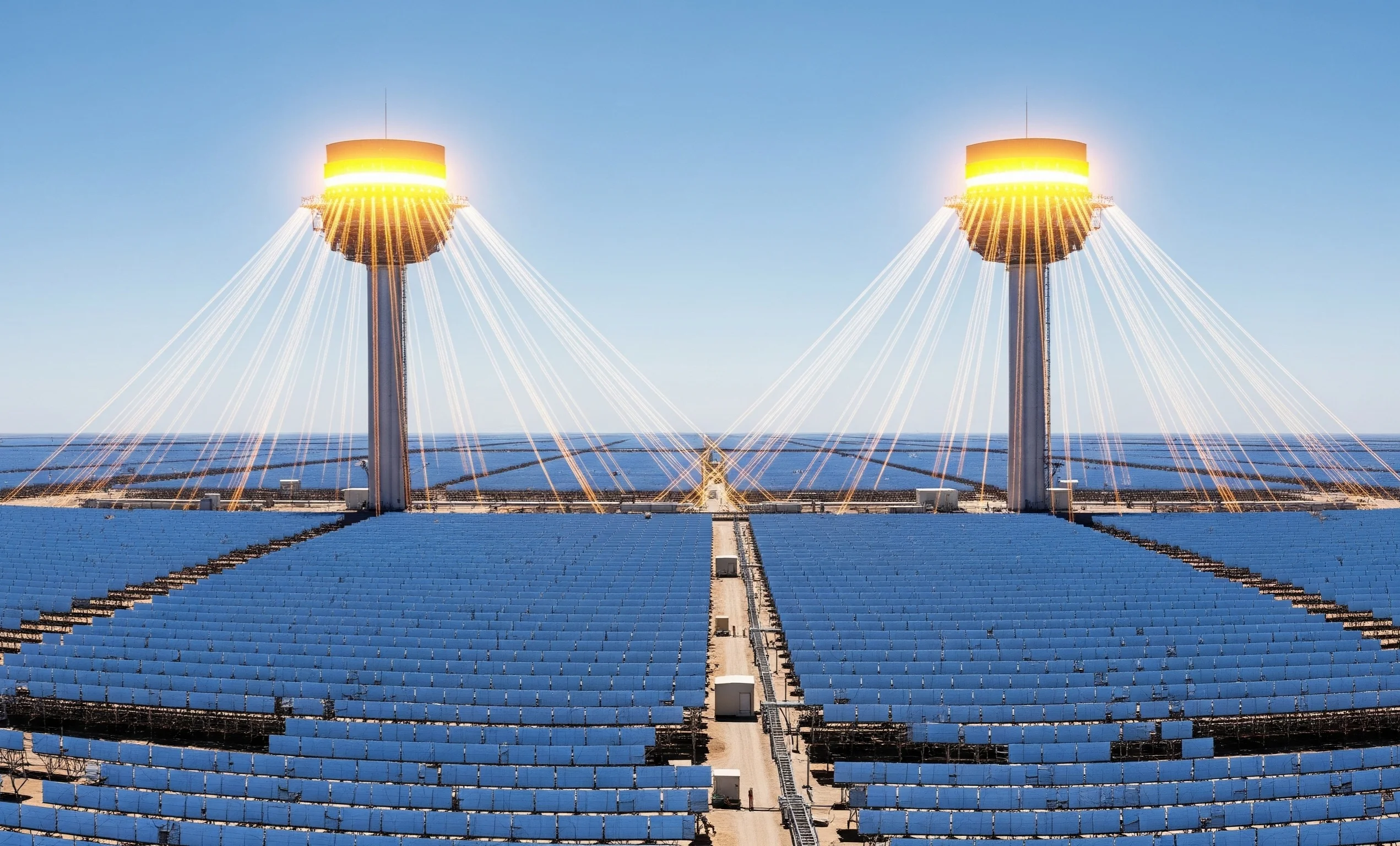
This power plant is classified as a concentrated solar power (CSP) plant and utilizes solar tower technology. Its operating principle is based on a massive array of mirrors that automatically track the sun’s movement. Imagine a field of over 15,000 mirrors, called heliostats. These mirrors focus the sun’s rays onto special receivers located at the tops of two 179-meter-tall towers.
Sunlight concentrated at a single point heats molten salt to extremely high temperatures of over 500°C. This hot salt acts as a heat source and is then used to convert water into steam. The steam, in turn, turns turbines to generate electricity. This process is much more efficient than conventional solar panels, as it allows for energy production even after sunset.
Why are two towers better than one?
Traditional solar IR power plants use only a single tower. However, engineers in China have adopted an innovative design that significantly increases efficiency.
- Optimized energy collection: Two towers allow for more efficient distribution of reflected light, reducing scattering and loss. This ensures more uniform heating of the receivers throughout the day.
- Loss Reduction: Splitting the power flow between two receivers helps avoid overheating and damage to equipment, which is a problem for single-tower stations during peak hours.
- Efficiency at all times: Two towers allow the system to better cope with changing sunlight angles throughout the day, ensuring maximum energy absorption.
The Future: Stability and Ecology
One of the main challenges of solar energy is its intermittency-electricity production depends on weather and time. The Datong power plant solves this problem with an integrated molten salt energy storage system. This system can retain heat for 12 hours, allowing the plant to generate electricity even at night or in cloudy weather.
The plant’s total capacity is 100 MW, making it one of the most powerful projects of its kind. This innovation demonstrates that renewable energy technologies are advancing and becoming not only environmentally friendly but also reliable and stable power sources that can replace traditional power plants. This is an important step toward achieving global carbon reduction goals.


0 Comments