
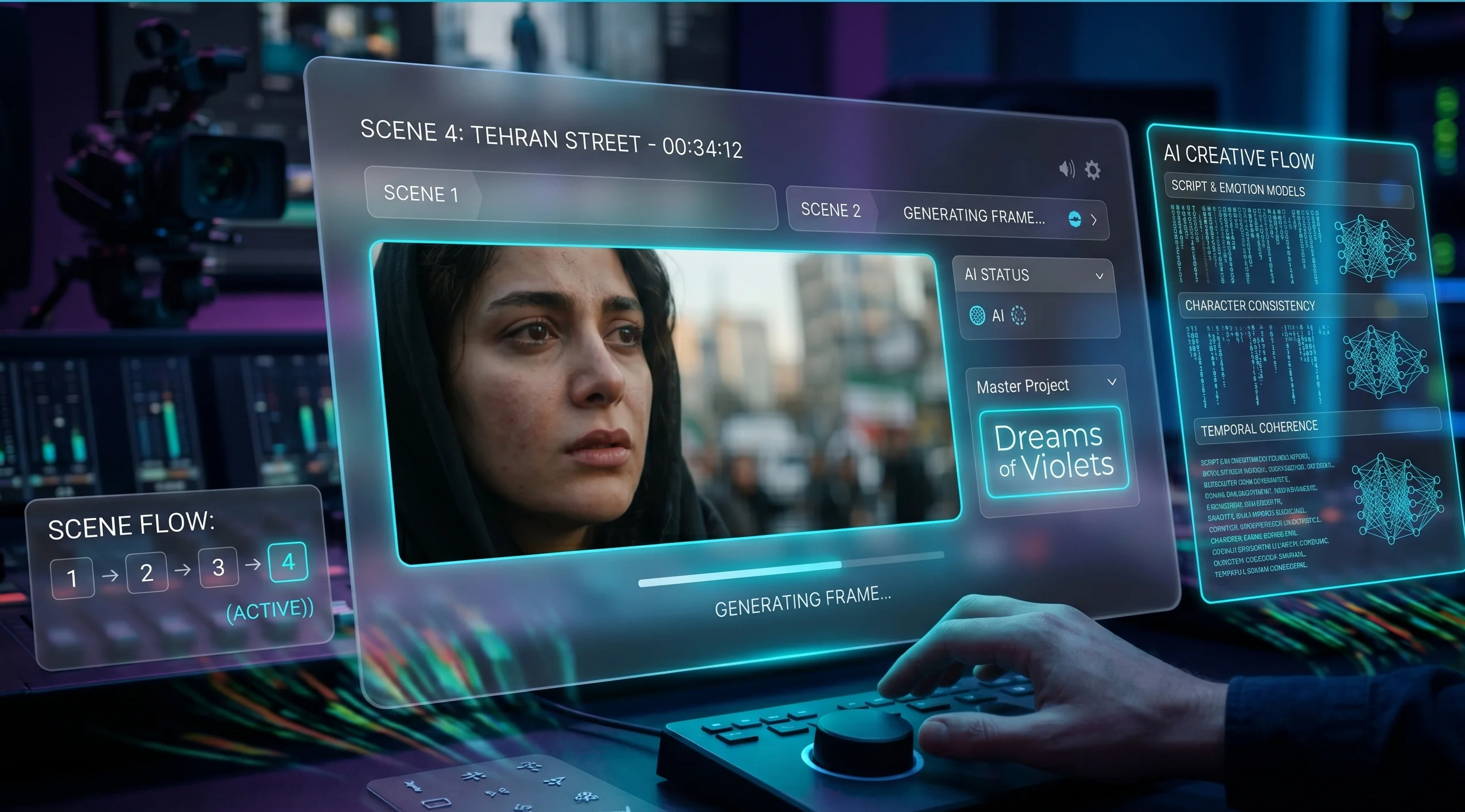
Artificial Intelligence Enters Major Film Festival Competition
The inclusion of the feature-length narrative film Dreams of Violets into the 2026 Tribeca Festival lineup has established new benchmarks for the independent film industry. This 75-minute drama represents the first instance where a major international film festival has accepted a feature film generated entirely through automated models without traditional physical sets, cinematography, or an on-camera cast. The selection has ignited intense debates among critics, producers, and guild representatives who recently advocated for strict regulations regarding automation in creative industries.
Festival organizers justified their decision by demonstrating that the technology served not as a replacement for human artistry, but as the only accessible asset for exiled creators. The narrative focuses on the Iranian resistance and civilian crackdowns in Tehran. For filmmakers facing political persecution and unable to return to their homeland, generative systems provided a functional alternative to recreate precise historical and domestic environments without relying on expensive studio infrastructure or facing physical danger in restricted zones.
Production Economics and Technical Infrastructure
The financial ledger of Dreams of Violets has become a central point of discussion within production circles. The total production cost amounted to exactly 2000 USD. Within the traditional film business, this budget would scarcely cover a few hours of professional lighting rentals or a single shift for a camera assistant. Instead, the entire visual development, editing, and sound design were handled by a minimal team utilizing commercial workstations and cloud-based architecture.
To produce images and maintain character consistency across scenes, the filmmakers utilized a proprietary foundation framework known as Fountain 0 alongside consumer tools designed for frame-to-frame synthesis. The primary challenge in automated filmmaking typically involves image artifacts and shifting fine details between sequential shots. The team mitigated this by building a multi-layered post-processing pipeline that analyzed each primary frame to anchor specific facial markers and clothing structures programmatically.
Temporal Coherence and Motion Tracking Challenges
The primary barrier to executing long-form cinema via software models lies in managing temporal coherence. Standard text-to-video generators produce stable short clips lasting 3 to 5 seconds but fail to preserve architectural geometry, human anatomy, or facial fidelity over longer sequences. In Dreams of Violets, the technical team resolved this limitation by separating each sequence into distinct three-dimensional depth maps, which were subsequently populated with textures using neural networks.
To generate natural dialogue and expressions, motion-transfer systems were deployed. The directors recorded their own performances via standard webcams, allowing the tracking models to map micro-expressions, eye movements, and articulation onto the synthetic characters. This step minimized the unnatural stiffness commonly found in fully automated content. The voice tracks and dialogue mixing were handled similarly, utilizing advanced speech synthesis software calibrated to mimic specific regional dialects and ambient acoustic environments.
Industry Adaptation and Intellectual Property Rights
The presentation of automated feature films at major festivals creates clear challenges for entertainment lawyers and distribution platforms. Current copyright frameworks in several jurisdictions refuse to register intellectual property generated without explicit human authorship. Statutes often mandate that a creative work must originate from a human being to secure protection. The producers of Dreams of Violets counter this by proving that every output resulted from manual prompt structuring, digital masking, and meticulous timeline editing.
Industry reception remains split into distinct camps. Some professionals argue that automated workflows diminish the roles of actors, cinematographers, and set designers, lowering the barrier to entry to basic software literacy. Conversely, proponents view this development as a democratization of cinema that allows independent directors to produce complex historical narratives or high-budget aesthetics without studio financing. The future of theatrical distribution for such films remains uncertain due to existing union agreements governing mainstream exhibition spaces.



0 Comments