
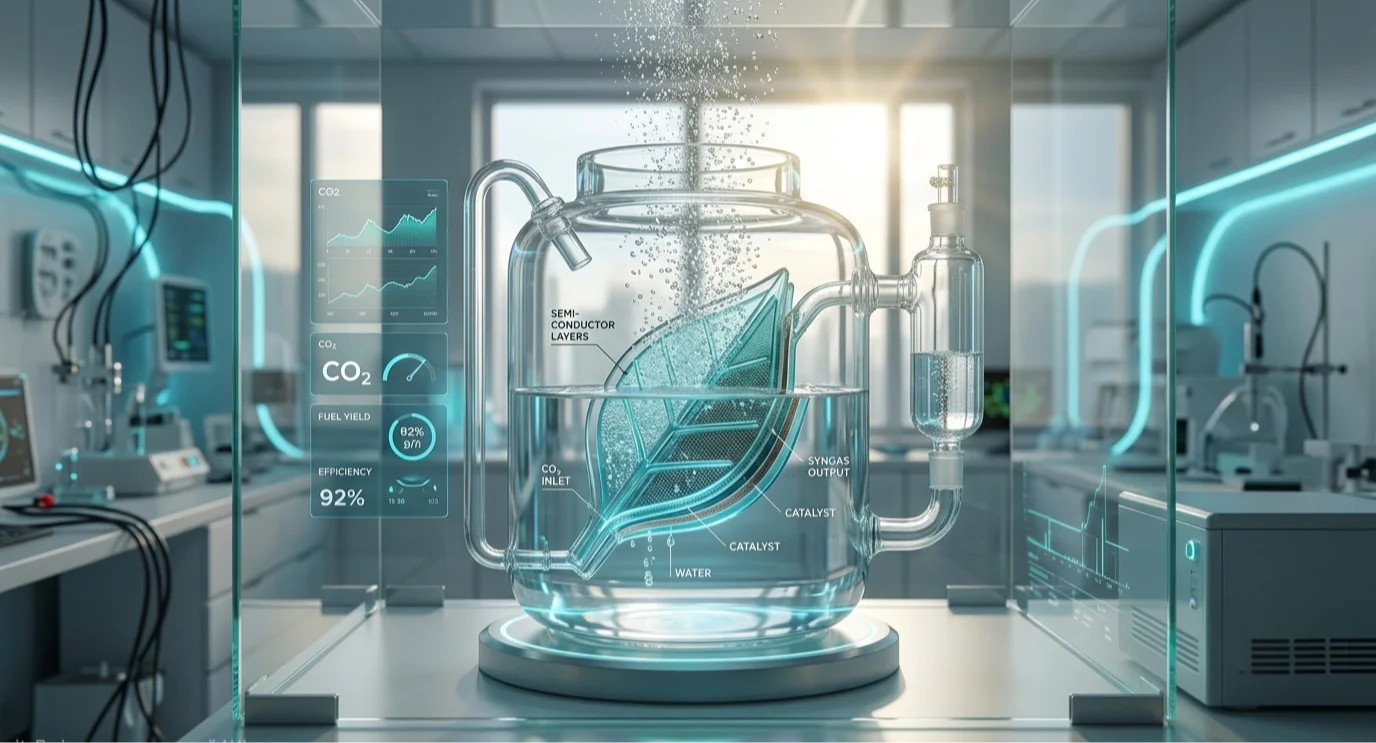
The Mechanism of Artificial Leaf Operation
The concept of directly converting greenhouse gases into liquid or gaseous fuels is based on mimicking natural photosynthesis. Modern laboratory devices developed by researchers at the University of Cambridge function as fully autonomous photoelectrochemical cells. Unlike conventional solar panels that generate electrical current for subsequent water electrolysis, the artificial leaf integrates light absorption and chemical synthesis into a single monolithic device.
The core of the design consists of multi-layered semiconductor structures integrated with selective catalysts. When sunlight hits the device surface, separated charges – electrons and holes – are generated inside the semiconductors. These charges migrate to the surface catalysts, where two simultaneous reactions occur: water oxidation releasing oxygen and carbon dioxide reduction. The main technical advantage is the lack of any need for an external power source or a complex wiring system, which significantly reduces the potential cost of industrial installations.
Catalyst Composition and Semiconductor Structure
The efficiency of energy conversion in such systems critically depends on the materials used for light absorption and chemical reaction acceleration. For a long time, scientists relied on expensive noble metals, including platinum and gold, but modern architectures are shifting toward more affordable alternatives. To absorb a wide spectrum of solar radiation, perovskite absorbers are used, demonstrating high efficiency when combined with special protective layers that prevent material degradation in an aqueous environment.
Catalytic layers are most often formed based on cobalt complexes or specially structured copper. Copper catalysts possess a unique ability to reduce CO2 molecules into complex hydrocarbons such as methanol, ethanol, or ethylene. Through precise nanostructuring of the catalyst surface, it is possible to direct the reaction toward a specific target product, minimizing the emission of undesirable side gases.
Efficiency Assessment and Technical Specifications
To understand the commercial potential of artificial photosynthesis technology, it is necessary to analyze its current performance parameters. Below are the technical data of laboratory prototypes recorded during long-term tests under standard solar illumination conditions.
The low percentage of conversion efficiency in the early stages of development kept the industry back for a long time. However, the figure of 1.5% already exceeds the average efficiency of natural photosynthesis in most land plants, which is typically less than 1%. The primary engineering challenge remains increasing the active surface area while maintaining the uniformity of catalytic layers and the stability of protective coatings for perovskites.
Scaling Pathways and Economic Barriers
Moving the technology from laboratory glass containers to large-scale industrial plants requires solving several fundamental tasks. First, the supply of carbon dioxide to artificial photosynthesis devices must be integrated directly with direct air capture (DAC) units or industrial emissions from thermal power plants and cement factories. This will allow for the creation of a continuous carbon utilization cycle.
Second, the current cost of producing fuel using artificial leaves remains high due to the limited lifespan of semiconductor materials. An aqueous environment under constant ultraviolet radiation causes photocorrosion, leading to a loss of catalyst activity within a few days of continuous operation. Research groups are actively working on creating ultrathin protective layers of metal oxides that allow electrons to pass through while protecting the light-sensitive layer from destruction.
Integration Prospects into Fuel Infrastructure
The main value of products obtained using artificial leaves lies in their complete compatibility with existing logistical infrastructure. The resulting syngas (a mixture of hydrogen and carbon monoxide) can be processed into synthetic aviation fuel or diesel using the classic Fischer-Tropsch process. Liquid methanol, in turn, is a ready-made chemical raw material and a convenient energy carrier that does not require cryogenic storage conditions, unlike pure hydrogen.




0 Comments