
The History of Shortage and the Unexpected Decision of AMD Engineers
The AMD Ryzen 7 5800X3D processor was once a real breakthrough for the gaming industry due to the introduction of innovative three-dimensional caching technology. However, for a long time, the stability of the supply of this chip remained under threat due to the high technical complexity of production. Recently, AMD representatives officially confirmed information that previously circulated only as rumors among hardware engineers. The popular gaming processor was not just returned to the assembly line after a pause, its architectural structure had to be redesigned practically from scratch to ensure a stable yield of usable dies.
The decision to return to optimizing the crystal based on the Zen 3 architecture was driven by stably high demand for the AM4 platform. Users are in no hurry to completely change motherboards and RAM, since the performance of solutions with an additional layer of third-level memory remains competitive even compared to more modern counterparts. However, the original manufacturing process for creating microchips had certain drawbacks that led to a high rejection rate during the vertical connection of silicon layers.
Technical Challenges of 3D V-Cache Technology Production
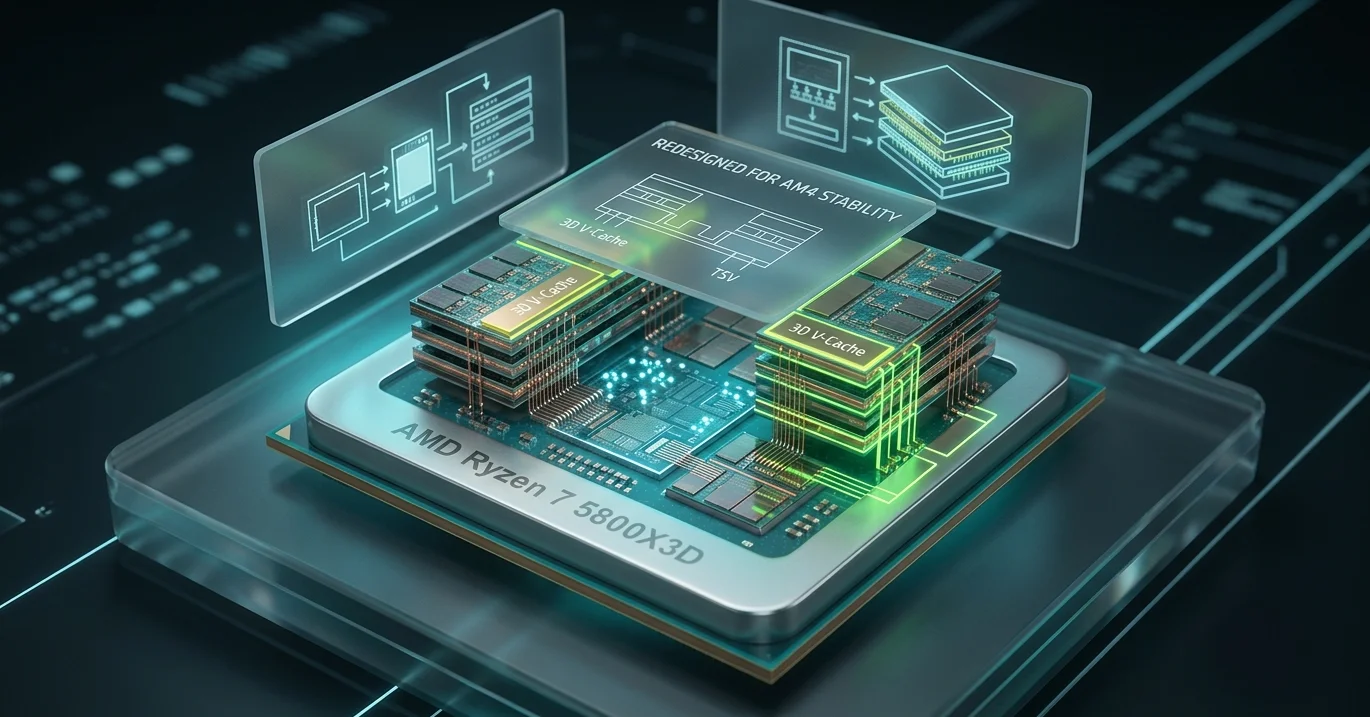
The essence of 3D V-Cache technology lies in the physical stacking of an additional crystal of static SRAM memory on top of the main compute block, the Core Complex Die. To implement such a connection, special microscopic holes in the silicon, called Through-Silicon Vias, are used. The main problem of the first revision was the thermal expansion of materials during long-term intensive workloads. Different layers of silicon heated unevenly, which created micro-deformations of the internal structure.
During the modernization of the chip, AMD engineers, together with specialists from the TSMC factory, completely redesigned the substrate topology and the structure of the connecting elements. The layout of the conductors was optimized, which allowed for the redistribution of heat flows away from the computing cores and prevented local overheating of the interface zone. This architectural update allowed the company not only to resume mass production of the scarce processor but also to significantly reduce its production cost by improving the efficiency of silicon wafers.
Impact of the Update on System Stability and Overclocking
The new revision of the silicon did not bring direct changes to clock speeds or cache size, as the processor must strictly comply with the original specifications to maintain compatibility with older motherboards. The base frequency is still 3.4 GHz with the ability to automatically boost up to 4.5 GHz, and the total amount of L3 cache equals 96 MB. However, internal changes had a positive effect on the energy characteristics of the microchip during heavy tasks.
The updated conductor layout provides a more uniform distribution of supply voltage across the entire area of the computing block. This helps avoid sharp temperature spikes that were characteristic of the first batches of processors in 2022. Although the frequency multiplier for this model remains locked by the manufacturer to prevent damage to the fragile memory structure, users of the updated versions note better stability of RAM operation in the Infinity Fabric bus synchronization mode and lower operating temperatures under liquid cooling systems.
Why the AM4 Platform Remains a Priority for AMD
The decision to invest resources in a complete redesign of an old processor instead of a full transition to new architectures demonstrates the flexibility of the company’s marketing strategy. The AM4 platform has a huge user base worldwide. Many owners of systems based on B450 or X570 chipsets prefer a local upgrade of the processor rather than a full-fledged transition to the AM5 platform, which requires additional costs for purchasing expensive DDR5 standard memory and a new motherboard.
Thanks to the architectural update of the Ryzen 7 5800X3D, AMD gained the opportunity to maintain its presence in the budget and mid-range segments of the gaming market, successfully competing with opponents’ solutions without a significant drop in profit margins. This step confirms that the potential of 3D chip packaging technology is far from exhausted, and engineering optimizations are able to extend the life cycle of successful hardware solutions for several years without the need for a radical change in lithographic equipment.




0 Comments