
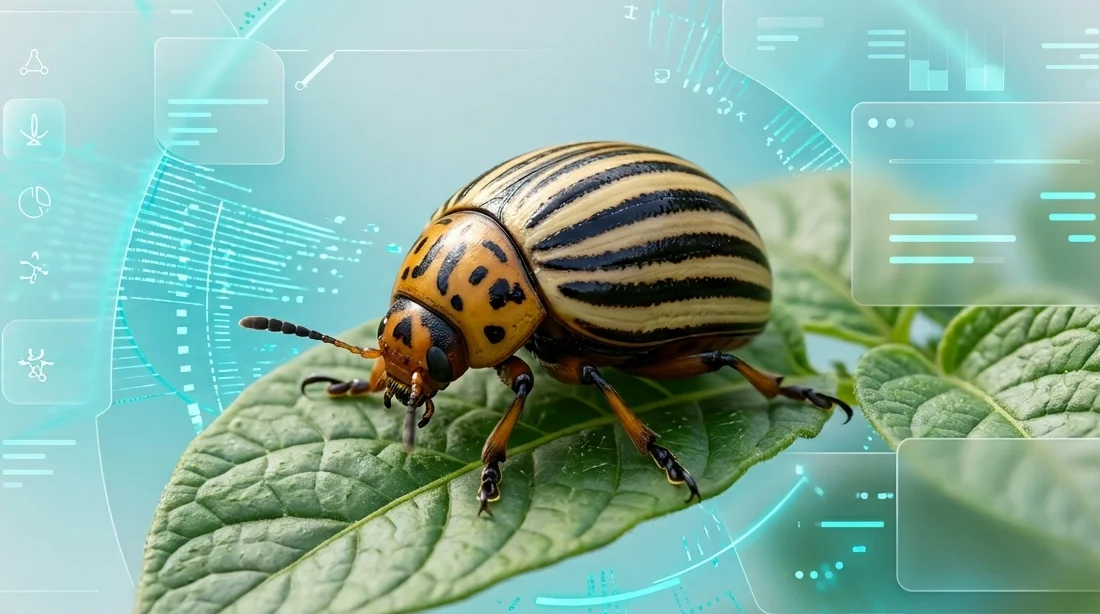
The True Origins of the Main Potato Pest
The Colorado potato beetle (Leptinotarsa decemlineata) received its common geographical name due to a historical coincidence that shaped a persistent misconception about its native home. The true homeland of this insect is the mountainous regions on the border of modern Mexico and the United States, specifically the Sierra Madre plateau. For thousands of years, this species remained an obscure element of the local ecosystem, feeding exclusively on wild nightshade plants. The situation changed dramatically in the nineteenth century, when American pioneers began moving west and planting domestic potatoes on a massive scale. The intersection of the pest’s natural habitat with anthropogenic crops led to the first documented mass transition of a wild insect to a cultivated plant species. The beetle began its eastward expansion at a speed of approximately 100 km per year, reaching the Atlantic coast by 1874, from where it spread to Europe via commercial cargo ships.
Soviet Propaganda and the Cold War Saboteur Myth
In 1950, at the height of the Cold War, Soviet newspapers and radio stations launched a massive media campaign. The appearance of the beetle on the agricultural fields of East Germany, Poland, and the USSR was officially declared a planned biological attack by the United States. Propaganda outlets claimed that American military aircraft were deliberately dropping containers filled with beetles to undermine the food security of the socialist bloc. The insect received an official Soviet nickname – “The American Saboteur”. Despite the plausibility of the myth for the general public due to shifting geopolitical tensions, entomologists had already thoroughly documented the natural movement of the population across Europe, which had been ongoing since World War I. Natural migration vectors included strong winds, railway transport, and the uncontrolled movement of military supplies during World War II.
Biochemical Self-Defense and the Hazards of Mechanical Crushing
The extreme survival rate of the Colorado potato beetle is driven by its specific biochemical evolution. By consuming plants from the Solanaceae family, the insect accumulates a toxic alkaloid called solanine within its tissues, larvae, and eggs. This toxin is lethal to most vertebrates and other insects, which explains why natural predators are virtually absent in the European agricultural landscape. Mechanically crushing beetles or their eggs directly on the soil is a severe agricultural mistake for several critical reasons
- The pest’s eggs have a high chitinous resistance, and when a cluster is deformed, some of them remain completely undamaged.
- The adult body contains chemical alarm pheromones that, when spilled onto open soil, trigger an intensive flight of neighboring populations to that specific area.
- Mass release of solanine into the anaerobic upper layer of the soil suppresses beneficial microflora responsible for natural fertility.
The only effective method of mechanical control is collecting the insects into containers filled with concentrated saline solution, kerosene, or their subsequent incineration outside the cultivation plots.
Evolutionary Resistance to Chemical Insecticides
The Colorado potato beetle holds the absolute record among agricultural pests for its speed of adaptation to synthetic poisons. Since the first mass application of DDT in the 1940s, the insect has developed genetic resistance to more than 50 different classes of chemical insecticides. The mechanism of this adaptation works on the principle of accelerated natural selection. Since a single female lays between 400 and 700 eggs per season, even when 98% of a population is eliminated, the remaining 2% of individuals with random genetic mutations survive and pass their resistance to the next generations, which emerge just 3 weeks later.
Integrated Pest Management Strategies
Since complete eradication of the species via chemical means is mathematically impossible, modern agronomy has shifted toward Integrated Pest Management (IPM) strategies. The foundational element is strict crop rotation. If potatoes are not planted in the same location for two consecutive years, beetles emerging from winter diapause find themselves without a primary food source, leading to the natural starvation of a massive part of the population. Additionally, biological products based on the soil bacterium Bacillus thuringiensis are widely used. Its protein toxin destroys the digestive tract of coleopteran larvae but remains completely safe for bees, birds, and humans. Deep autumn tilling allows growers to lift overwintering individuals to the surface where they perish from freezing temperatures, while companion planting of barrier crops with strong odors (marigolds, coriander) disorients insect receptors during their search for host plants.




0 Comments