
A New Milestone in Extreme Overclocking History
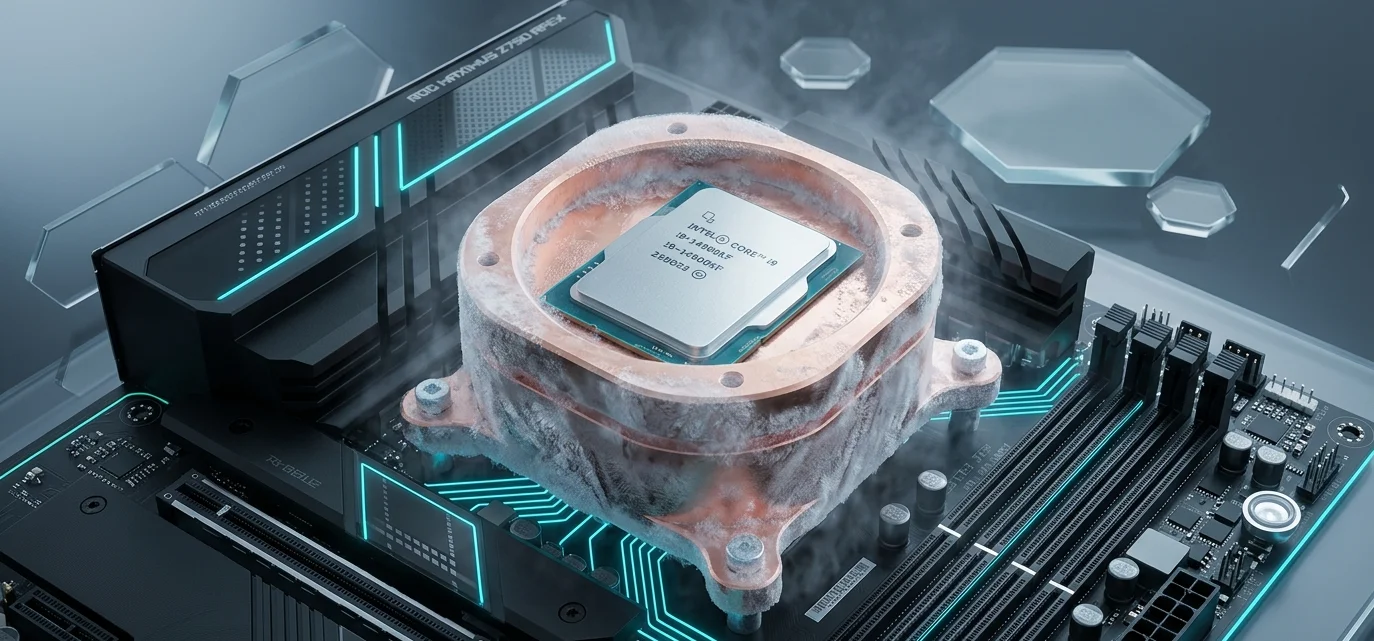
The computer hardware industry has recorded an update to the absolute world record for central processor clock frequency. An enthusiast using the pseudonym wytiwx managed to overcome the previous barrier, forcing a flagship Core i9-14900KF chip to run at 9206.34 MHz. The result officially passed the validation procedure in the database of the popular CPU-Z utility and was registered on the specialized overclocking portal HWBot.
This event displaced the previous best result, which stood at 9117 MHz and was achieved on a processor of the same architecture. Extreme overclocking of modern semiconductor dies requires not only a lucky piece of silicon but also specific engineering preparation of the test bench.
Hardware Configuration and Component Selection
To achieve this frequency, the overclockers chose the ASUS ROG Maximus Z790 Apex motherboard. This board is designed specifically for benchmarking and features optimized routing for RAM traces alongside a reinforced multi-phase power delivery system. The VRM components on the board are capable of withstanding high current loads without critical voltage drops, which is a basic condition for stability when operating outside factory specifications.
The test system utilized a DDR5 memory kit from G.Skill. To minimize the load on the integrated memory controller inside the processor and reduce the probability of errors, the architecture was simplified. The overclockers used only a single memory channel, lowering the frequency and loosening the modules’ timings.
Liquid Helium Extreme Cooling Specifications
Standard air coolers or ready-made liquid cooling systems are completely incapable of handling the heat output of a chip whose voltage is raised to values around 1.8 V or more. Under normal temperatures, such a regime leads to immediate degradation or thermal destruction of the silicon wafer. Liquid helium was used to overcome the thermal barrier.
Liquid helium has a boiling point at approximately -269 °C, which is much closer to absolute zero than the indicators of liquid nitrogen. The main difficulty of working with helium lies in its physical properties. It evaporates significantly faster than nitrogen and requires special sealed containers and custom thick-walled copper pots installed directly on the processor’s heat spreader.
Architectural Parameter Optimization for Validation
Modern Core i9 processors have a hybrid structure consisting of performance and efficient cores. To force the silicon to work at a frequency exceeding 9.2 GHz, the architecture of the chip had to be artificially limited through BIOS settings. The overclocker completely disabled all performance P-cores and most of the efficient ones. The validation was passed with only 3 efficient E-cores active in a single thread.
This approach allows for a radical reduction in the thermal load on individual sections of the die, preventing localized overheating. The system bus frequency during the record capture was 100.07 MHz, and the processor multiplier was raised to 92. The platform’s stability in this mode was measured in seconds. The system had just enough time to generate the CPU-Z utility validation file before the operating system terminated due to a critical kernel error.
Prospects for Further Frequency Scaling
Achieving a result of 9.2 GHz demonstrates the technological potential of the 10-nanometer Intel 7 process technology, on the basis of which the Raptor Lake Refresh family is built. Such experiments have no practical value for ordinary users or gamers, since computer operation in this mode is impossible without a constant supply of expensive coolant. However, for engineers, this is an important indicator of architectural strength and power management capabilities in premium motherboards.



0 Comments