
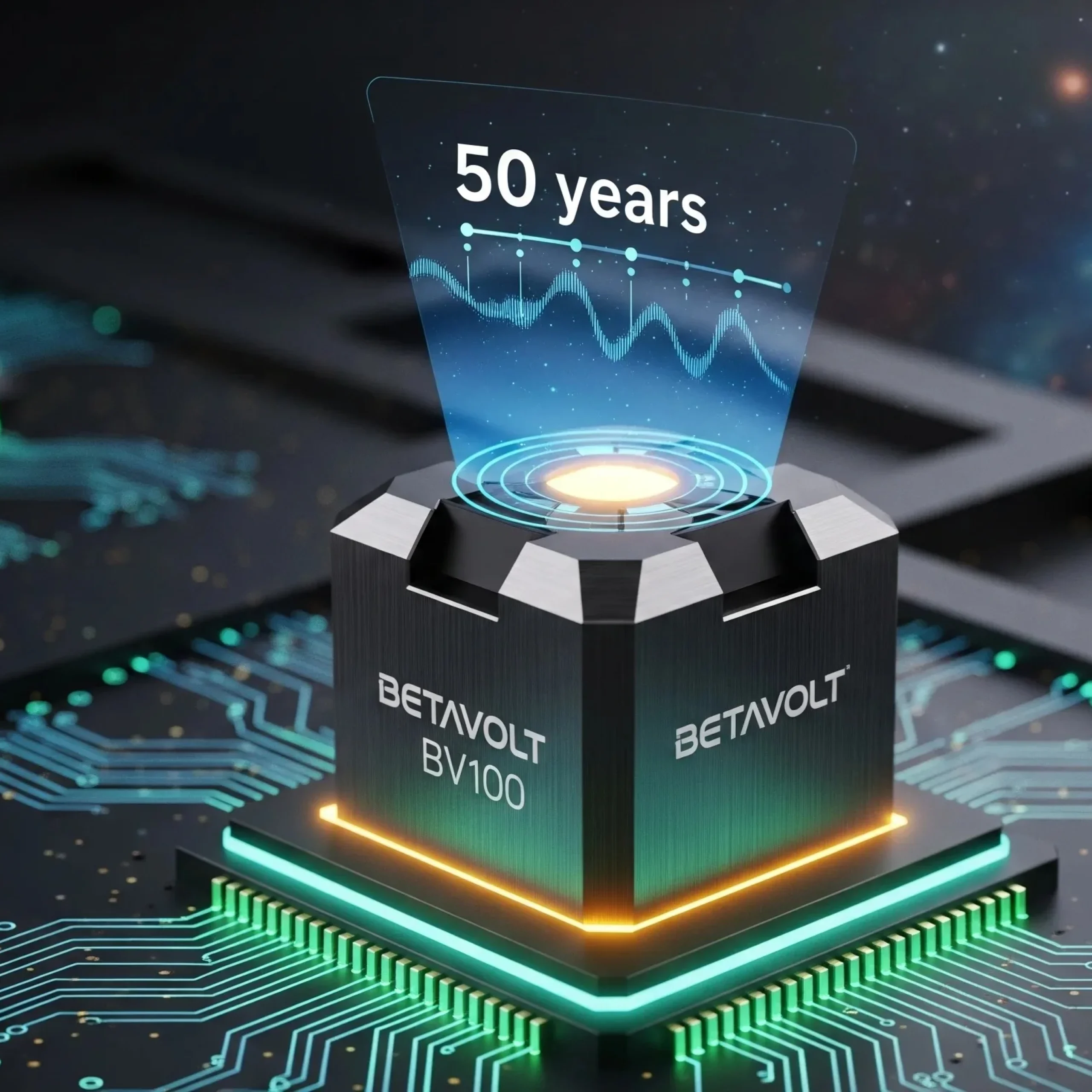
Energy technologies are constantly advancing, but even the most advanced batteries require regular charging. This creates limitations for devices operating in remote locations, such as space or inside the human body. Recently, the Chinese company Betavolt Technology announced the development of the BV100 nuclear battery, which they claim can generate electricity for 50 years without recharging. This breakthrough not only renews interest in nuclear technologies as energy sources but also opens the way to new opportunities in various industries.
What is beta voltaic development and how does it work?
Betavolt’s nuclear battery operates using betavoltaic technology. This means it converts the energy of beta decay (electron radiation) directly into electric current. The key element here is the radioactive isotope Nickel-63, which serves as the energy source. The company sandwiched thin sheets of Nickel-63 between two layers of diamond semiconductors. The diamond semiconductors perform a dual function: they not only convert electron energy into electricity but also act as a protective shield, preventing radiation leakage.
Key Features of the BV100 Battery
The new nuclear battery is striking in its miniature size and performance. It measures just 15 x 15 x 5 mm, making it smaller than a coin. Initially, it produces 100 microwatts of power and a voltage of 3 V. This isn’t enough to power a smartphone or laptop, but it’s sufficient for microsensors, medical implants, deep-sea exploration equipment, and drones. The company plans to develop more powerful versions capable of generating up to 1 W of power, making them suitable for use in mobile phones.
Applications: from space to medical implants.
The main advantage of a nuclear battery is its exceptional service life and reliability. This opens up wide possibilities for applications where replacing or recharging conventional batteries is impossible or extremely difficult. Among the most promising areas are:
- Space Technology The battery can power satellites, space probes and research equipment, ensuring uninterrupted operation for many decades.
- Medical devices: Application in pacemakers, cochlear implants and other devices implanted in the human body will significantly simplify the lives of patients by eliminating the need for surgery to replace batteries.
- Military Equipment and Monitoring: The battery can power sensors used for reconnaissance purposes, operating autonomously for many years.
Betavolt Technology is already working on prototypes for commercial applications, demonstrating its seriousness.
Is a nuclear battery safe?
The word “nuclear” may raise concerns, but the company claims the BV100 is completely safe for users. Its key safety arguments include:
- No Radiation: The diamond semiconductors surrounding the isotope completely block radiation, making the device safe for everyday use.
- Resistance: The battery cannot catch fire, explode or melt as it can withstand temperatures from -60°C to 120°C.
- Safe disposal: After its useful life (50 years), Nickel-63 decays into a stable, non-radioactive isotope of copper.
Thanks to its safety and compactness, the nuclear battery could become a key element of future technologies that will revolutionize the energy sector.



0 Comments