
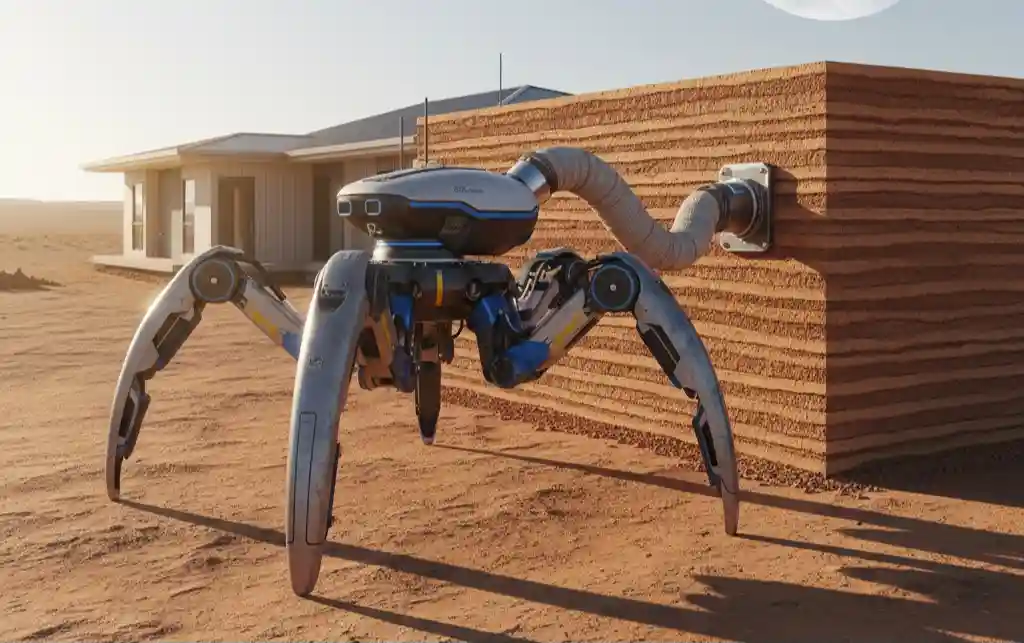
The construction world is on the brink of a true revolution, and Australia is leading the way. Engineering companies Crest Robotics and Earthbuilt Technology have unveiled their latest creation – a six-legged autonomous construction robot named Charlotte. This machine, resembling a futuristic spider, promises not just to speed up but to fundamentally change the process of home construction.
Charlotte: Speed and efficiency impossible for a human
The Charlotte robotic robot’s main advantage is its incredible speed. The developers claim the robot can completely print the load-bearing walls of a standard 200-square-meter residential building in less than 24 hours. This is equivalent to the work of over 100 masons working simultaneously, but with the precision only automated systems can provide. This opens up new opportunities to rapidly address the global affordable housing shortage.
Earthbagging Technology: Cement-free construction using local materials
Unlike most existing 3D printers, which use expensive concrete mixes, Charlotte uses an innovative approach known as automated earthbagging. This is a key factor that makes this Australian development truly revolutionary.
- Local resources: The robot uses available bulk materials such as sand, clay and ordinary soil, as well as crushed construction waste (broken bricks, glass).
- Environmentally Friendly: Completely eliminating traditional cement dramatically reduces the carbon footprint of construction, making it one of the most environmentally friendly processes on the market.
- The process: The material is injected under pressure, extruded into a strong textile sleeve, and immediately compacted. This continuous process creates strong, layered walls that harden to a sandstone consistency within 72 hours.
Design Driven by Mobility: Why a Six-Legged Robot?
Charlotte’s unique six-legged design was no accident. Most industrial 3D printers are bulky, gantry-style systems that require fixing and complex installation on-site. Robopavok, however, solves the problem of logistics and maneuverability:
- Easy transportation: The robot folds compactly for transport and can be quickly deployed on any construction site.
- Autonomous maneuverability: With six legs, Charlotte remains stable and can easily navigate uneven surfaces without the need for rails, cranes, or complex support systems.
- Precision and Control: The robot follows the digital 3D model to ensure precise material layering, while built-in sensors continuously monitor the thickness and evenness of each layer.
Economic feasibility and the fight against the housing crisis
The implementation of this technology has significant economic potential, especially in the context of rising prices for traditional materials and a shortage of skilled labor. By using local, often recycled, materials, Charlotte dramatically reduces its dependence on global supply chains.
- Cost Reduction: Eliminating the need to transport large volumes of cement and bricks, as well as reducing labor costs, significantly reduces the cost of housing construction.
- Structural Resilience: Printed walls have increased resistance to moisture, fire, termites, and even extreme weather conditions, making them ideal for regions prone to cyclones and other natural disasters.
While the exact cost of a finished home may vary, similar 3D printing projects in Australia are already demonstrating cost savings of up to 22% on wall construction compared to traditional methods.
Space Potential: Building on the Moon with Soil
The revolutionary potential of the Charlotte robotic spider extends far beyond Earth. The project was developed with the potential for use in space architecture in mind. Its ability to utilize local materials makes it an ideal tool for future space missions.
- Lunar Regolith: On the Moon, Charlotte will be able to use lunar regolith (dust and loose rock) as a primary building material.
- Autonomy in a hostile environment: The ability to operate autonomously and its compact size allow for the preparation of infrastructure and monthly bases for the arrival of crews.
Thus, Charlotte is not just a step, but a true leap in 3D construction. This Australian development combines robotics, steel, and speed, offering an efficient and environmentally friendly solution to housing problems on Earth and ushering in a new era of space architecture.


0 Comments