
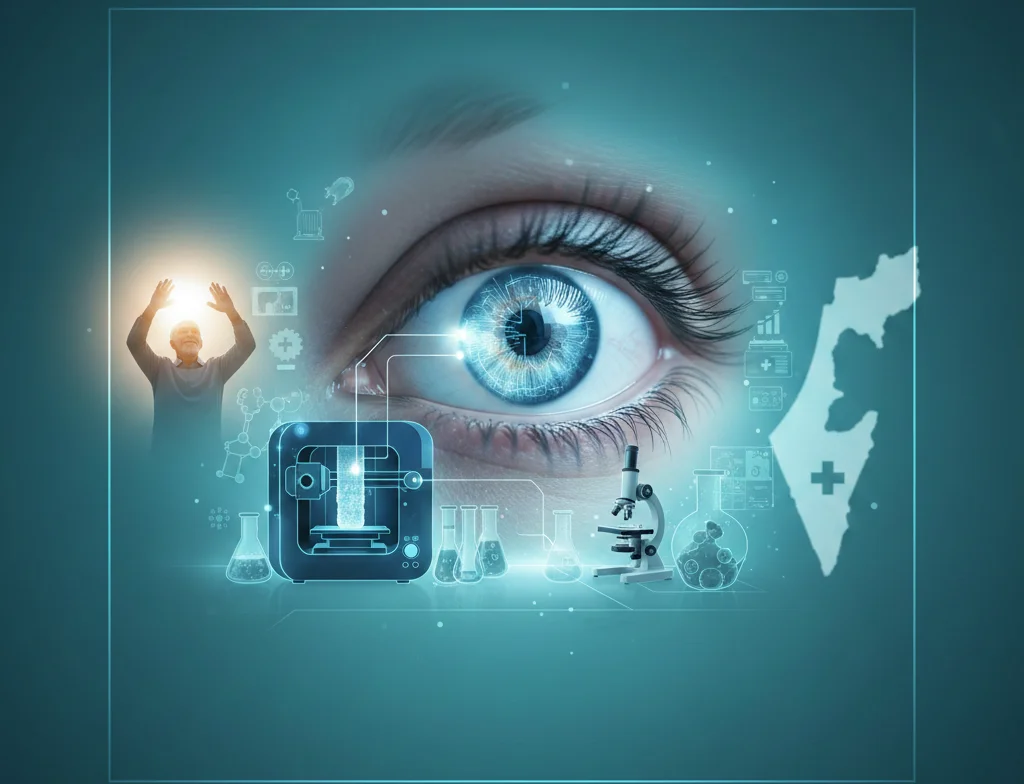
Learn how Israeli surgeons became the first in the world to restore vision to a blind person using the 3D-printed CorNeat KPro cornea. A revolution in ophthalmology without donors.
An artificial cornea restored vision after ten years of blindness.
The medical world was rocked by news from Israel, where doctors performed a true miracle. For the first time in medical history, a 78-year-old patient, who had completely lost his sight more than ten years earlier, was able to see again. This was made possible by implanting an artificial cornea created using cutting-edge 3D printing and bioengineering technologies. The surgery, performed at Rabin Medical Center, paved the way for overcoming the global shortage of donor tissue.
CorNeat KPro Technology and Its Features
The real star of this success was the CorNeat KPro implant, developed by the Israeli startup CorNeat Vision. Unlike traditional methods, which rely on tissue from deceased donors, this device is entirely synthetic yet biocompatible. It is made of a special honeycomb material that mimics the structure of human tissue.
- Use of biocompatible synthetic fibers that do not cause rejection.
- Integration with the patient’s own tissues without the need for complex biological donor cells.
- Minimal surgical intervention, significantly reducing rehabilitation time.
- Stable optical part providing high image clarity.
The operation that changed Jamal Furani’s life
Patient Jamal Furani suffered from corneal edema and other complications that led to complete blindness. He lived in complete darkness for ten years until he became the first participant in a clinical trial of a new technology. The surgery lasted less than an hour, and the results exceeded the doctors’ wildest expectations.
The very next day after the surgery, when the protective bandage was removed, the patient was able to see his family. Moreover, he successfully passed the vision test, reading numbers and letters on a chart. This confirmed that the artificial cornea had perfectly integrated and was functioning properly.
The Future of Ophthalmology and the Role of AI
Developing similar implants is impossible without advanced technology. Modern AI systems help model the ideal corneal shape, taking into account the individual parameters of the eye. The use of AI in biomedicine allows for the creation of structures that the human body perceives as its own, minimizing the risk of complications.
Today, approximately 2 million people worldwide are waiting for a corneal transplant. Due to a shortage of donors, most of them are left permanently blind. CorNeat KPro technology could be the solution to this humanitarian crisis. Because the production of these implants can be scaled up using 3D printing, the cost of the procedure will decrease over time, making it accessible to patients worldwide.
Advantages over donor organs
The main disadvantage of donor corneas is the risk of immune system rejection. Furthermore, donor tissue has a limited shelf life and requires strict logistical control. CorNeat Vision’s synthetic solution eliminates these drawbacks. The implant can be stored on the shelf for a long time and is ready for use at any time.
The success of this operation in Israel marks the first step in the company’s ambitious plan to obtain international certifications. This will allow thousands of surgeons worldwide to restore sight to their patients without long waits on organ transplant lists.




0 Comments