
- The Scale of Infrastructure Gridlock in the US Tech Industry
- Energy Grid Strain and Water Resource Depletion
- Financial Losses for Investors and the Development Bottleneck
- Anatomy of a Blocked Tech Project
- The Political Dimensions of Infrastructure Backlash
- Future Outlook and New Engineering Paradigms
The Scale of Infrastructure Gridlock in the US Tech Industry
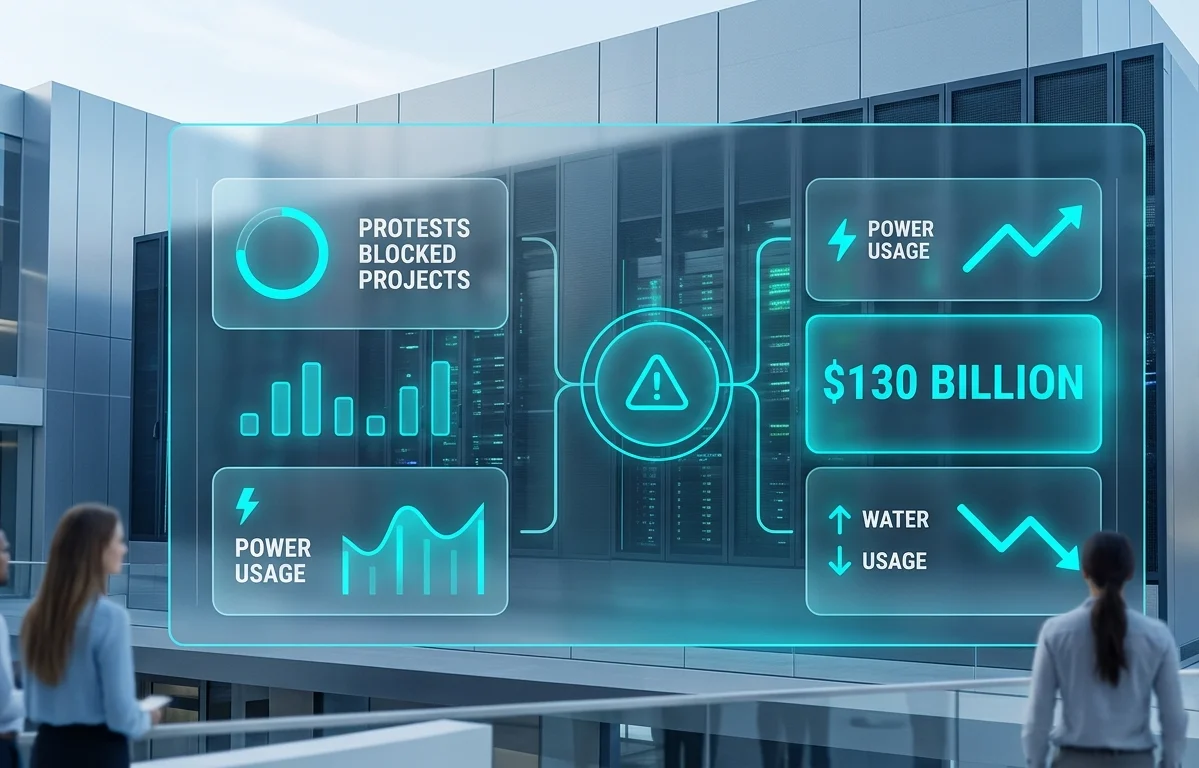
The expansion of artificial intelligence systems and cloud computing has run into an unexpected and highly potent wave of grassroots resistance. According to the latest analytical reports from Data Center Watch covering the first half of 2026, at least 75 major data center construction projects have been blocked, frozen, or delayed across the United States. The combined financial value of these stalled facilities has reached an astronomical 130 billion USD. The situation has evolved into a systemic crisis that threatens the long-term deployment goals of major tech companies seeking to build next-generation computing hardware networks.
The primary driver behind this phenomenon is widespread community dissatisfaction. Local residents are organizing into powerful advocacy groups to protect their environmental and infrastructural interests. Statistical tracking reveals that the number of active grassroots groups opposing data center developments in the US has skyrocketed to 833 organizations, spanning 49 states. This indicates that opposition to technology infrastructure expansion has graduated from a localized issue, previously centered mostly in Northern Virginia, into a dominant nationwide trend.
Energy Grid Strain and Water Resource Depletion
The core justification for community anger lies in the colossal resource consumption characteristics of modern facilities. Modern data centers tailored for training and operating artificial intelligence models require exponentially more electrical energy and water than traditional cloud storage facilities of previous generations. This reality poses a direct threat to the stability of regional power grids and domestic water infrastructure.
To contextualize the problem, it is helpful to examine the resource footprint of an average AI data center compared to residential consumption metrics. The power demands of a single large-scale computing cluster can easily overwhelm local electrical substations, leading to higher electricity bills for residents and increased risks of brownouts during peak summer or winter weather conditions.
Beyond direct electricity usage, cooling technology presents an immense challenge. Running thousands of high-performance graphics processing units creates megawatts of thermal energy that must be dissipated via liquid or forced-air cooling designs. Forced-air cooling generates a relentless high-frequency hum from industrial fans, producing severe noise pollution within a multi-kilometer radius and depressing property values. Conversely, liquid cooling designs evaporate millions of liters of clean water daily, a practice that has drawn sharp criticism in drought-prone states.
Financial Losses for Investors and the Development Bottleneck
For major corporations, a frozen project means more than just a delayed timeline, it translates to immediate capital destruction for funds already sunk into site preparation. Entities like Amazon Web Services, Google, and Microsoft are being forced to completely re-evaluate their expansion roadmaps. In many instances, land parcel acquisitions are finalized at premium rates, intricate engineering blueprints are drawn, and preliminary utility grid agreements are signed, only for the entire process to stall indefinitely during final municipal zoning hearings or environmental permit reviews.
Anatomy of a Blocked Tech Project
Industry researchers have highlighted specific cases where an established cloud provider invested roughly 150 million USD in civil engineering, site grading, and high-voltage line routing before public opposition mounted. Following coordinated pushback from local residents backed by county supervisors, the building authorization was rescinded due to newly introduced nocturnal noise ordinances. In another scenario, a state environmental watchdog uncovered unmitigated risks to a local aquifer, stripping the developer of water utility access and forcing the facility into indefinite conservation status.
The Political Dimensions of Infrastructure Backlash
The data center deployment issue has quickly transcended local zoning disputes, emerging as a major political wildcard in the lead-up to the 2026 US midterm elections. This particular infrastructure conflict has a rare political dynamic, uniting voters from traditionally polarized factions across the American political landscape.
- Democratic officials find themselves in an awkward position, attempting to balance tech sector growth and job creation with the environmental demands of their progressive voter base.
- Republican voters and conservative local leaders oppose the mega-developments on the grounds of private property protection, historical land preservation, and fears regarding residential property devaluation.
- The federal government faces a sharp contradiction between maintaining global AI dominance and managing an aging national electrical grid that cannot sustain the projected loads.
- Candidates in critical swing states like Virginia, Ohio, and Georgia, which host the highest concentrations of data infrastructure, are now forced to explicitly outline their policies regarding data center restrictions. Demonstrating uncritical support for big tech corporate expansions without addressing local taxpayer concerns has become a liabilities for politicians on both sides of the aisle.
Future Outlook and New Engineering Paradigms
Unlocking the 130 billion dollar development logjam will require the technology sector to overhaul its approach to community relations and structural design. Relying on federal lobbying or top-down regulatory pressure is proving ineffective against localized resistance movements. Engineers are now searching for radically different technological architectures to house computing infrastructure.
Promising avenues include abandoning freshwater cooling entirely in favor of closed-loop systems utilizing recycled industrial wastewater or seawater. Companies are also shifting focus toward building new computing infrastructure in naturally cold climates or adjacent to areas with stranded renewable energy assets, such as wind corridors in West Texas or remote areas of Alaska. However, this strategy introduces massive capital expenditures for new fiber-optic backhaul routes to maintain the ultra-low latency metrics required by advanced AI algorithms.



0 Comments