
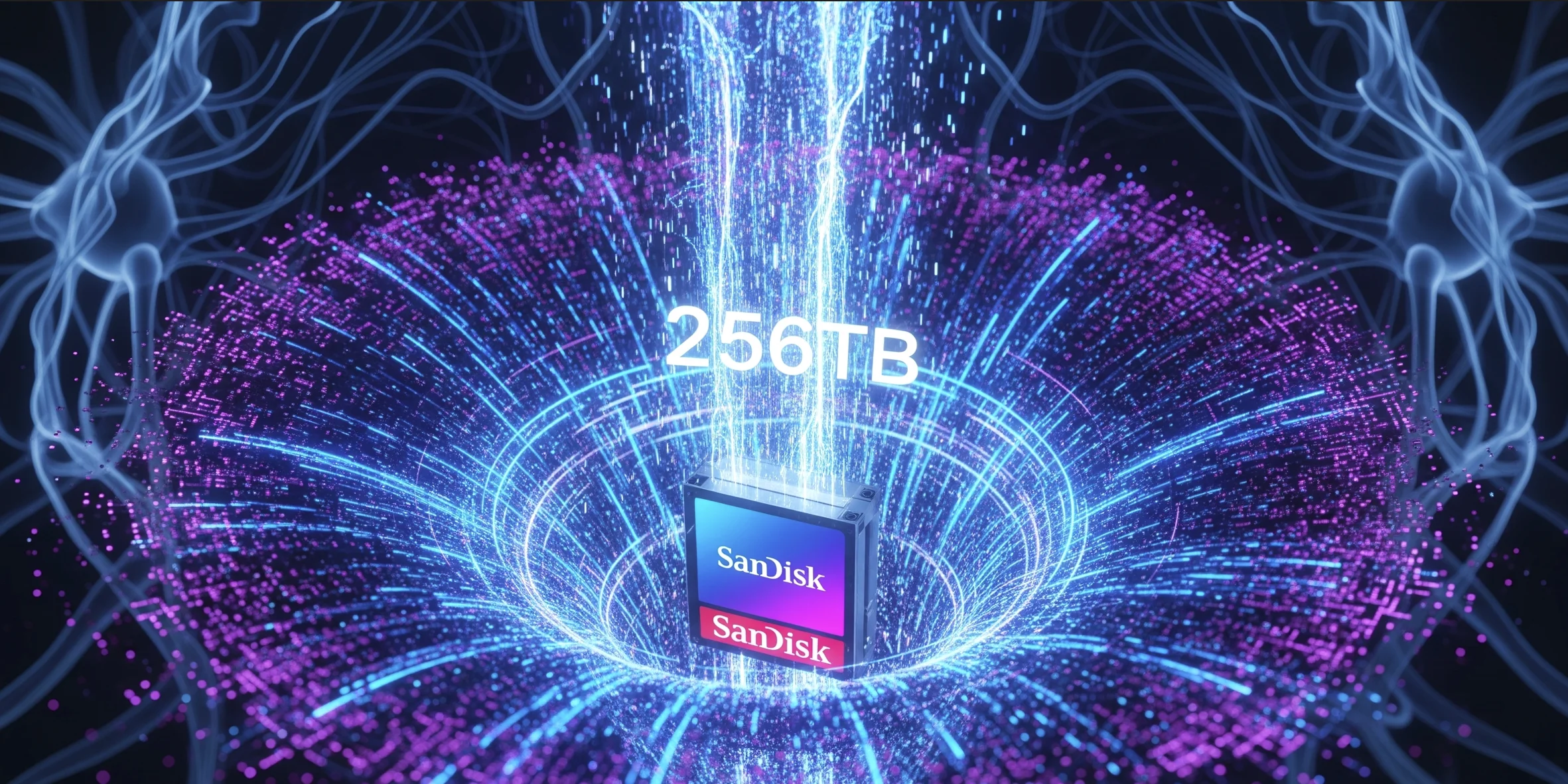
In an era where artificial intelligence (AI) technologies are advancing at breakneck speed, data storage requirements are becoming increasingly stringent. SanDisk, a division of Western Digital, has introduced a revolutionary 256TB SSD that could be a game-changer in the enterprise storage market. This SSD is designed specifically to meet the extreme speed and capacity needs of large AI models, machine learning, and big data analytics. While this drive is a true technological marvel, its specifications and intended application have several key nuances that should be considered.
Specifications and architecture
This SanDisk SSD stands out not only for its colossal capacity but also for its unique architecture. It uses the latest flash memory technology, likely PLC (Penta-Level Cell), which stores five bits of information in a single cell, significantly increasing recording density. However, one of its key advantages is speed: thanks to the PCIe Gen 5 interface or even higher, the drive delivers incredible sequential read and write performance. This allows AI systems to access petabytes of data almost instantly, significantly accelerating the model training and inference process. Thanks to its optimized architecture, this high-capacity SSD is capable of processing colossal data streams in parallel, which is critical for modern data centers.
Why does AI require such volume and speed?
The growth of AI capabilities is directly dependent on the volume and speed of data processing. Traditional hard drives have long been unable to meet these requirements.
- Model training: Modern large-scale language models (LLMs), such as GPT-4, require terabytes and sometimes petabytes of data for training. Rapid access to this information significantly reduces training time.
- Big Data Processing: In analytical systems that work with big data, data access speed is critical. This enterprise SSD enables complex calculations and analysis in real time.
- Machine learning: Experimenting with different algorithms and models requires fast loading and unloading of datasets. The high speed of an SSD accelerates this iterative process, allowing scientists and engineers to work more efficiently.
- Rendering and Simulation: In the field of 3D modeling and scientific simulations, where AI algorithms are used to accelerate calculations, a large-capacity and high-speed SSD allows you to save and process large projects without lag.
The Nuances of a New SSD: Market Reality
While the SanDisk SSD is a breakthrough, it has its own set of limitations. First, its price will likely be in the tens of thousands of dollars, putting it out of reach for consumers. It’s a product aimed squarely at the enterprise segment and large data centers. Second, PLC NAND technology, while offering massive capacity, typically has a lower TBW (terabyte written lifetime) than MLC or TLC. This means the drive may have a limited lifespan under the constant, intensive write operations typical of some machine learning workloads. Third, the power consumption of such a device will likely be significantly higher than standard SSDs, placing additional demands on cooling systems.
Impact on the market and the future of data warehousing
SanDisk’s development is a signal to the entire industry. It demonstrates that storage manufacturers are ready to innovate to meet the growing needs of AI. This AI-focused SSD ushers in a new era where speed and capacity are no longer a tradeoff. Thanks to these technologies, data centers will be able to reduce the number of equipment needed, which in turn will reduce energy and maintenance costs. Other manufacturers, such as Samsung, Micron, and Kioxia, are expected to introduce their solutions in this segment in the coming years. This will lead to increased competition, potentially making similar technologies more accessible in the future.



0 Comments