
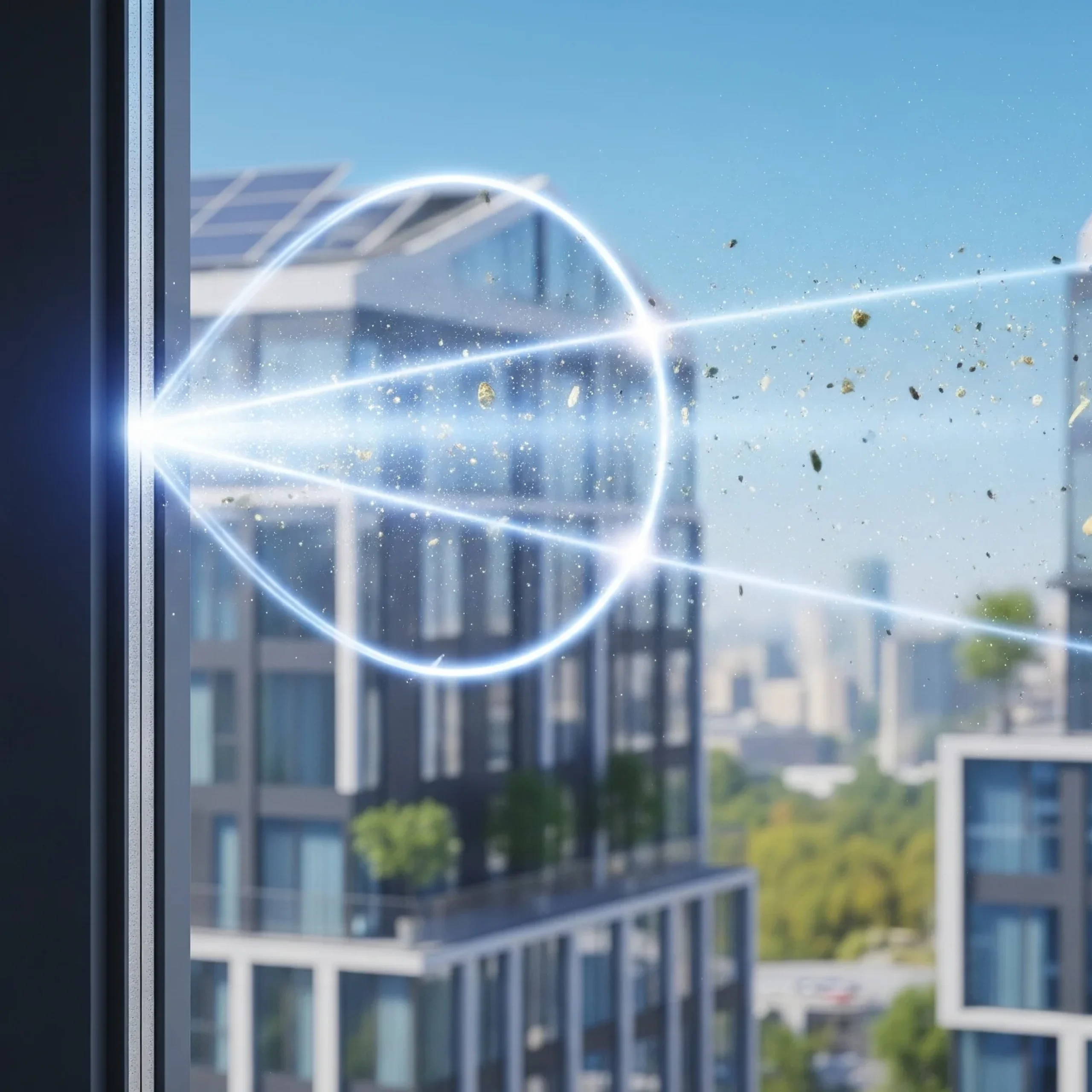
Self-cleaning, water-free glass is not science fiction, but the result of work by Chinese scientists. This innovative technology offers a solution to one of the most common problems: dirty glass surfaces, especially for windows, car windshields, camera lenses, and, most importantly, solar panels. Until now, most self-cleaning solutions have relied on photocatalytic coatings that react to sunlight but require rain or water to wash away loosened dirt. This invention eliminates the need for water, making it indispensable for use in arid regions. The self-cleaning technology developed by the scientists opens up new possibilities for sustainable and effective glass surface maintenance.
How does “dry” self-cleaning glass work?
The core of this unique development is a multilayer coating that combines antistatic and nanostructured properties. The first layer, which comes into contact with the environment, has a specific microtexture that reduces the contact area with dust particles. This significantly hinders their adhesion to the surface. The second layer performs an antistatic function, neutralizing the electrostatic charge that is the primary cause of dust attraction. When dust particles fall on the surface, they do not adhere, but rather clump into large clusters that are easily blown away by the slightest gust of wind or simply by gravity. This innovative anti-dust glass operates on a principle completely different from hydrophilic coatings, ensuring a clean surface without any liquids.
Advantages over existing technologies
The new self-cleaning glass has a number of significant advantages over traditional analogues.
- Water Independence: This technology is ideal for regions with limited access to water or dry climates. It guarantees a clean surface regardless of weather conditions.
- Resource saving: Reduces the need for water and cleaning chemicals, making the technology environmentally responsible.
- Reduced maintenance costs: Large structures, such as skyscrapers or large solar power plants, eliminate the need for frequent and costly manual cleaning. This can save millions of dollars annually.
- Improving Efficiency: For solar panels, clean glass ensures maximum light absorption, which directly impacts power generation. Contamination can reduce panel efficiency by 25% or more, and this technology maintains it at an optimal level.
Thus, water-free glass is not only a convenient solution, but also a cost-effective tool for increasing productivity and reducing costs.
Applications: from windows to optics
The potential applications of this technology are enormous. It could be used in construction to create windows that require no cleaning, especially on high floors. In the automotive industry, it could enable the creation of windshields that provide constant visibility, reducing road hazards. Glass for solar panels will be particularly in demand, as maintaining their cleanliness is key to maximizing energy generation. In optics, the coating could be applied to the lenses of cameras, telescopes, and other instruments, significantly improving image quality and reducing maintenance. Even for consumer products, such as smartphone or tablet screens, this technology could provide an improved user experience.
The Future of Smart Glass
The developers are already working to improve the technology to increase its durability and resistance to aggressive external factors. The primary goal is to make the coating as durable and scratch-resistant as possible, which is critical for the automotive and construction industries. Further research could focus on combining anti-dust glass with other “smart” features, such as adjustable transparency or heat absorption. This invention is an important step toward creating fully autonomous and environmentally friendly buildings, vehicles, and energy generation systems. It demonstrates that nanotechnology and engineering can solve everyday problems, making our lives simpler and more efficient.




0 Comments