
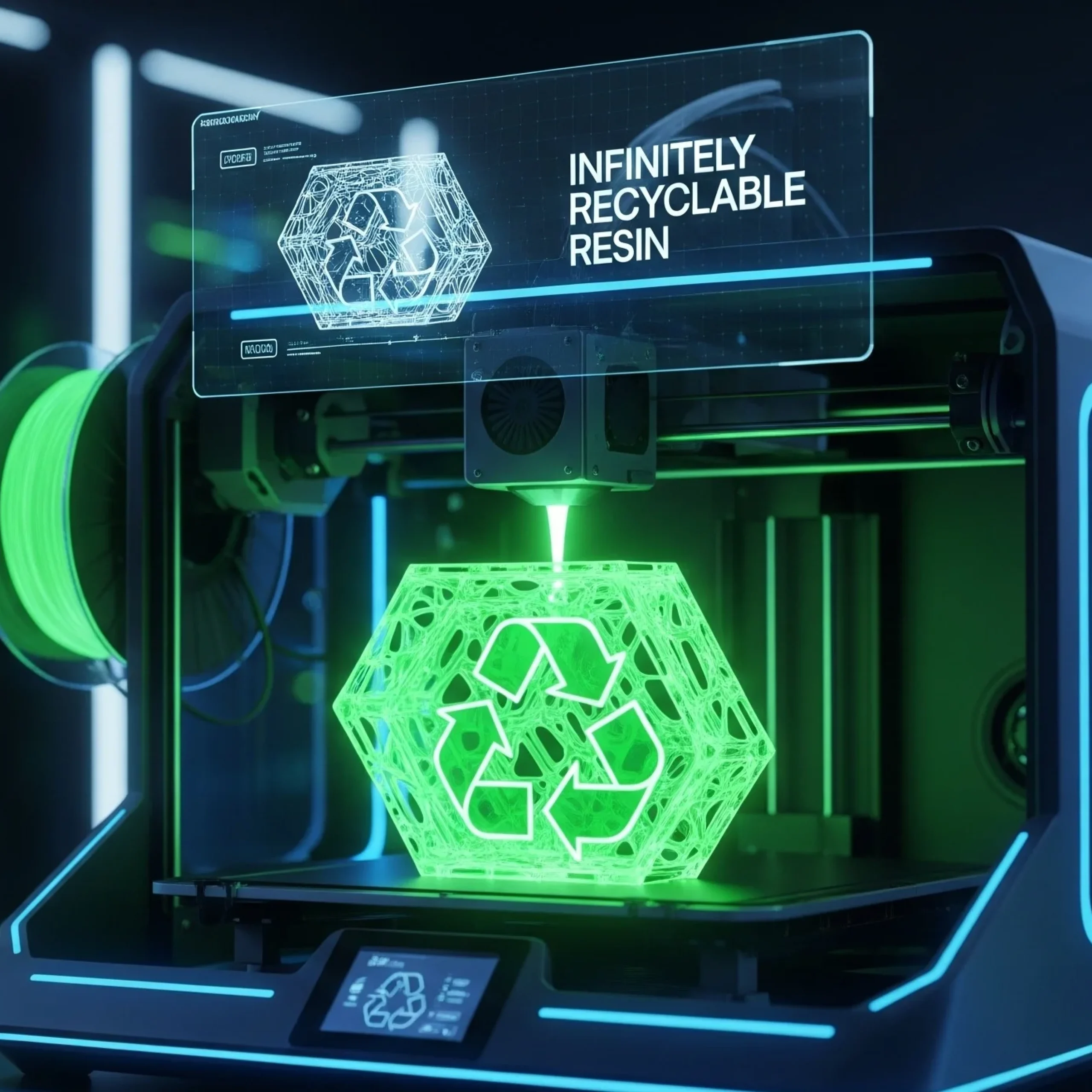
The world of 3D printing is on the cusp of significant change thanks to a breakthrough invention: an infinitely recyclable resin. This discovery not only expands the capabilities of additive manufacturing but also offers an effective solution to one of its biggest challenges: waste disposal. Widely used traditional photopolymer resins are thermosetting, meaning their polymer chains form a strong, irreversible structure after curing. As a result, broken or unwanted parts made from these resins cannot be recycled, leading to waste accumulation. This new material revolutionizes this by bringing circular economy principles to 3D printing. This recyclable resin allows for the repeated use of raw materials, making the production process more sustainable and environmentally friendly.
How does innovative development work?
The basis of this technology is the resin’s unique chemical structure. Unlike conventional polymers, it contains special chemical bonds that can be broken and reformed under certain conditions, such as heat and chemical reagents. This allows the hardened plastic to be converted back into a liquid form, ready for reuse. The recycling process, which includes grinding, dissolving, and purification, fully restores the resin’s original properties without losing its strength or other physical characteristics. This mechanism ensures high quality of the final product, regardless of the number of recycling cycles, which is key to widespread adoption. The developers claim that this environmentally friendly 3D resin can be transformed into new objects with the same ease and precision as the virgin material.
Comparison with existing materials
Today, most 3D printing resins are single-use. Their disposal is complex and resource-intensive. This innovative material offers a number of significant advantages.
- Environmental friendliness: Significantly reducing waste and negative environmental impact. This promotes sustainable production principles.
- Economic benefit: Thanks to the ability to reuse raw materials, companies can significantly reduce material costs. For example, if 1 kg of traditional resin costs $50, recycling allows for significant savings in the long term.
- Quality: Even after repeated processing, the innovative resin retains its mechanical properties, such as strength, hardness and resistance to deformation.
While this material may have a higher initial cost than some base resins, its long-term benefits and resource savings make it more attractive to businesses.
Applications and potential
This 3D printing technology has the potential to be a game-changer for many industries. In industry, it can be used to create prototypes, tools, and spare parts that can be remade rather than discarded after wear. It’s an ideal solution for manufacturing processes that require frequent updates or modifications. In medicine, recyclable resin can be used to create customized prosthetics, orthotics, and training models, allowing for the recycling of old models, reducing medical waste. Even in the consumer sector, this material could become the basis for creating personalized products that support a circular economy. For example, users could recycle old toys or accessories and print new ones.
Future 3D Printing and Sustainable Manufacturing
The development of this resin is more than just a new material; it’s a step toward sustainable and responsible manufacturing. In the context of global challenges related to environmental pollution and resource depletion, such innovations are crucial. They not only help reduce plastic waste but also promote the development of a circular economy, where materials are used for as long as possible. Experts estimate that the implementation of such technologies could significantly reduce the carbon footprint of 3D printing, making it more attractive to large companies striving to adhere to ESG standards. Future developments may focus on creating similar materials with different physical properties, expanding the color palette, and optimizing the recycling process for even greater efficiency. This technology opens new horizons for engineers and designers, providing a powerful tool for environmentally conscious creation.



0 Comments